What the Global Risks Report 2026 really says about the urgency of environmental threats
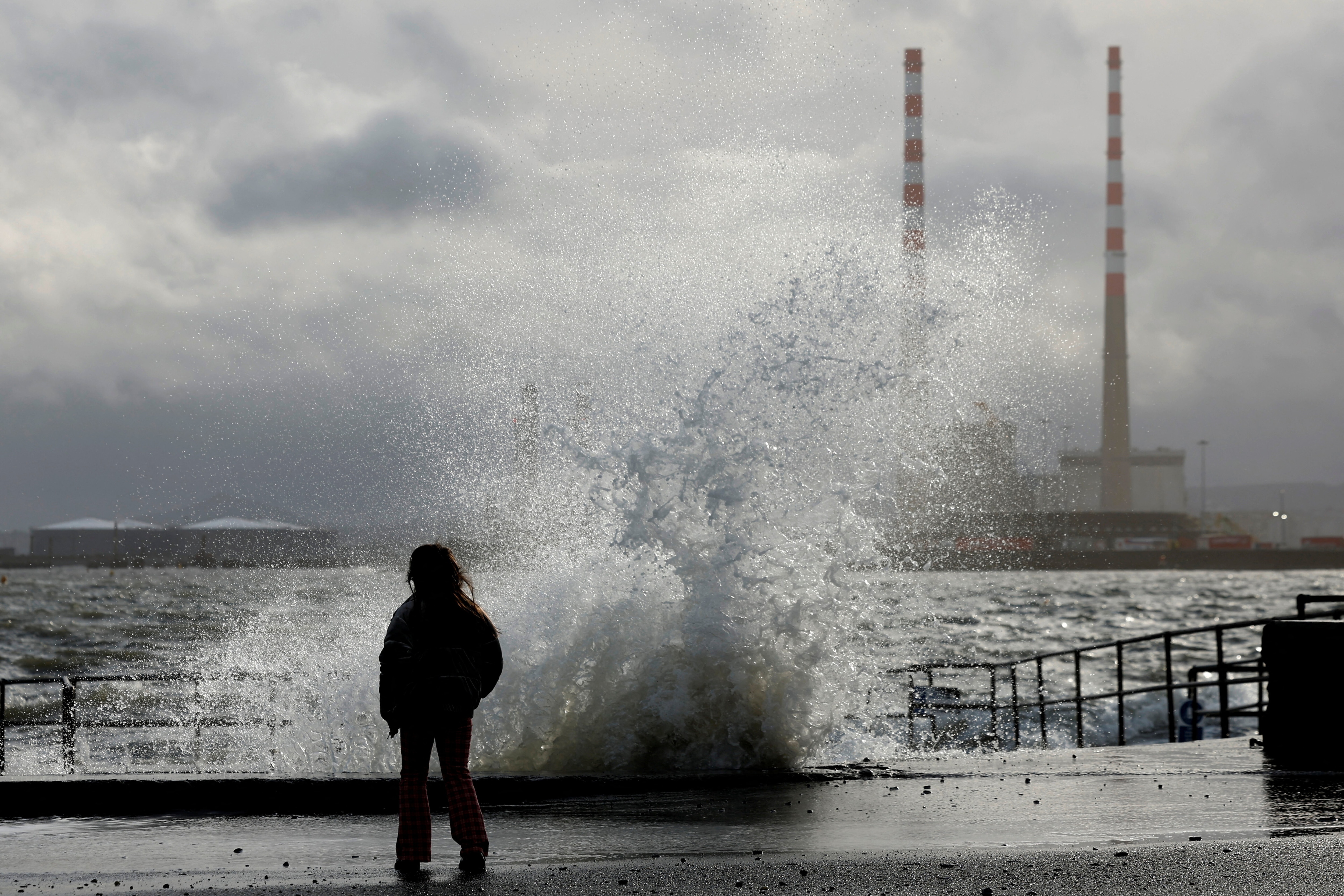
Environmental risks remain among the most severe global threats, according to the 2026 Global Risks Report but their perceived urgency differs across time horizons. Image: REUTERS/Clodagh Kilcoyne
- Environmental risks remain among the most severe global threats, according to the 2026 Global Risks Report but their perceived urgency differs across time horizons.
- Short-term risk perceptions are shifting, not because environmental threats are easing but because new shocks are competing for attention.
- Environmental risks now operate across multiple timelines, from immediate disruption to long-term systemic stress: responses must work on both horizons at once.
Environmental risks continue to rank among the most severe global threats in the World Economic Forum’s Global Risks Report. There are, however, signs of a shift, not in the underlying reality of these risks but in how they are perceived over different time horizons.
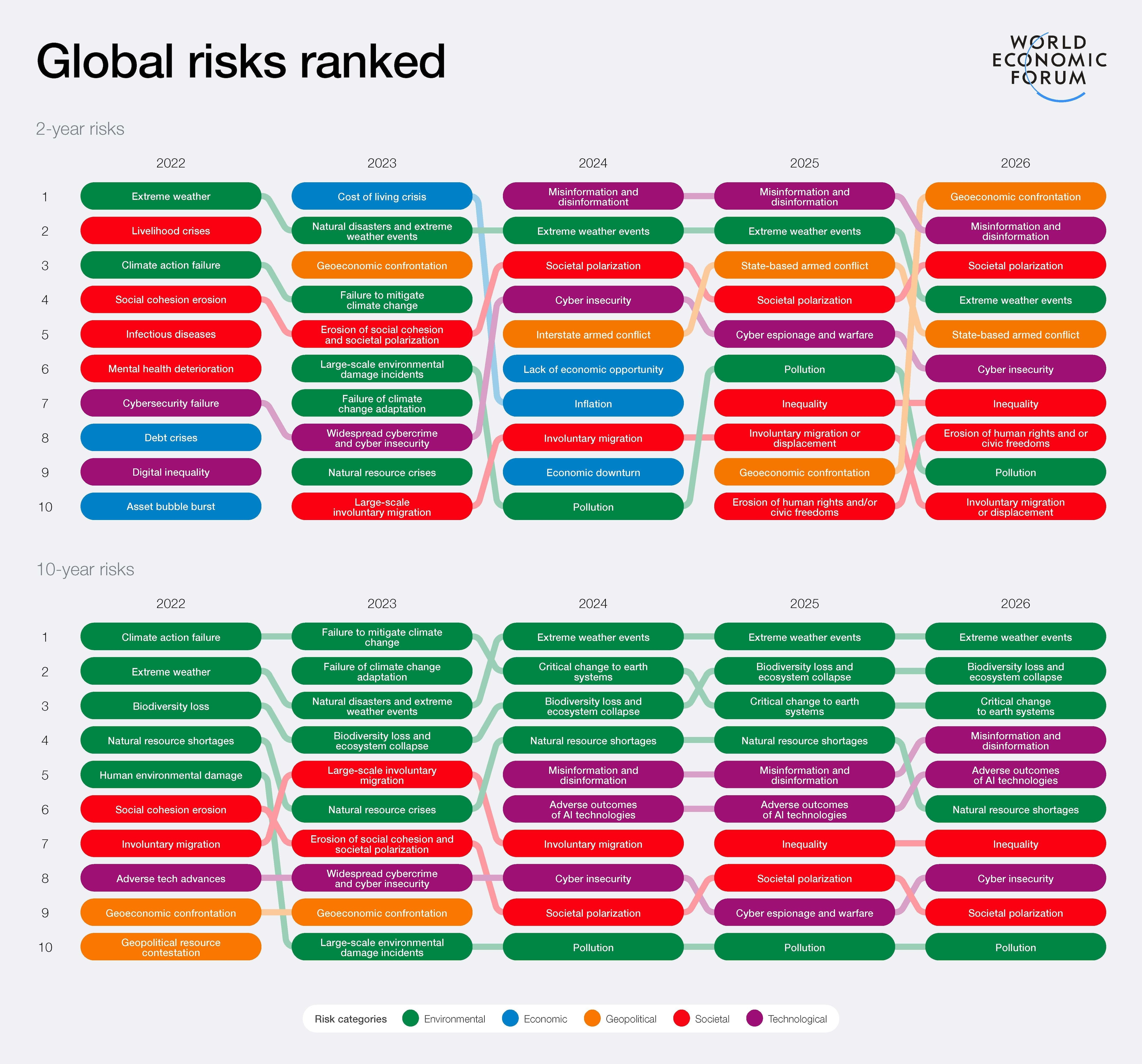
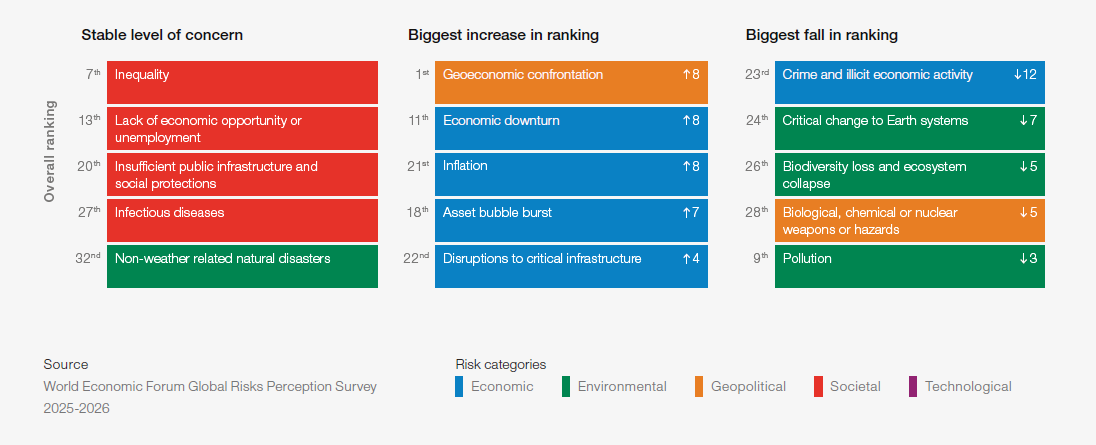
In the 2026 edition of the report, respondents place geoeconomic confrontation and state-based armed conflict at the top of the two-year risks outlook, with misinformation and disinformation also featuring prominently. Environmental risks, which had ranked among the top short-term concerns in recent years, have now moved slightly lower.
This does not reflect a downgrading of environmental risk itself. Rather, at a moment when decision-makers are already navigating multiple, overlapping crises, it highlights a widening gap between short-term attention and longer-term dangers and the fact that a growing number of environmental risks are already crystallizing.
The issue is not that near-term environmental risks have disappeared. On the contrary, some environmental risks now appear less as future threats than as persistent current realities. Extreme weather is a case in point, with annual insured losses now consistently exceeding $100 billion and with wider economic losses reaching far higher.
This shift of environmental risks from anticipation to experience may help explain how they can recede in the short-term rankings even as their impacts intensify. The Global Risks Report’s two-year outlook captures what respondents are most worried about as the trigger for a material global crisis.
In 2026, these “here and now” concerns unsurprisingly lean more heavily than before towards geopolitical fragmentation, conflict and information integrity.
Why short-term risk rankings shift quickly
Looking back over recent editions of the Global Risks Report, the two-year time horizon has proved highly responsive to unfolding shocks. In 2021, amid the global pandemic, infectious diseases dominated. By 2023, the cost-of-living crisis had moved to the fore.
In 2024 and 2025, the rapid diffusion of generative AI and rising geopolitical tensions had already elevated misinformation and state-based conflict in the rankings. The 2026 results continue this pattern.
This is not an argument for complacency. The downward trend in short-term environmental risks comes despite a growing body of scientific and economic evidence pointing to escalating climate impacts and rising costs of inaction.
We should not mistake a shift in short-term attention for an easing of underlying exposures. This becomes clearer when turning to the Global Risks Report’s longer-term rankings, which tell a different and remarkably consistent story.
Over the 10-year time horizon, environmental risks continue to dominate the global risk landscape, as they have since 2017. Extreme weather, biodiversity loss and critical changes to Earth systems rank among the top positions, reflecting their cumulative and systemic nature.
Three-quarters of respondents describe the environmental outlook as “turbulent” or “stormy,” their most pessimistic assessment across all risk categories.
Leaders need strategies that work across timelines
Taken together, these findings point to a core challenge for decision-makers. Strategies must have traction at both the short- and long-term horizons. Focusing on the latter without the former provides organizations with a map and a compass but no radar to detect the dangers directly ahead.
The challenge is not simply to protect long-term ambition from short-term distraction but to build strategies that can absorb immediate disruption while still driving structural change.
Transforming infrastructure, supply chains and production systems to address climate and nature risks requires long planning horizons and sustained investment. But at the same time, climate impacts can disrupt operational continuity in the near term: damaging assets, interrupting logistics, threatening workforce safety and undermining insurability.
Importantly, if there are shifts in short-term risk perceptions, they are not translating into inaction. For example, throughout many sectors, organizations are already increasing investment in climate resilience and related activity.
Markets for adaptation solutions are already estimated to exceed $1 trillion and are expanding fast. The evidence increasingly suggests that investment in climate resilience can pay for itself many times over.
When environmental risks become economic and geopolitical risks
Environmental risks are sometimes viewed as long-term because their impacts unfold unevenly across systems. However, this framing can obscure how quickly climate- and nature-related disruptions can affect operational continuity, not just for businesses but for communities too.
Flooding, heat stress, water scarcity and ecosystem degradation already pose material risks to logistics networks, workforce safety and even fiscal stability.
At the same time, addressing these risks requires sustained, long-term effort. Early investment matters. Designing, financing and deploying both engineered and nature-based solutions takes years, not months. Transforming supply chains, infrastructure and land-use systems cannot be achieved on the basis of short-term signals alone.
Environmental risks are deeply interconnected with social, economic and geopolitical dynamics. Environmental stress can exacerbate economic risks and act as a driver of social instability.
Estimates suggest that approximately 40% of intrastate conflicts over recent decades have been linked to natural resource pressures, while economic losses from weather- and climate-related extremes continue to rise (now approximately $500 billion in Europe alone), with much of the damage remaining uninsured.
These interconnections reinforce a central insight of the Global Risks Report: the future is not fixed but is shaped by the choices made today. Environmental risks do not sit alongside geopolitical or economic risks as competing priorities.
Instead, they increasingly shape the conditions under which those risks play out. Together, they form part of the underlying context that will define global security, stability and growth in the years ahead.
Don't miss any update on this topic
Create a free account and access your personalized content collection with our latest publications and analyses.
License and Republishing
World Economic Forum articles may be republished in accordance with the Creative Commons Attribution-NonCommercial-NoDerivatives 4.0 International Public License, and in accordance with our Terms of Use.
The views expressed in this article are those of the author alone and not the World Economic Forum.

Forum Stories newsletter
Bringing you weekly curated insights and analysis on the global issues that matter.
More on Global RisksSee all

Markus Kirchschlager and Benedikt Gieger
March 20, 2026


