Why making AI sustainable by design is key to a greener future

Sustainability must be embedded into AI’s design, measurement and governance from the outset. Image: benzoix/Unsplash
- AI-driven insights help the world meet sustainability goals, but powering the technology requires resources at daunting scales.
- By 2028, AI could use over half of data centre power demand and consume as much electricity a year as 22% of all US households.
- Sustainability must be embedded into AI’s design, measurement and governance from the outset – not treated as an afterthought.
Artificial intelligence (AI) is transforming sustainability – and exposing a paradox. It can optimize energy systems, forecast climate risks and accelerate breakthroughs in conservation and materials. Yet training large models, moving massive datasets and refreshing specialized hardware consume electricity, water and minerals at daunting scales.
The more we rely on AI to achieve climate goals, the greater the risk of overshooting planetary boundaries. The solution is clear: Sustainability must be embedded into AI’s design, measurement and governance from the outset – not treated as an afterthought.
The time to act is now. By 2028, more than half of data centre electricity could be devoted to AI, according to NTT Data's Sustainable AI for a Greener Tomorrow report. At that point, AI alone could consume as much electricity annually as 22% of all US households.
Water impacts are equally sobering. Training a single large model can require millions of litres and even 10–50 simple queries can amount to roughly half a litre of water once cooling and power generation are taken into account. At the same time, digital infrastructure accelerates demand for critical minerals, intensifying supply chain risk.
What is sustainable AI?
For much of the past decade, AI progress has been measured almost entirely by accuracy scores and benchmark wins.
Sustainable AI shifts the lens to efficiency and responsibility. It challenges teams to design, train, deploy and retire systems with the explicit goal of minimizing environmental impact across the full lifecycle – from raw material extraction and chip fabrication to data processing, training, inference and end of life.
In practice, that means choosing smaller or distilled models when they meet requirements, reusing and fine tuning rather than retraining from scratch, and building code, pipelines and infrastructure for resource efficiency and transparency.
The result is a broader definition of “state of the art” – one that prizes ecological performance alongside task accuracy.
Measuring AI’s sustainability to reduce risk and strengthen resilience
Measuring sustainable change requires more than compliance – it demands clarity and consistency.
Unlike traditional industries with frameworks like the Greenhouse Gas Protocol, AI lacks standardized methods to track energy use, carbon emissions, water consumption and e‑waste across its lifecycle. Existing tools can log data automatically, but they often trade accuracy for ease of use, leaving organizations with fragmented and incomplete assessments.
Because AI’s environmental impact varies by region, infrastructure and operational practices, meaningful measurement must integrate diverse data points into holistic, real‑time lifecycle assessments.
Only then can organizations identify high‑impact phases – such as hardware manufacturing and large‑scale model training – and act decisively to reduce risks, strengthen resilience and create long‑term value.
Closing the theory-practice gap
Two practical tools point the way. Tools like the AI Energy Score embed accountability into model cards, disclosures and governance, fostering industry‑wide adoption of energy‑efficient practices.
At the hardware level, Compute Carbon Intensity offers a standardized measure of accelerator efficiency, factoring in emissions from raw‑material extraction, chip fabrication and operational energy use.
Together, these approaches make efficiency visible and investable – moving sustainability from rhetoric to roadmap.
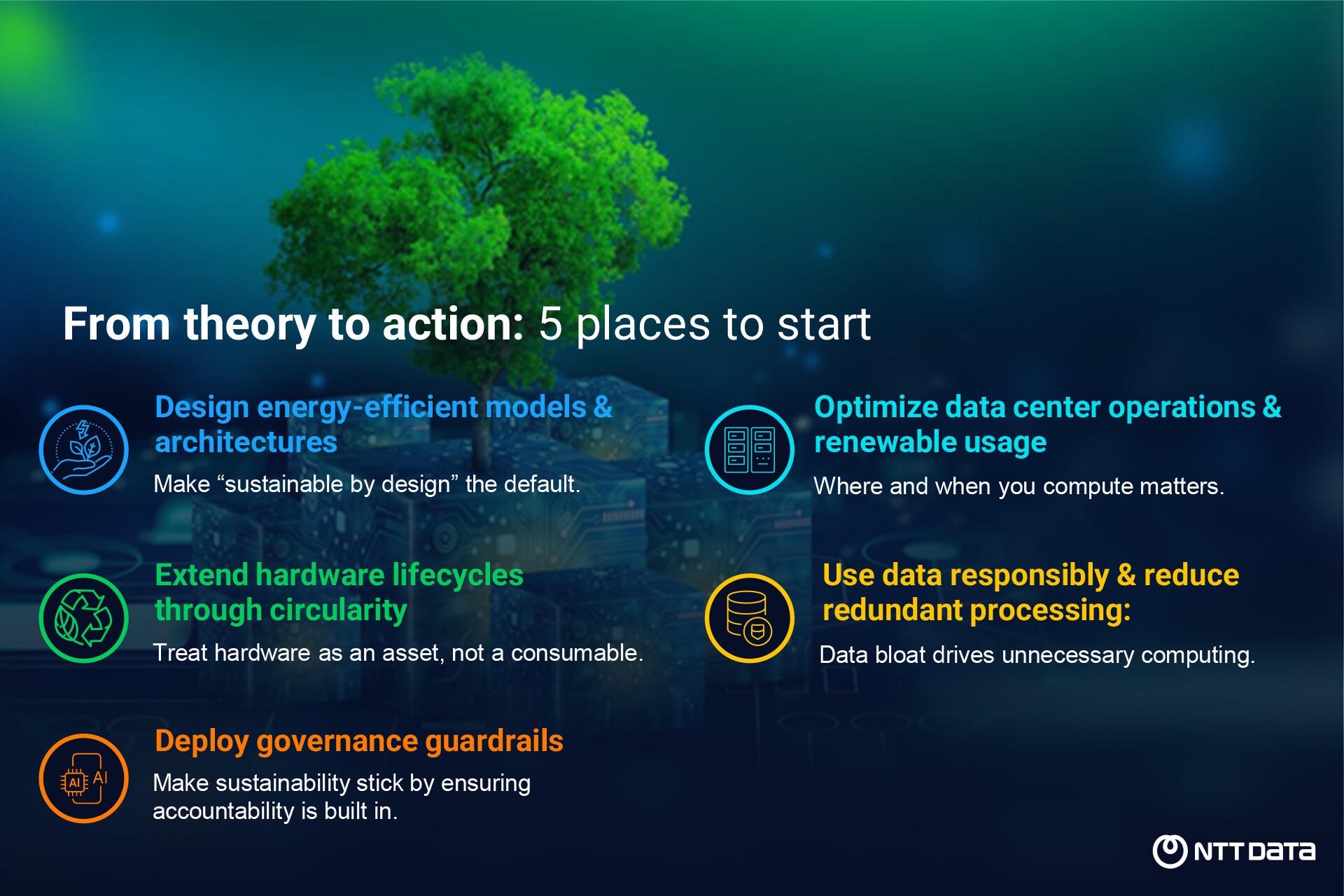
Here are five actions we can take immediately to start making AI more sustainable.
- Design energy‑efficient models and architectures: Make “sustainable by design” the default
- Optimize data centre operations and renewable usage: Where and when you compute matters
- Extend hardware lifecycles through circularity: Treat hardware as an asset, not a consumable
- Use data responsibly and reduce redundant processing: Data bloat drives unnecessary compute
- Deploy governance guardrails: Make sustainability stick by ensuring accountability is built in
Collective action key to sustainable AI
AI’s environmental footprint is too complex for any single actor to solve alone. Energy providers, hardware manufacturers, cloud and data centre operators, developers, investors, regulators, customers and e‑waste partners all shape the outcomes.
Real progress comes when we work together – building open benchmarks for energy and water use, adopting common lifecycle‑assessment methods, sharing best practices and advancing policies that reward efficiency over raw scale.
Industry initiatives such as green software patterns and standardized disclosures are already raising the floor. The next step is for leaders to raise the ceiling – contributing data, artefacts and case studies that others can build on.
Sustainable AI as a catalyst for innovation
Sustainable AI is not a constraint on innovation; it is a catalyst for better engineering and more resilient businesses.
Teams that pursue efficiency discover faster models, lower costs and products that scale gracefully. Boards gain credible progress against net zero and nature goals. And society benefits as AI delivers insight without mortgaging the future.
Our destination is clear: an AI ecosystem where performance and planetary stewardship advance together. Getting there starts with the choices we make now – measuring what matters, engineering for enough and treating sustainability as a first-class requirement for every model, workload and purchase decision.
Don't miss any update on this topic
Create a free account and access your personalized content collection with our latest publications and analyses.
License and Republishing
World Economic Forum articles may be republished in accordance with the Creative Commons Attribution-NonCommercial-NoDerivatives 4.0 International Public License, and in accordance with our Terms of Use.
The views expressed in this article are those of the author alone and not the World Economic Forum.
Stay up to date:
Artificial Intelligence
Related topics:


Forum Stories newsletter
Bringing you weekly curated insights and analysis on the global issues that matter.
More on Climate Action and Waste Reduction See all

Kanni Wignaraja, Marc-André Franche and Azusa Kubota
March 20, 2026