How to prioritize cyber resilience in the healthcare sector

Cyber resilience in the healthcare sector often comes out of a precarious balancing exercise of priorities Image: REUTERS/Phil McCarten
Sander Zeijlemaker
Research Affiliate Cybersecurity, MIT Sloan (CAMS), Managing Director, Disem Institute- The healthcare sector is becoming an increasingly targeted by adversaries. Consolidation and digital transformation reinforce this situation.
- Balancing investment among patient care, digital innovation and cyber resilience in the healthcare sector is challenging and often counterintuitive.
- Strategic digital twin technology, as an example of a management flight simulator, addresses the call for new tools to foster executive awareness and thought leadership.
Healthcare is one of the most targeted sectors for cyberattacks, facing severe financial, operational and patient-safety consequences. The combination of sensitive patient data and legacy technology makes providers prime targets for ransomware, data breaches and other sophisticated threats.
As a result, materialized cyber threats increasingly disrupt care delivery and erode patient trust. Today, healthcare is among the most expensive industries to suffer a breach, with incidents averaging $7.42 million and costs are expected to rise as digital complexity, the attack surface and adversary capabilities continue to grow.
What is the cyber threat exposure to healthcare?
The risk landscape of the healthcare sector is evolving rapidly. Healthcare consolidation and technology-driven transformation are the primary drivers reshaping the sector. Hospitals increasingly merge services, such as laboratories, into centralized hubs to reduce redundancies, manage complexity and improve quality.
Meanwhile, integrated digital health platforms amplify this trend by enabling data integration and advanced analytics to strengthen personalized care. Together, physical and digital consolidation deliver scaled and coordinated, patient-focused services.
However, they also expand risk exposure: supply chain dependencies and third-party vulnerabilities create new entry points for adversaries, as evidenced by the sharp rise in supply chain attacks.
Simultaneously, healthcare is embracing technologies such as robotics, AI diagnostics and advanced medical devices to enhance efficiency and care quality. These innovations promise faster decisions, personalized treatments and reduced clinician workload. Yet, success hinges on patient trust, where privacy, usability and security are paramount.
Unfortunately, research shows that cyber risks are complex and dynamic, making them difficult to govern. They are, therefore, often underestimated as a reactive approach, even in healthcare. Consequences include:
- Short-term impacts: Service interruptions, delayed patient care, heightened clinical risk and costly recovery efforts.
- Long-term impacts: Loss of reputation and patient trust, revenue decline, intellectual property theft and misuse of patient data leading to identity fraud.
- Legal exposure: Non-compliance with cyber resilience obligations for medical devices, breach reporting and safeguarding critical infrastructure.
Consequently, cyber resilience in the healthcare sector is foundational. Governing cyber risks is essential to protecting patient care, sustaining trust and enabling innovation in an increasingly connected healthcare ecosystem.
What is the investment paradox in healthcare?
Healthcare is unlike any other industry; it is rooted in a cultural and ethical commitment to deliver life-saving care. Many professionals are bound by an oath that prioritizes patient well-being above all else.
This mission shapes strategic decisions, driving leaders to invest heavily in clinical capacity, treatment innovation and technologies that promise measurable improvements in care quality and efficiency.
This noble focus, however, creates an investment bias. Under budget constraints, resources often concentrate on front-line delivery and transformative technologies, leaving limited flexibility for other critical areas such as cybersecurity or maintenance.
Tight margins and operational pressures reinforce this dynamic, making it difficult to balance immediate care imperatives with systemic resilience. Cybersecurity investments, therefore, frequently lag behind, even as digital transformation accelerates.
The consequences of this imbalance are stark. Cyberattacks disrupt treatment and endanger lives by shutting down access to electronic health records, diagnostic tools and medication protocols.
For example, a blood service attack reduced blood sample tests from 10,000 to 400 per day, significantly affecting patient treatment, delaying surgeries and exponentially increasing demand for blood type O, which can be used by any patient.
A large ransomware incident at a hospital forced patient diversions and overwhelmed neighbouring emergency departments, pushing ambulance transport to its limits.
Research confirms the scale of patient safety exposure: nearly 70% of healthcare organizations report patient care disruptions after cyberattacks, 56% experience delayed procedures and 28% observe increased mortality risk.
While healthcare’s mission-driven investment model is admirable, without recalibration, it can be undermined by unaddressed vulnerabilities that threaten patient safety and system stability.
This reality demands heightened executive awareness and strong thought leadership to embed resilience as a strategic priority, ensuring that innovation and care delivery remain secure in an increasingly connected world.
How can digital twins drive cyber resilience in the healthcare sector?
Cybersecurity collaboration is vital to building resilience against complex threats. The triple-helix model (uniting businesses, knowledge institutions and government) accelerates innovation through shared expertise and resources.
This trust-based approach delivers practical solutions and technologies that enhance security and create societal value.
Building on this insight, the MIT CAMS forum, in collaboration with Dutch national security and healthcare agency Z-CERT and the European cyber and healthcare platform EU-Health ISAC, developed strategic digital twin technology replicating the strategic decision-making environment of hospitals.
These digital twins mirror real-world hospital ecosystems by linking patient flows with enterprise architecture, staffing patterns and financial performance. Leaders use the simulation technology to uncover hidden dynamics and refine cyber-risk management strategies, aligning them more closely with clinical, operational and financial realities.
This gives leaders a safe, strategic environment to evaluate untested strategies, pressure-test investment decisions and sharpen organizational judgment without disrupting real-world operations or patient care.
Interdependencies become visible, showing how decisions ripple across departments, partners and clinical pathways, while a dashboard can show how different strategies and budgets can be combined to defend against sophisticated ransomware threats and their relevant trade-offs.
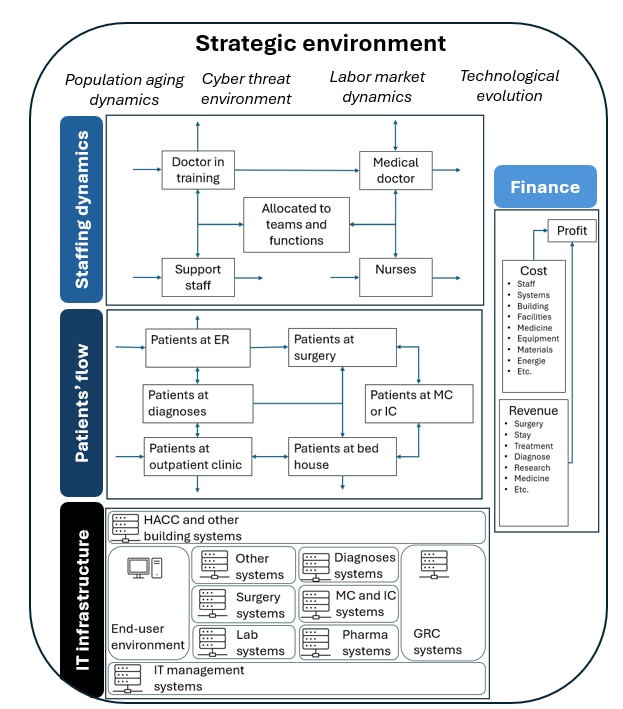
Why strategic digital twin technology could strengthen cyber risk governance
Strategic digital twins give healthcare executives a powerful way to elevate cyber-risk awareness and strategic decision-making. By simulating the future impact of choices, they reveal how alternative and sometimes counterintuitive strategies can outperform familiar approaches.
These solutions expose the medical, operational and financial consequences of materialized cyber threats, offering the clarity traditional methods often lack.
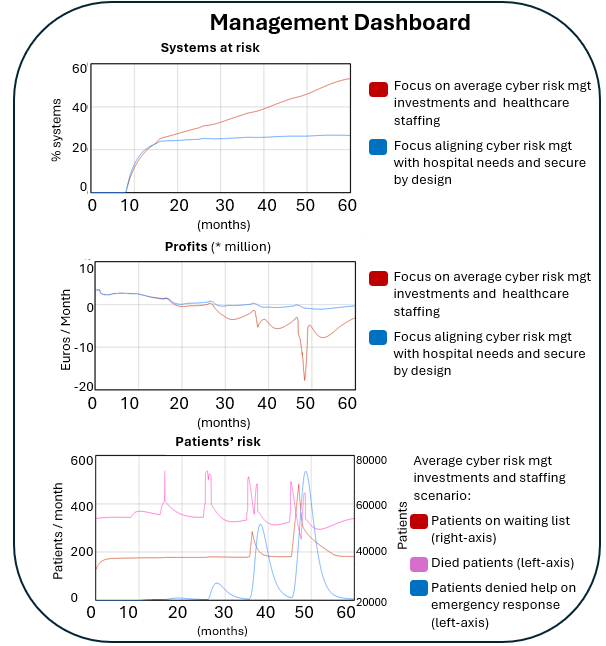
Because healthcare decisions are deeply interconnected, this holistic view helps leaders see how cyber-risk investments influence clinical capacity, operational stability and patient care. Digital twins provide a forward-looking lens that links cyber resilience in the healthcare sector to organizational performance.
They enable executives to see how investment decisions cascade across the organization through targeted simulations; to prioritize budgets for maximum impact, faster response and improved clinical capacity; and to identify counterintuitive strategies that transform cyber‑risk management into a value driver for patient safety and care delivery.
Don't miss any update on this topic
Create a free account and access your personalized content collection with our latest publications and analyses.
License and Republishing
World Economic Forum articles may be republished in accordance with the Creative Commons Attribution-NonCommercial-NoDerivatives 4.0 International Public License, and in accordance with our Terms of Use.
The views expressed in this article are those of the author alone and not the World Economic Forum.
Stay up to date:
Cybersecurity


Forum Stories newsletter
Bringing you weekly curated insights and analysis on the global issues that matter.
More on CybersecuritySee all

Akshay Joshi
March 17, 2026


