Cyber resilience must be collective and cross-industry. Image: Unspalsh/Jacques Dillies
Humberto Luiz Ribeiro da Silva
Head, Center for Cyber Incident Prevention, Ciberlab, University of Brasilia- Three evolving realities – the push for circularity, strategic coopetition and technological progress – mean many players in a value chain will share the same data-driven ecosystem.
- This creates both efficiencies and risk. On the latter, recent cyber incidents demonstrate that targeting one business can affect dependent organizations, with costs reaching into the billions.
- To thrive, organizations must embed preemptive cybersecurity, combining third-party risk management, threat lifecycle models and embedding systemic cyber resilience.
A profound reshaping of global value chains is underway. The World Economic Forum's Advanced Manufacturing and Value Chains Council, at a recent meeting in Dubai, identified a push for circular, nature-positive manufacturing and a geopolitical shift towards strategic coopetition as driving forces.
Simultaneously, advances in artificial intelligence (AI), connected robotics, and digital twins are blurring the boundaries between physical and digital systems, contributing to the transformation while expanding exposure to new risks.
This transformation builds on earlier waves of supply-chain digitalization, from electronic data interchange and barcode standards to radio frequency identification (RFID) and sensor-based tracking, which enabled automation at scale but were never designed for today’s hyper-connected industrial environment.
As these factories, suppliers, and logistics networks increasingly form integrated, data-driven ecosystems to create new efficiencies, they also expand the digital attack surfaces targeted by criminals, posing unprecedented risks as cyber incidents affect interdependent infrastructures worldwide.
As a result, systemic cyber shocks have become a defining feature of the past decade.
The NotPetya cyberattack in 2017 demonstrated how a single, uncontained incident could cascade through global supply chains: initially spread via a routine software update, it weakened companies such as Maersk, Merck and FedEx/TNT, causing over $10 billion in losses and forcing Maersk to rebuild 49,000 laptops and 4,000 servers.
Research by the New York Fed later showed how the disruption rippled across dependent firms, underscoring that cyber failures are no longer isolated IT incidents but cross-industry shocks that undermine industrial continuity and trust.
In this environment, cyber resilience has become a foundational enabler of trust, allowing innovation, sustainability and competitiveness to advance in parallel. This is also the focus of the Forum’s paper From Shock to Strategy: Building Value Chains for the Next 30 Years, which observes that global value chains are being rewired away from pure efficiency and toward resilience.
Reflecting growing interdependence, near-shoring, dual sourcing and digital transparency, the just-in-time mindset is being replaced. Among the eight forces shaping this transition, cybersecurity now stands out as a structural enabler of continuity and stakeholder confidence.
Why cyber resilience by design is important for industrial innovation
As advanced manufacturing becomes more digital and interconnected, resilience can no longer be treated as an afterthought. The Forum and University of Oxford’s Cyber Resilience Compass define resilience as the ability to minimize the impact of cyber incidents on an organization’s core objectives.
In industrial ecosystems, this translates into protecting operational continuity, data integrity, intellectual property and trust among partners, regulators and society.
Cyber resilience is not a technical feature; it is a governance discipline measured by leadership engagement, cultural awareness, and the integration of cyber indicators into corporate dashboards. It enables production systems to remain simultaneously intelligent and secure.
Advanced manufacturing increasingly depends on digital systems that collect and exchange massive volumes of data in real time. The convergence of operational technology (OT) and information technology (IT), including smart sensors, industrial Internet of Things (IoT) devices, and connected robotics, drives unprecedented efficiency, precision and sustainability.
Yet every connected controller or device can also serve as an entry point for malicious interference, turning localized incidents into systemic disruptions. Therefore, data integrity and provenance are core cybersecurity concerns.
To address this risk, cyber resilience by design ensures that innovation and protection evolve together. Segregated monitoring, network segmentation and zero-trust validation of devices and telemetry data are essential safeguards for operational integrity.
Innovation hubs and research centres play a key role by linking secure digital infrastructures to workforce upskilling and shared governance frameworks. There is particular urgency in emerging and developing countries to pursue cyber resilience by design – the cybersecurity challenges and opportunities of the second half of this decade will be proportionate to the pace and scale at which countries digitalize.
Resilience must also extend beyond factory walls. A company’s cybersecurity posture is only as strong as that of its weakest supplier. Modern production ecosystems rely on thousands of interconnected partners, such as component manufacturers, logistics providers and cloud platforms.
Effective third-party risk management requires continuous vigilance, shared intelligence and joint recovery exercises.
To sustain evolution, cyber-resilient innovation must become an inherent feature of industrial design, ensuring that the systems shaping the future of manufacturing are not only intelligent and efficient but also secure, adaptive, trusted and attuned to the complex realities of an increasingly interconnected world.
Cyber-resilient industrial innovation integrates cybersecurity into every layer of value creation, from product engineering and automation to partner ecosystems, ensuring that progress in connectivity strengthens rather than threatens the foundations of production.
3 key takeaways for building collective cyber resilience
1. Cyber incidents hit performance
Cyber shocks, from the NotPetya cyberattack to the rise of organized cybercrime targeting supply chains, show why cyber resilience must be tackled collectively and industry-wide.
A growing number of incidents, including disruptions at Jaguar Land Rover in August and at Collins Aerospace and several European airports in September 2025, demonstrate how cyber events directly affect day-to-day performance, causing a quarterly loss of almost £500 million and delays and flight cancellations, respectively. They hit the very metrics that define operational excellence in connected production networks – efficiency, continuity and trust – making the cost of digital insecurity tangible.

2. Acting before the breach prevents broad damage
For preparedness, leading manufacturers align their collective actions with a cyber threat lifecycle model, e.g., MITRE's Adversary Lifecycle and ATT&CK, which provide a knowledge base of adversarial tactics to help develop defensive methodologies. Early detection during criminal reconnaissance or weaponization stages can prevent exponential damage later in the attack lifecycle.
This contemporary governance model reframes cybersecurity from an isolated IT practice into an interorganizational discipline that safeguards innovation and continuity. Such a proactive approach enables organizations to act together, anticipate, contain and neutralize threats before they disrupt production in their value chain, evolving supply-chain-wide understanding of risks, behaviours and interdependencies.
Have you read?
3. Building systemic awareness achieves success
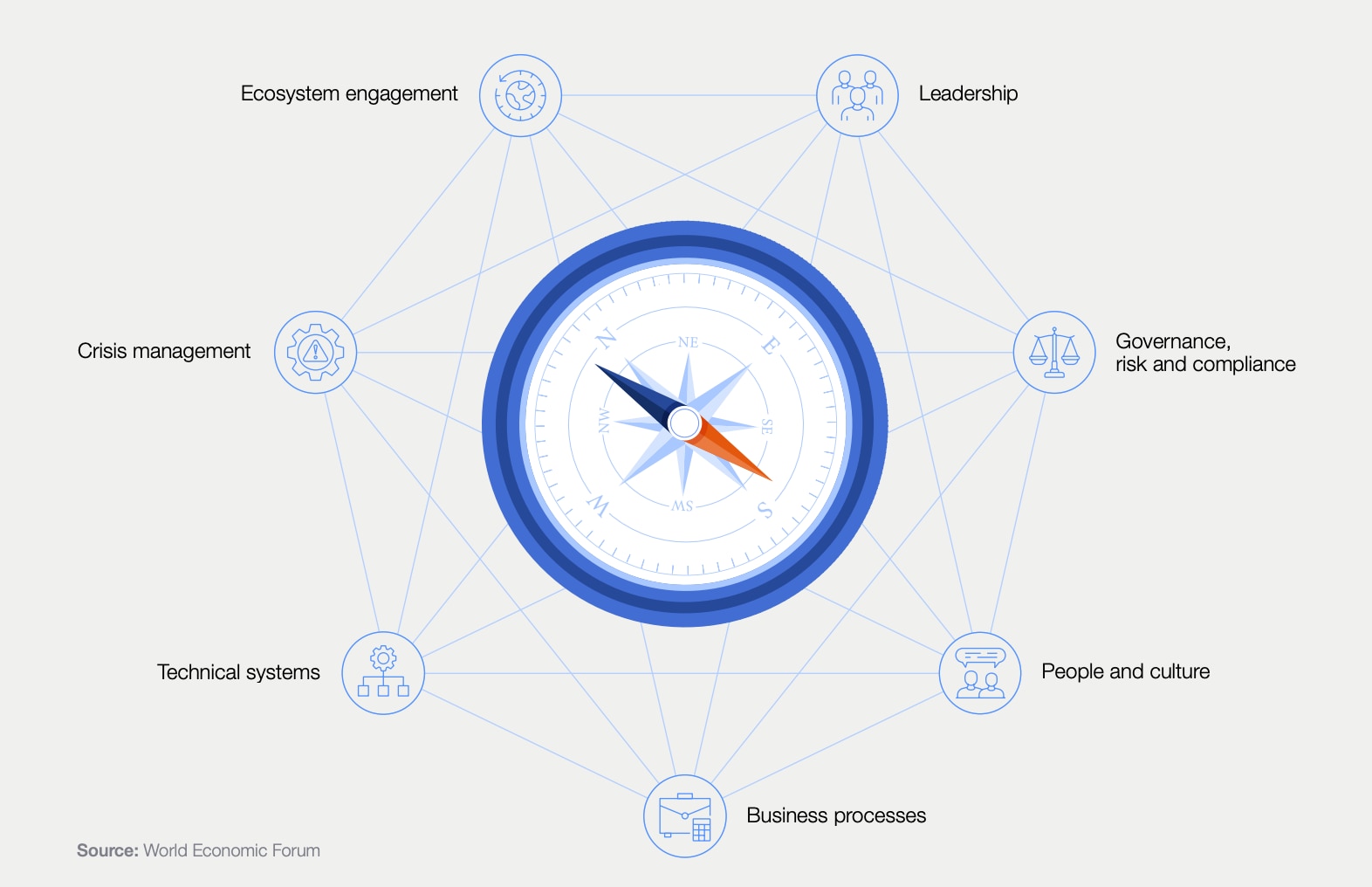
Technology alone cannot deliver resilience. Thus, the Cyber Resilience Compass organizes practices into seven domains defining a maturity roadmap: leadership, governance, people, business processes, technical systems, crisis management and ecosystem engagement.
These domains, ideally led by a chief information security officer, connect cybersecurity with industrial reliability, environment, social and governance (ESG) compliance and operational performance, and set the stage for a systemic awareness approach, integrating organization-wide education, simulation and shared intelligence that reinforce collective vigilance.
Regular cyber-resilience briefings at the board level, participation in information sharing and analysis centres and sector-wide tabletop exercises are examples of initiatives that transform awareness into anticipation, the cultural backbone of industrial resilience.
From shock to strategy
As reaffirmed by the Forum Councils’ Dubai agenda, the future of production ecosystems is being rewritten and depends on three converging forces: technological innovation, accelerating efficiency but introducing algorithmic risk; circularity, demanding secure traceability; and coopetition, requiring resilience amid interdependence.
Cyber resilience binds them, ensuring sovereignty, sustainability and shared progress. To thrive, organizations must embed preemptive cybersecurity, combining third-party risk management, threat lifecycle preemption, team maturity and performance-driven metrics.
Cybersecurity is no longer only a technical issue; it is a cross-functional, ecosystem-wide governance imperative for survival.
To stay ahead, organizations must go beyond their walls before they go down.
License and Republishing
World Economic Forum articles may be republished in accordance with the Creative Commons Attribution-NonCommercial-NoDerivatives 4.0 International Public License, and in accordance with our Terms of Use.
The views expressed in this article are those of the author alone and not the World Economic Forum.

Forum Stories newsletter
Bringing you weekly curated insights and analysis on the global issues that matter.
More on CybersecuritySee all

Spencer Feingold
March 25, 2026


