Redefining corporate strategy in a more volatile world

The Strait of Hormuz, a crucial shipping lane for oil and natural gas, is effectively shut due to the conflict. Image: REUTERS/Stringer/File Photo
Francisco Betti
Head, Global Industries Team; Member of the Executive Committee, World Economic Forum- In a world of rolling shocks, companies have had to embrace 'continuous adaptation'. It's now clear the rules of long-term planning are being rewritten.
- Leading companies are redefining strategy for the current era by treating every major decision as a dynamic bet and updating it as new signals emerge.
- New analysis from the Forum's Head of Global Industries and Bain & Company points to the shifts reshaping how companies plan now.
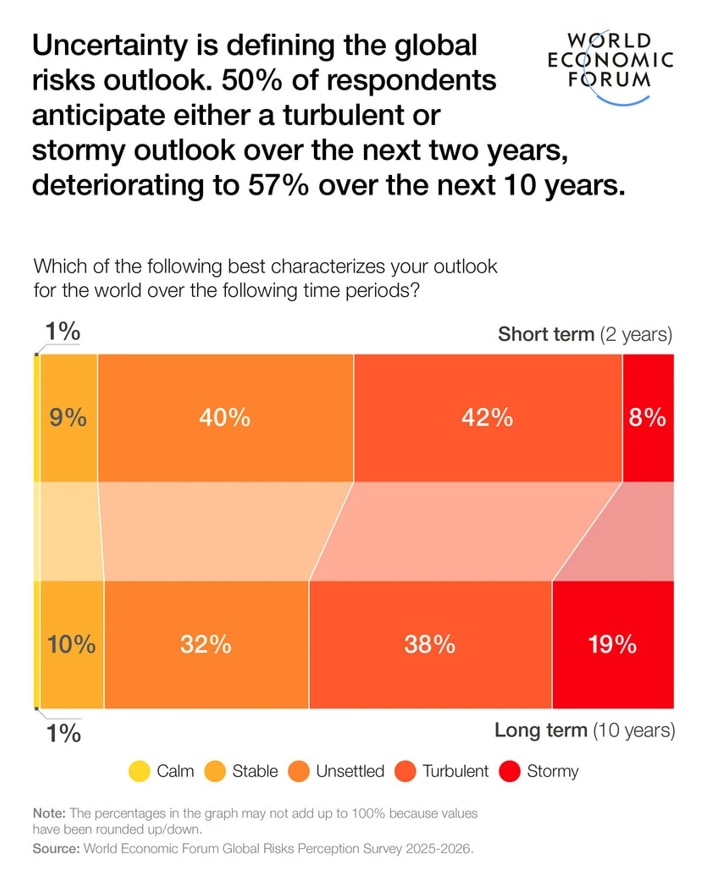
The world has entered an era of permanent disruption. Every six months, it seems a new crisis sends leaders back to the drawing board to re-examine plans they thought were settled. Geopolitical conflicts and trade barriers, the exponential advancement of AI, workforce transformation, volatility around energy prices and the availability of materials have created a pervasive and unprecedented uncertainty that has replaced the relative predictability that once underpinned corporate planning.
The mood shift was palpable at the World Economic Forum Annual Meeting in Davos at the start of the year. Past gatherings were dominated by business leaders playing offence – deploying capital, optimizing supply chains, expanding into new markets. This year, instead, they were playing defence while trying to first understand an increasingly complex global context and its implications for economies, industries, and businesses.
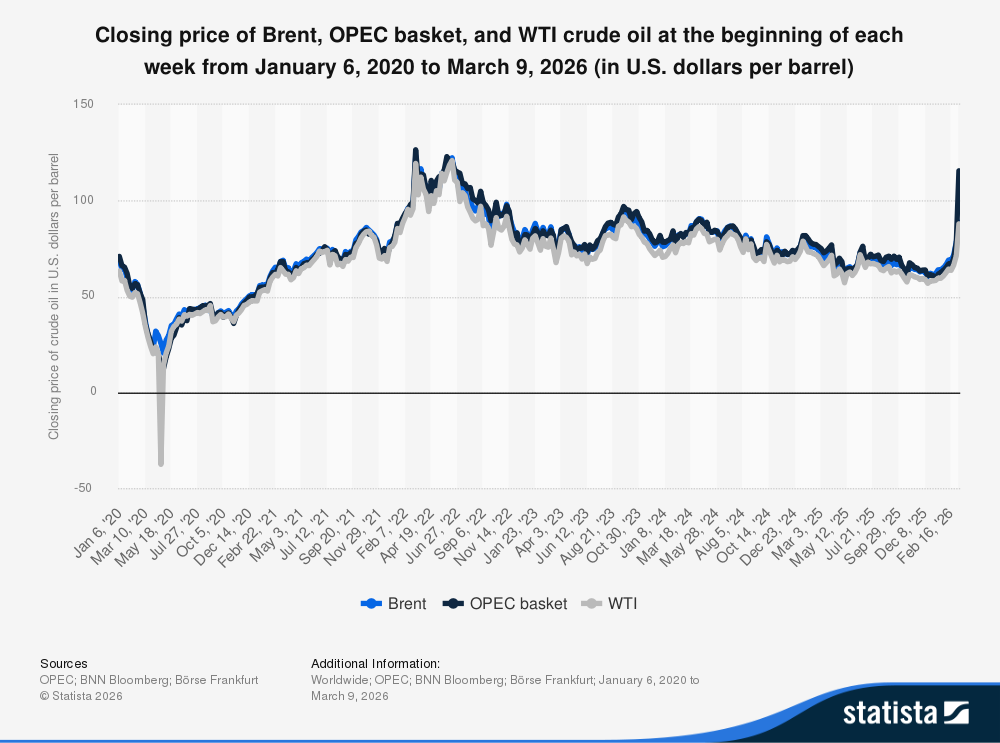
Soon after, the US-Israel-Iran escalation has sent energy prices soaring, with impacts reverberating across global trade routes – revisiting scenarios similar to the post-pandemic economic rebound, where recovery exceeded the pace of energy supply, as well as the Russia-Ukraine conflict, which resulted in unprecedented increases in natural gas and electricity prices.
In parallel, the fast development of agentic AI is redefining the enterprise world in the continuous search for efficiencies and productivity gains, while also forcing companies to rethink their business models to unlock new growth.
It's now clear that strategy is no longer about optimizing a working world. It is about navigating a highly uncertain one.
What does strategy mean now?
Strategy is now more critical yet more difficult. Shifting boundaries – driven by geopolitics, technology and the energy transition – demand immediate attention, but these seismic shifts are far more complex to anticipate than traditional competitive dynamics.
But some things have not changed. CEOs are still making fundamental choices: where to play and how to win.
They are still making trade-offs and aligning organizations around bets. And they are still largely operating across two time horizons: a short-term Delivery Agenda, optimizing the core business over 12 to 36 months, and a long-term Development Agenda – building the future business model over five to 10 years.
What has changed is that three capabilities: prediction, adaptability and resilience. They have moved from abstract concepts to the operational core of the strategy function. In a world of low clarity, a company's ability to make informed predictions, withstand shocks and pivot quickly is no longer a nice-to-have. It is the new strategy.
Strategy must evolve from an occasional exercise into a continuous 'stage zero' conversation with the C-suite and board, re-examining what leaders believed, what has changed and whether predictions need updating.
At the same time, the inputs feeding that conversation have multiplied exponentially. Strategy teams must now account for geopolitical tensions, geoeconomic shifts, workforce challenges, the energy transition and the accelerating pace of technological change.
'The strategy machinery must spin faster'
The speed at which a strategy must function has accelerated beyond the capability of most organizations.
What was once a five-year strategic horizon has compressed into a 12-month horizon, while a two-to-three-year plan is now a six-month view. The strategy machinery must spin at a speed no company is used to managing.
In this environment, the instinct to 'wait and see' is the riskiest move of all. In a world with more clarity, a leader could afford to pause on 10% of decisions while launching the other 90%. Today, those proportions have reversed, but waiting is not caution – it is abdication. It is betting that everything will stay the same. Doing nothing today is often riskier than changing course.

Strategy must instead become a continuous cycle: constantly updated, almost in real time – scanning for signals, gathering new evidence and recalibrating. Think of it as a Bayesian process: what data do we have, how does it change our predictions and convictions and what actions must follow? The companies whose strategic cycles are faster and sharper than their competitors' will hold a decisive competitive advantage.
Technology is part of the answer here. AI can turn a traditional, human-led review process into a continuous, automated, real-time board that informs decision making in real time. AI can dramatically increase the pace of data processing, accounting for far more variables, curating information and delivering insightful interpretations of the data.
But AI does not provide answers. It provides speed. The essential human moment remains: management must validate the data and the interpretation, then apply judgement to inform convictions and drive action.
Why conviction is key
With so little certainty, every strategic choice is a bet. Deciding to enter a market is going long. Deciding to exit one is going short. In this environment, the degree of conviction a leader holds in each bet determines the strategic path.
When conviction is high, the path is clear: move fast, move linearly, be willing to make one-way-door decisions. High conviction buys speed but accepts the trade-off of less resilience and less adaptability.
When conviction is lower, the path changes entirely. Leaders should experiment more, pursue multiple streams and constantly scan for signals. They should invest in adaptability – because if the bet is wrong, the organization must survive the day it finds out – and in resilience, shifting from a ‘just-in-time’ strategic mindset to a ‘just-in-case’ one for scenarios where adaptation alone might be too slow for survival.
This echoes the transformation the world saw in supply chains during the pandemic, when operational strategy shifted from hyper-efficient precision to building buffers against disruption.
Neither path is right nor wrong. Different leaders will hold varying levels of conviction when examining the same facts. The critical point is that conviction must be assessed explicitly and honestly – it is the foundation upon which every subsequent decision rests.
What must change now
To meet this new reality, organizations need to act. The corporate strategy function must be elevated. Just as the operations function moved to the front during COVID-19 because Chief Operating Officers understood how to keep organizations running through crisis, the strategy function is now poised for its own ascent.
Leaders must also ensure they have the right talent for a more complex world. If geopolitics is now a primary input shaping strategy, the strategy team needs people who deeply understand geopolitics. Building a 'brain trust' across the new critical inputs – macro trends, technology shifts, energy, workforce dynamics – is essential for informing the predictions and convictions that drive decisions.
The companies that move first to re-anchor their strategy will not merely survive the next disruption; they will be positioned to lead through it.
License and Republishing
World Economic Forum articles may be republished in accordance with the Creative Commons Attribution-NonCommercial-NoDerivatives 4.0 International Public License, and in accordance with our Terms of Use.
The views expressed in this article are those of the author alone and not the World Economic Forum.
Related topics:

Forum Stories newsletter
Bringing you weekly curated insights and analysis on the global issues that matter.
More on BusinessSee all

Jovan Jovanovic
March 11, 2026


