Why the quantum revolution risks leaving women behind – and what to do about it

When a technology is built by a narrow segment of society, the resulting solutions are rarely representative. Image: Unsplash
- Quantum technologies offer immense global benefits but we must proactively include women to avoid bias.
- Persistent gender gaps in physics and computer science translate into lower female workforce participation in quantum.
- A more inclusive quantum economy starts with each individual decision maker choosing to act.
Breakthroughs in frontier technologies like quantum computing offer huge potential benefits across industries and societies, from the discovery of new lifesaving drugs to finding cleaner ways to power the planet. But these benefits are not guaranteed to be universal. History warns us that when a technology is built by a narrow segment of society, the resulting solutions are rarely representative.
Unless we make a deliberate and sustained effort to ensure women have a seat at the design table, we risk baking gender bias into the foundations of the quantum economy by creating a quantum divide that excludes half of the world’s population.
A striking absence in quantum science
The challenge starts in academia, where women systematically have lower participation in the disciplines that underpin quantum science.
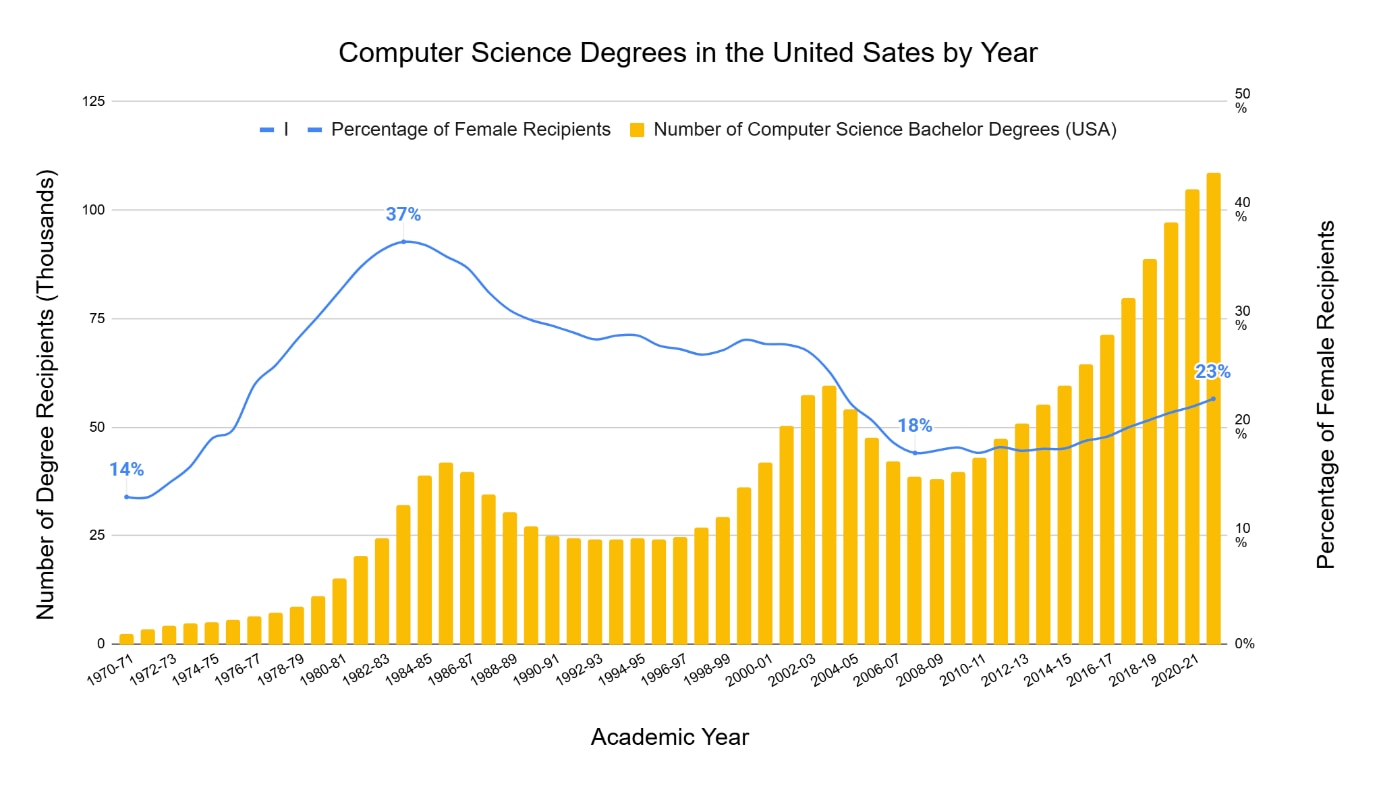
Take the example of computer sciences, a key “feeder” field for quantum software. In the early years of modern computing, most software professionals were actually women, while men dominated hardware, Xavier Leroy states in Genre et Sciences. The advent of personal computers in the 1980s marked a turning point, with a significant increase in the number of men studying computer science, while the number of women remained stable.
Overall, this decreased the representation of women, who now account for only 20% of computer scientists, compared to nearly 40% in 1985. Three main stereotypes emerged: the geek, passionate about computing; the hacker, skillfully building systems from scratch; and the entrepreneur, creating a company from a computer in his garage. All three stereotypes are extremely gendered.
The quantum industry also requires advanced physics expertise – another academic field where women are significantly underrepresented. For example, in the US in 2020, only 25% of physics bachelor laureates were women. Although this constitutes an increase from 19% in 2015, the rate of change is slow.
Indeed, across almost all the STEM subjects that will fuel the quantum revolution, we see the same story playing out: in 2022, women comprised 56% of first-time entrants into tertiary education across OECD countries. And yet only 15% of women chose to study a STEM subject, compared to 41% of male new entrants.
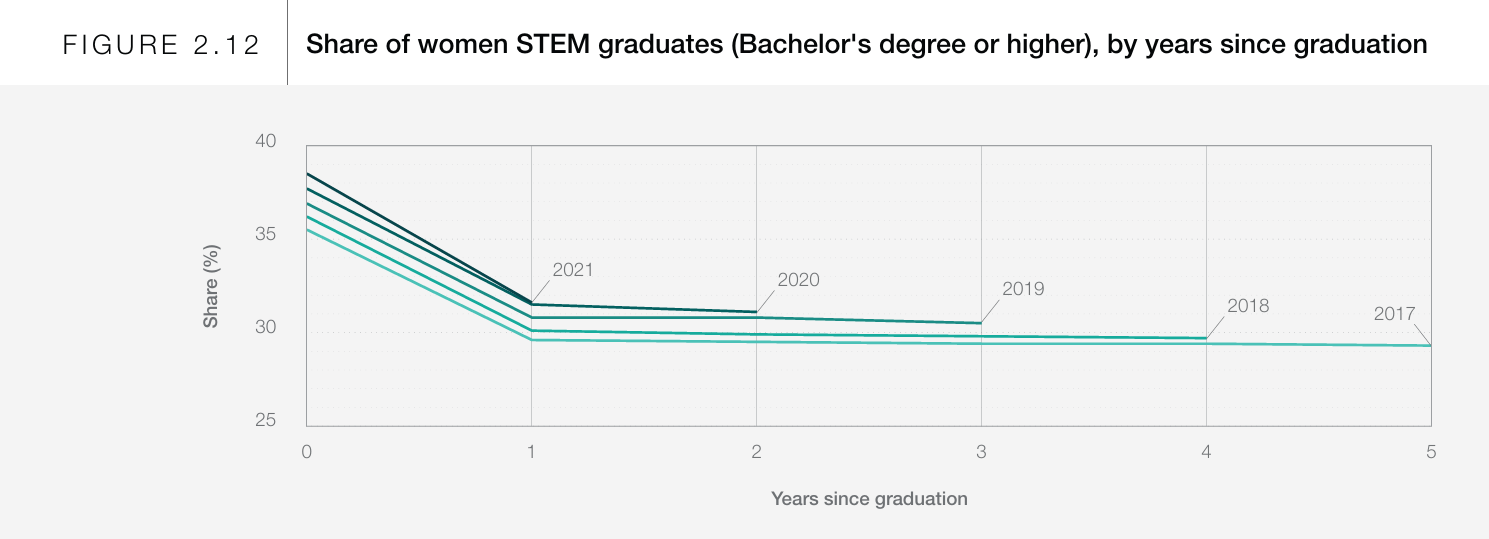
Invariably, gender underrepresentation in these academic programmes will translate into even greater imbalance in the industry, aggravating gender inequality throughout the quantum value chain. This is already demonstrated in a 2022 survey from the Unitary Foundation on quantum open-source software development, where only 19% of respondents identified as female, while 73% identified as male. Moreover, female integration in the STEM workforce drops significantly after the first year, although after this initial transition, they are less likely to leave. This “leaky pipeline” demonstrates that in addition to increasing gender diversity at postgraduate level, supporting recent graduates in their early professional steps is a priority.
When gender bias is a feature of the design
While the precise causes of these gender gaps in both academia and industry are complex and still a topic of debate, the consequences of them are not: when large segments of the population are systematically excluded from a sector, bias becomes a feature of the design, rather than a bug in the system.
This is not a theoretical concern. We have already seen the cost of a male-default world in healthcare, where the exclusion of women from clinical design has had enormous societal and economic costs. A recent analysis by the World Economic Forum, in collaboration with the McKinsey Health Institute, found that women spend on average 25% more of their lives in poor health than men, partially because of a lack of sex-based treatment development and delivery. When women are absent from the design of frontier technologies, whether in 20th-century medicine or 21st-century quantum, the long-term impact is undeniable.
Designing a universal quantum revolution
Despite decades of outreach, many women already working in the field argue that the needle has barely moved. The current model of scientific leadership, funding and authority is often cited as a primary barrier. As the Women for Quantum collective recently argued, the existing structures are simply ineffective at achieving true gender equity. To change the outcome, we must address the pipeline and change the environment.
Some promising success stories suggest this structural shift is possible. Carnegie Mellon University, for instance, managed to reduce its gender gap in computer science by fundamentally rethinking its entry requirements. By focusing on competence and removing the prerequisite of prior coding experience, and by adapting the environment to be more inclusive, they achieved higher gender diversity without compromising their status as a top-ten global programme.
Symbolic shifts matter, too. In 2026, a project at the Eiffel Tower will begin correcting a century of scientific erasure. For decades, the tower has displayed the names of 72 great scientists – all of them men. By inscribing the names of 72 female counterparts alongside them, the project aims to dismantle the Matilda effect – the systemic bias that has long rendered women’s technical achievements invisible.
While these large-scale projects can be replicated in monuments and institutions around the world, every individual decision-maker building the quantum ecosystem can make a difference. Success requires a conscious effort to foster inclusive environments and recognize the talent that is already there. As the astrophysicist Françoise Combes suggests, the path forward is a matter of recognition: “Each time you have a decision to make, think about the women who may be invisible.”
Don't miss any update on this topic
Create a free account and access your personalized content collection with our latest publications and analyses.
License and Republishing
World Economic Forum articles may be republished in accordance with the Creative Commons Attribution-NonCommercial-NoDerivatives 4.0 International Public License, and in accordance with our Terms of Use.
The views expressed in this article are those of the author alone and not the World Economic Forum.
Stay up to date:
Gender Equality
Related topics:


Forum Stories newsletter
Bringing you weekly curated insights and analysis on the global issues that matter.
More on Emerging TechnologiesSee all

Olumide Durotoluwa
March 6, 2026


