What will growth look like in the new economy?

Sustained growth in the new economy will depend on strengthening productivity and human capital as technology and knowledge become central to value creation. Image: Unsplash/Lo Lo
- A new World Economic Forum report, Growth in the New Economy: Towards a Blueprint, outlines trends, 'no-regret' strategies and dilemmas shaping long-term growth.
- AI adoption, geostrategic competition, rising debt, and environmental and demographic challenges are poised to shape the new economy, and demand new growth strategies.
- On the sidelines of the IMF and World Bank Spring Meetings 2026, the Centre for the New Economy and Society convened a series of leadership dialogues on the global economic outlook, the implications of the energy and commodities shock, and the future of jobs and inequality in the new economy.
- Here are the key findings from the report, alongside takeaways from the IMF and World Bank Spring Meetings 2026.
The world can change a lot in just three months. Back in January, Kristalina Georgieva, the head of the International Monetary Fund (IMF), was cautiously optimistic about the state of the global economy when she spoke at Davos. Momentum was building.
Now the IMF has confirmed that the context has deteriorated. The global growth forecast for the year has been revised down by 0.2 percentage points - from 3.3% in January, to 3.1% in the latest IMF World Economic Outlook, published to coincide with its annual Spring Meetings with the World Bank in Washington. This drop in projected growth "largely reflects the disruptions from the conflict in the Middle East".
Had the war not started in February, the IMF was on track to upgrade its growth projection for 2026 to 3.4%. But with the Strait of Hormuz chokepoint shut, the daily flow of oil has fallen by 13%, says the IMF, while Brent crude surged from $72 before hostilities started to a peak of $120 per barrel.
Georgieva described the shock as "large, global, and asymmetric". Even under the most optimistic scenario, she warned, there will be "no neat and clean return to the status quo ante". Some estimates suggest that it might take up to 12 weeks to rebalance global tanker fleet and loading operations after reopening of the Strait of Hormuz, with lasting damage to production capacity and molecules.
In the meantime, a set of structural transformations – from AI adoption and geostrategic competition to record levels of debt and demographic and climate pressures – is reshaping the global economy.
The World Economic Forum's new report, Growth in the New Economy: Towards a Blueprint, argues that the strategies which generated returns in the old economy will no longer do so - and may actively erode the gains already made.
"The current context demands bold choices and trade-offs," says Attilio Di Battista, the Forum's Head of Economic Growth and Transformation. "Investing in productivity, talent and reinforcing the fundamentals of economic policy are clear winning strategies that hold across every country and income level."
Building on two years of dialogues with nearly 200 global business leaders held as part of the Forum’s Future of Growth Initiative, policy-makers and experts, and a survey of more than 11,000 executives worldwide, the report outlines the frontier of the new economy as well as key trends, “no-regret” strategies and dilemmas shaping economic growth in the long-term.
How the Forum helps leaders make sense of AI and collaborate on responsible innovation
'Bold choices and trade-offs'
So what should leaders actually do in the face of so much uncertainty? The report identifies "no-regret" moves and open dilemmas that will define four major areas of economic policy in the coming decade:
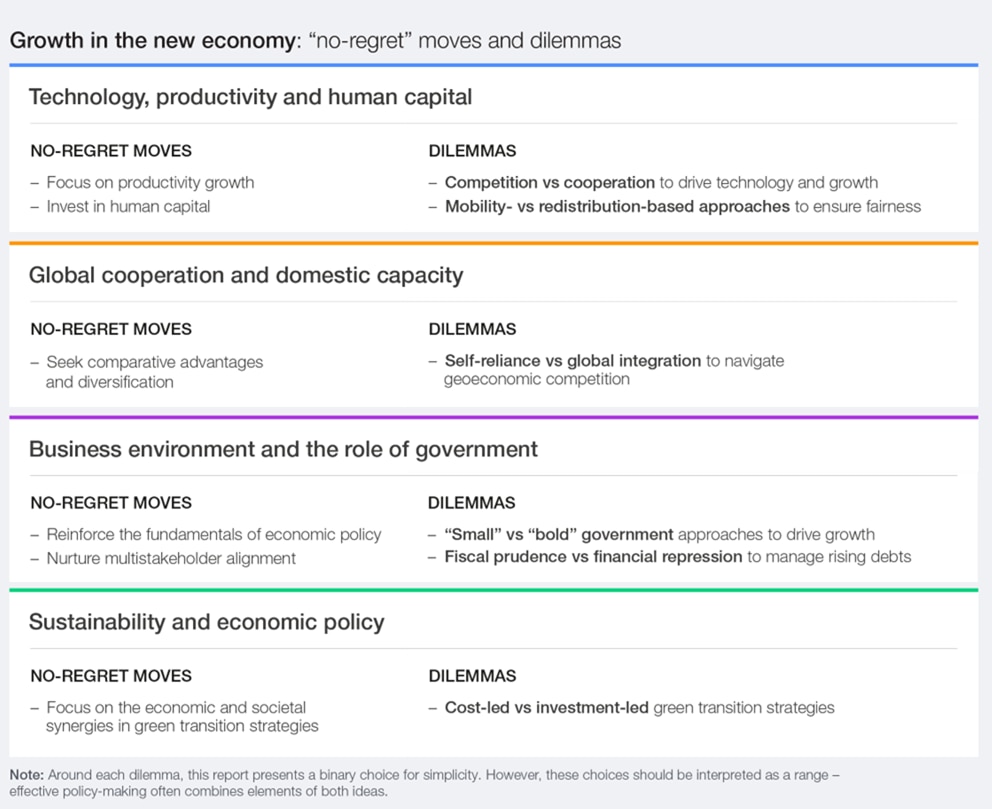
- Technology, productivity and human capital. Sustained growth in the new economy will depend on strengthening productivity and human capital as technology and knowledge become central to value creation. Governments and businesses must navigate between different approaches to translating innovation into new sources of growth and ensuring its benefits are widely shared, pursuing coordinated or competition-led approaches to harness technology and prioritize redistribution or mobility-based strategies for economic inclusion.
- Global cooperation and domestic capacity. Leveraging comparative advantage and diversification remain “no-regret” strategies that may enable expansion of economic opportunity and resilience. But governments and businesses will need to balance global engagement with stronger domestic capacity, navigating between self-reliance and global integration strategies.
- Business environment and the role of government. In the new economy, reinforcing the fundamentals of economic policy – including credible institutions, high-quality infrastructure and macroeconomic stability – and strengthening multistakeholder alignment continue to be winning strategies. The role of government in economic transformation can range from minimal to more expansive, while policy-makers face hard choices to manage debt levels, shifting between greater fiscal prudence and forms of financial repression.
- Sustainability and economic policy. Focusing on the economic and societal benefits of green transition strategies is essential to unlocking long-term prosperity and resilience. Critical dilemmas around how to manage the costs and trade-offs of greener growth persist, with decision-makers navigating a range of investment-led and cost-led strategies.
Where growth will come from
Amid the tremors brought by the conflict in the Middle East, the report points to long-term shifts in the engines and composition of economic growth.
A small number of economies will drive a large share of global expansion, shaping demand, investment flows and economic influence over the rest of the decade. Asia alone is projected to account for more than 50% of cumulative global growth through 2030, while middle-income economies are expected to drive 65% of global GDP over the same period. Despite growing the fastest, low-income economies are still projected to account for only 1% of new output, a reminder that growth rate and growth weight are entirely different things.
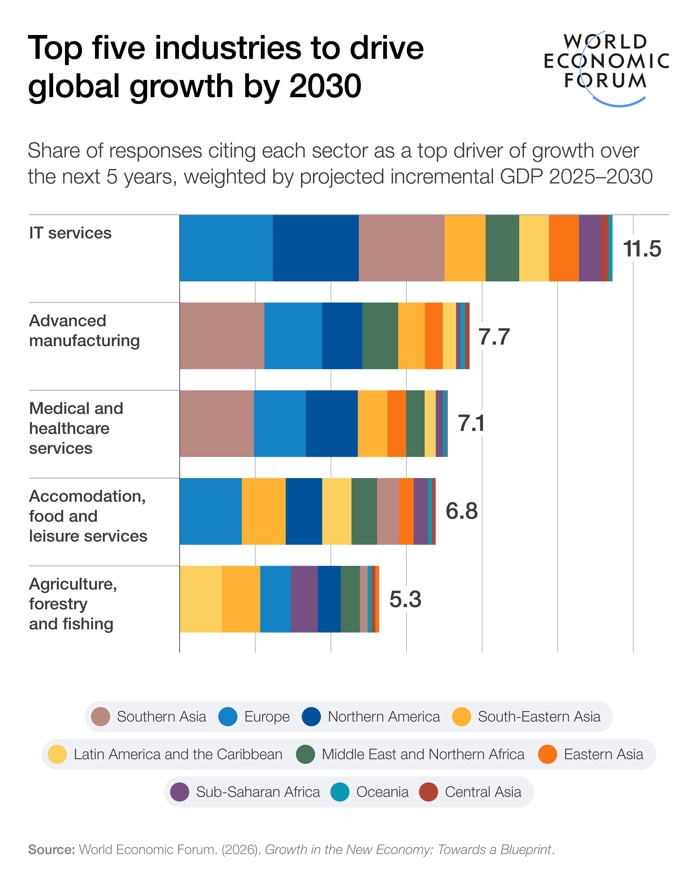
At the industry level, business leaders expect growth opportunities over the next five years in IT services, advanced manufacturing, healthcare and accommodation and leisure. Foreign demand and domestic corporate investment are seen as the primary growth drivers across most industries, while domestic consumer spending or public expenditure are likely to constrained by the pressure of high public debt and stagnant real incomes.
Pathways to growth in the new economy
According to the latest survey of more than 11,000 executives globally, high energy costs and policy instability stand out as the most common barriers to growth across regions and income levels. Skills shortages and regulatory constraints are also among the key concerns in high-income economies, while access to finance and infrastructure weigh on growth in low-income economies.
However, there might be new opportunities too.
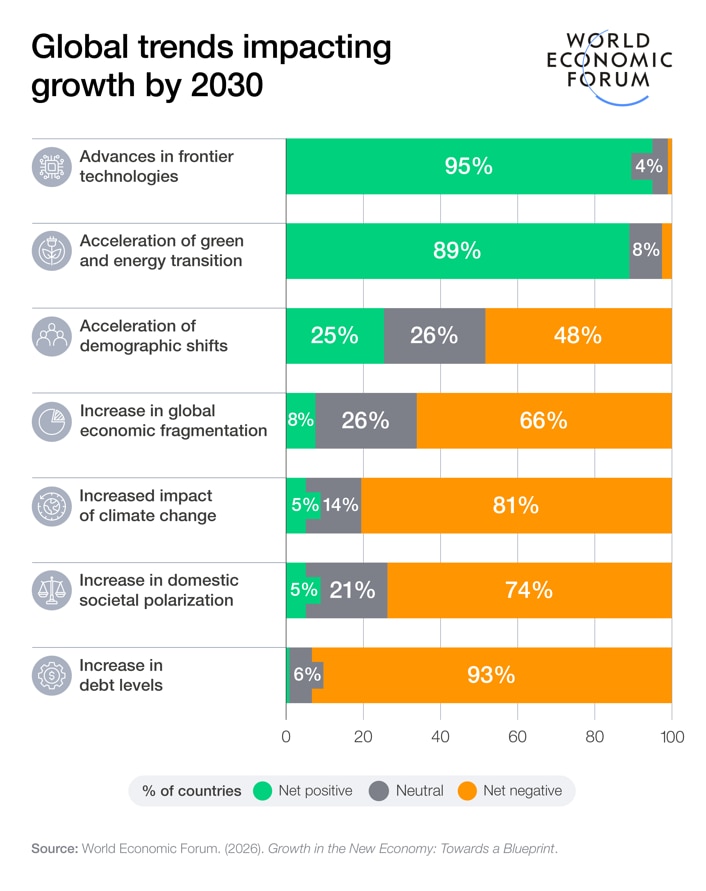
Looking at the next five years, executives expect frontier technologies and green and energy transition to drive growth across most countries.
Demographic shifts are likely to create divergent growth trajectories. Ageing and declining populations are expected to weigh on growth in Europe and East Asia, while younger populations in South Asia, Sub-Saharan Africa and parts of the Middle East could support growth if matched with jobs and economic opportunities.
Geoeconomic fragmentation is expected to drive divergence too. While it is mostly seen as a drag on growth, executives expect some geographies, like South-East Asia, to benefit from shifting supply chains and trade patterns.
The new economy is not a future scenario. It is here, being stress-tested in real time. Both the Forum's report and the Spring Meetings carry the same message: resilience is built in calm water, not crisis alone.
Growth will come from pairing proactive risk management with long-term thinking, investing in the fundamentals, ensuring the benefits of the ongoing transformations are widely shared, and resisting the pull of knee-jerk reactions that leave people worse off. As Georgieva put it: "war takes away everything we work for". So does the failure to prepare and adapt swiftly and smartly.
Find out more about the World Economic Forum's Future of Growth initiative here.
License and Republishing
World Economic Forum articles may be republished in accordance with the Creative Commons Attribution-NonCommercial-NoDerivatives 4.0 International Public License, and in accordance with our Terms of Use.
The views expressed in this article are those of the author alone and not the World Economic Forum.

Forum Stories newsletter
Bringing you weekly curated insights and analysis on the global issues that matter.
More on Economic GrowthSee all

Mekhla Jha and Sid Agarwal
September 21, 2026


