Catch up on the key stories and developments shaping the financial world.
Top stories: IMF flags weaker global growth as geopolitical risks intensify; Earnings season lifts big US banks’ profits; Korea markets rebound on foreign inflows.
For more on the World Economic Forum's work in finance, visit the Centre for Financial and Monetary Systems.
1. Global economy faces fragile growth path amid rising geopolitical risks
After a year dominated by trade and uncertainty shocks, the global economy is now facing a major new test from war in the Middle East, the International Monetary Fund (IMF) says in its April 2026 World Economic Outlook update, published ahead of its Spring Meetings with the World Bank in Washington DC, 13-18 April.
The Fund has revised its global growth forecast to 3.1%, down from 3.4% in 2025, bringing the global economy to a weak but stable pace. However, the forward view remains highly uncertain. For this reason, Global Economy in the Shadow of War sets out a “reference forecast” based on a Middle East conflict of limited duration and scope, with disruptions fading by mid-2026, alongside scenarios in which the conflict lasts longer or expands.
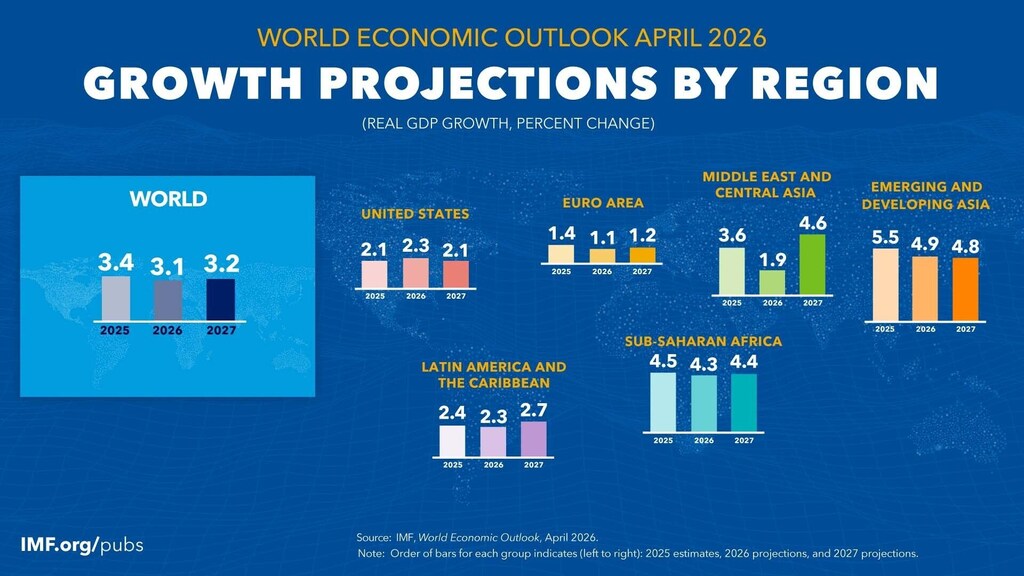
The impact is uneven across regions, with emerging and conflict-proximate economies facing the sharpest slowdown, while advanced economies are expected to see more moderate, though still subdued, growth.
Key takeaways:
The defence burden: Military outlays are rising by an average of 2.7 percentage points of GDP, largely deficit-financed, contributing to “fiscal dominance”, particularly in economies closest to the conflict.
Resilience factors: Despite the strain, global labour markets remain steady, with unemployment near historic lows in some advanced economies. Supply chain normalization outside conflict zones is also providing a floor for global trade.
AI productivity lag: Investment in AI remains strong, but productivity gains are arriving too slowly to offset geopolitical and energy shocks.
Overall, the Outlook points to a global economy operating under persistent pressures. While activity is holding up and labour market strength and supply chain easing offer some support, the path ahead remains fragile and highly sensitive to further disruption.
2. US banking giants lean into market volatility
If the IMF’s Outlook reflects the real economy’s constraints, first-quarter earnings from major US banks show a financial sector that has remained relatively resilient, with the 'big six' posting profits above estimates.
Goldman Sachs saw its best quarter in years. Meanwhile, Bank of America posted strong results, with earnings growth driven in part by higher trading revenue, illustrating how institutional business lines respond to more volatile global conditions.
Morgan Stanley’s stock traders were among those benefitting from a broader Wall Street surge, contributing to what Bloomberg described as a record “windfall” across major banks.
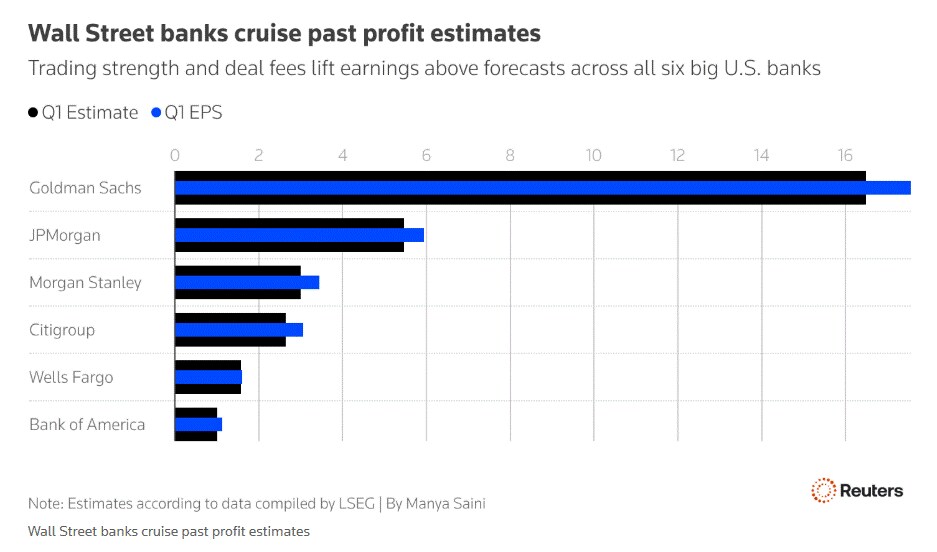
This robustness is being reported as part of a broader trend where corporate America is set to deliver "exceptionally strong" earnings despite continued uncertainty. Financial Times analysts cite supportive fiscal policy and a weaker dollar as key tailwinds, with the S&P 500 expected to see 12.6% year-on-year earnings growth.
Dealmaking has rebounded in the wake of a broader M&A surge, with activity now more structurally oriented and increasingly shaped by AI‑driven transactions.
While broader macroeconomic forecasts highlight risks from slowing productivity and fiscal pressures, parts of the financial sector appear to be adapting to shifting capital flows.
How the Forum helps leaders understand change in global financial systems
The Centre for Financial and Monetary Systems convenes leaders to make sense of transformation across global financial systems, from sustainability and resilience to innovation and digitalization.
By fostering cooperation and insight, the Centre helps partners align financial systems with long-term economic stability and shared prosperity.
3. More finance news to know
The Financial Stability Board has also warned that the Middle East conflict is creating significant global financial instability, with rising market volatility and tighter financial conditions. It highlighted risks from stretched asset valuations, high leverage in parts of the non-bank financial sector, and liquidity mismatches, noting that these vulnerabilities could amplify shocks and threaten sovereign bond markets, private credit and broader financial stability if conditions worsen.
Hedge funds have bought a record $86 billion in stocks over five sessions, driven mainly by systematic, trend-following strategies, according to Goldman Sachs data. The surge is among the fastest on record, as markets rally on easing geopolitical tensions, with estimates that funds could add another $70 billion if momentum continues.
European banks are resilient enough to withstand current geopolitical and financial shocks but must prepare for emerging risks, including AI-driven cyber threats, according to the head of the European Banking Authority. François-Louis Michaud said in a press briefing that lenders have strong capital buffers, while adding that private credit does not pose a systemic risk to the sector.
UK lenders have started cutting fixed mortgage rates as market conditions stabilize after a month of volatility linked to the Middle East conflict. The moves follow a recent fall in swap rates, which banks use to price mortgages, offering some relief to borrowers, though rates remain higher than before the recent turmoil.
South Korea’s financial markets are attracting foreign investors back after a sharp March selloff, with stocks rebounding on easing Middle East tensions, AI-driven tech demand and reform momentum. Despite renewed inflows, concerns remain over currency weakness and high volatility, with the won near multi-decade lows and the economy still exposed to energy price shocks.
Senior financial officials have warned that the latest AI models from major tech firms could pose a serious cybersecurity risk to the global banking system by exposing weaknesses in banks’ defences. Regulators say the rapid advance of these tools is outpacing current safeguards, raising calls for a more coordinated international response as policymakers assess how to manage the emerging risks.
Almost 40% of US data centre projects due this year risk delays as developers face permitting hurdles, labour shortages and strained power grids. Industry data suggests these bottlenecks could slow the rollout of AI infrastructure, with some projects already slipping by several months and raising concerns over how quickly companies can scale AI capacity.
4. Read more on Forum Stories
Global finance is undergoing a structural shift as geopolitical fragmentation replaces the post-Cold War era of open capital flows. World Economic Forum Managing Director Matthew Blake argues that rising trade barriers, sanctions and regional blocs are reshaping how money moves across borders, increasing complexity and risk for banks and investors. While new regional alliances and payment systems are emerging, they may signal a more divided global financial architecture unless institutions adapt quickly to a multipolar world.
In a world shaped by geopolitical shocks, supply chain disruption and rapid AI advances, resilience is becoming a core competitive advantage. In the video below, leaders across engineering, healthcare and robotics highlight the need for systems and teams that are designed to adapt, combine human expertise with AI and stay agile in the face of constant change:
Retirement planning is often built around the idea of a 'safe' withdrawal rate – a fixed rule for how much can be drawn from savings each year. But in a world of more volatile returns, shifting inflation and longer lifespans, that certainty is increasingly harder to sustain. Read more about why fixed rules may fall short, and a more flexible approach that adapts withdrawal strategies as economic conditions evolve might be best.