Economics tends to focus on production, consumption and financial value, treating nature as external.
'Oeconomy' refers to managing our 'home' within nature, where the economy acts as the bridge between people and the natural systems we depend on, shaping how resources are used and shared.
Finance should circulate value across natural, economic and social systems – changing the rules and incentives could enable markets to direct investment toward more sustainable choices for nature and society.
Economics is often defined as the study of how goods and services are produced, distributed and consumed. More broadly, it examines how people, businesses and governments make decisions about resources and how those decisions shape societies.
Economists typically study these processes at two levels: microeconomics, which focuses on smaller units such as households, firms, buyers and sellers and the markets in which they interact; and macroeconomics, which focuses on larger systems such as national or regional economies.
A typical illustration used in economics shows producers and consumers exchanging goods and services, with governments acting as regulators. In many versions of this model, nature is not depicted, even though natural resources and ecosystems enable economic activity.
Modern economics developed largely in Europe during its Enlightenment period and expanded rapidly with the Industrial Revolution. At this time, economic systems increasingly emphasized expanding production and consumption through mechanization and the large-scale exploitation of natural resources.
As local resources became scarce, materials were sourced from farther away. Likewise, when local waste-disposal limits were reached, waste was sent elsewhere. This geographic expansion made environmental impacts less visible and encouraged treating environmental damage and other harms as “external” to economic decision-making.
Today, consensus is growing among scientists and policymakers that we are approaching – and in some cases exceeded – planetary limits, as the impacts of overproduction and overconsumption become increasingly clear. Biodiversity loss, climate change, pollution and other global crises are widely understood as consequences of these patterns, leading to growing recognition that the current economic paradigm is reaching its limits.
Revisiting the ‘oeconomy’
The ancient Greek word “oikonomia” comes from words meaning “to manage the household” or “home.” When economics became a formal discipline in 18th-century Europe, many people, especially industrialists and intellectuals, were already physically and mentally distant from nature, living in growing towns and cities.
However, humans, like all living species, depend on nature for sustenance. Our needs comprise our ecological niche, which includes the natural environment and the species we interact with. At its core, oikonomia or 'oeconomy' refers to managing our home within nature, not separate from it.
As communities became more complex, people specialized in meeting others’ needs, making the exchange of goods, services and skills necessary. Across the world, grassroots economies operate in many forms but trade generally depends on four key functions:
A ledger or shared memory of exchanges.
A relative valuation of goods, services and skills.
Limits on value to prevent uncontrolled accumulation.
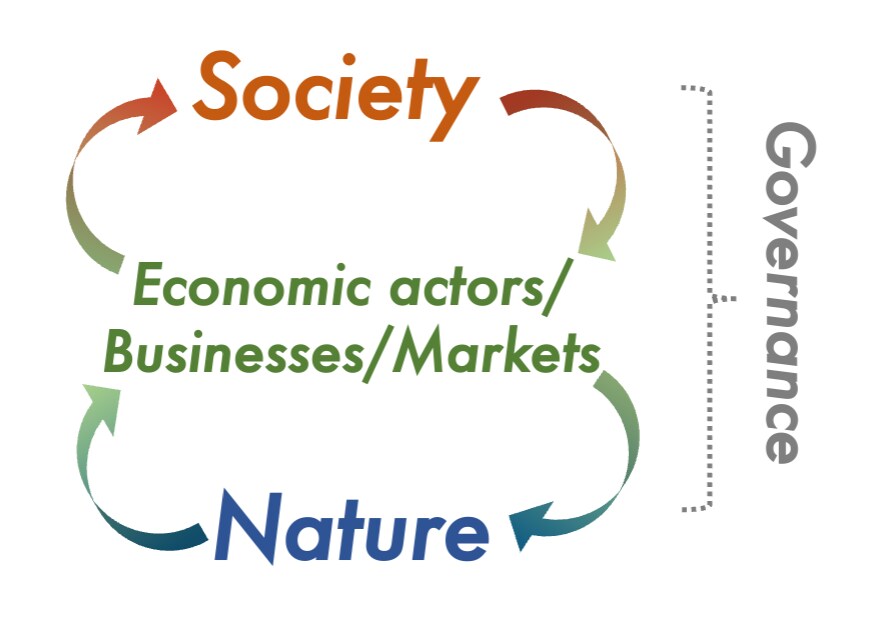
Rules or governance to guide the overall process (figure 2a).
As economies grow, exchanges become organized through markets. Businesses and other economic actors act as intermediaries, while currencies evolve to facilitate exchange.
The Intergovernmental Platform on Biodiversity and Ecosystem Services (IPBES), often described as the United Nations biodiversity panel, takes a holistic view of human interdependence with nature through the concept of contributions from nature – the benefits people receive from nature.
Its conceptual framework was designed to incorporate diverse cultures, knowledge systems and experiences, addressing this broad framing of oeconomy.
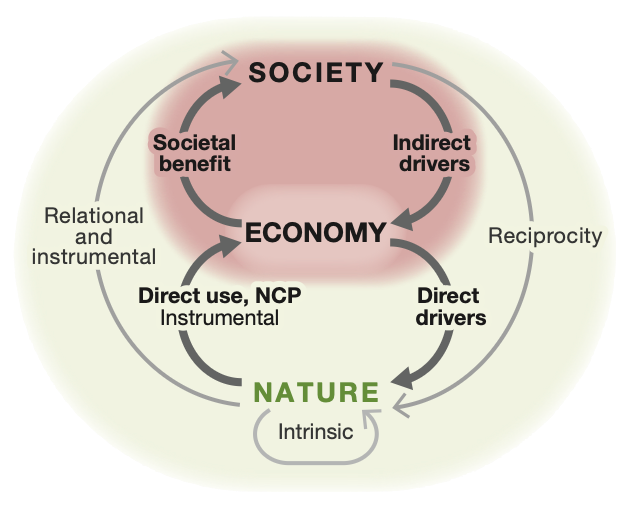
Over the past 50 years, the relationship among nature, the economy and society has been widely framed through the concept of sustainable development, often illustrated as three overlapping or nested circles. This more foundational interpretation of the oeconomy, however, places the economy as a fundamental mediator between people and nature (figure 2b).
This view starts with what we already know – economic actors produce goods and services through direct use from nature, transforming them for use by society.
At the same time, societal values and cultural norms shape regulations and other indirect drivers – such as population change, technology and preferences – that influence how economic actors operate. These determine the direct drivers or methods and extent of resource use and extraction from nature (direct drivers).
What is new is that this meaning of oeconomy applies with or without currencies or monetization, for all people and at all scales – from local households to national economies. It opens our minds to new solutions for transforming current crises towards sustainability.
Systems change in markets and values
The form of economy most familiar today is the currency-based market economy, which focuses on maximizing the use of natural resources and converting them into financial value, with wealth primarily measured in monetary terms.
The IPBES Transformative Change Assessment expresses the rules guiding this system as underlying causes of biodiversity loss and nature’s decline. These rules tend to:
Encourage domination over people and nature.
Amplify inequalities in power and wealth.
Prioritize short-term financial gain.
These permeate economic theory, from Adam Smith to modern neoliberal capitalism, in news coverage of politics and finance, in teaching business and law, and in everyday behaviour. Individuals are motivated to build wealth, or simply to avoid falling behind in an unequal world.
It is therefore not surprising that these same dynamics contribute to other intersecting crises of the Anthropocene, including climate change, pollution, financial instability and growing inequality. Faced with challenges of this scale and complexity, individuals can feel they have limited agency.
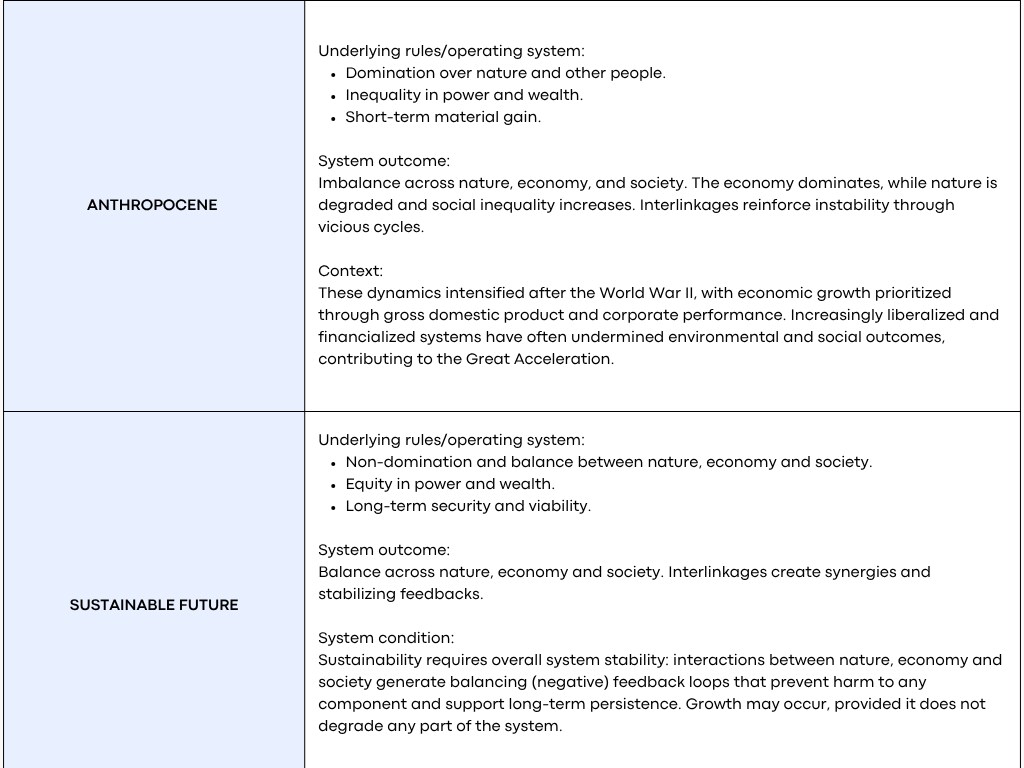
Climate change and biodiversity loss are often described as market failures but this model reframes them as values failures. Treating them as market failures implies that the system is fundamentally sound, when in fact they reflect deeper contradictions in the rules and values that shape markets.
As a result, many solutions rely on regulations or interventions that run counter to dominant market incentives. This imbalance is evident in global finance, where nature-positive investments are vastly outweighed by nature-negative ones, with ratios now cited as around 1:30.
If these underlying rules were changed (as illustrated in Figure 3), markets could instead incentivise solutions that work with the system rather than against it. In such a context, nature-positive investments would become not only desirable but also the most rational and rewarding choice, for investors and for society as a whole.
Rewiring finance
On closer inspection, this model shows that all wealth ultimately originates from nature, a well-established concept. Over time, natural resources are transformed through economic activity into financial value, which is then accumulated and shaped by social institutions.
In a capital model, where natural, economic, social and financial capital underpin society, value is converted between these forms. The primary role of finance is to facilitate these flows, linking nature, the economy and society.
The challenge in current markets is that value is increasingly locked in financial assets rather than circulating through the system. As a result, it is effectively removed from wider use, weakening the stabilizing feedback loops needed for balance.
This perspective underscores the importance of redirecting financial capital back into natural and social systems to restore balance across nature, the economy and society.
The task, then, is not to rewire finance so investment flows more efficiently and effectively to where it is needed. With the right rules, governance and implementation, markets can better direct capital and help repair past imbalances.
Dr David Obura is a Member of the World Economic Forum’s Global Future Council on Natural Capital, 2025-26. For more information, please visit the website or contact council manager Shivin Kohli.