Southern Asia faces shared risks and tackling them will require joint solutions
Deep dive
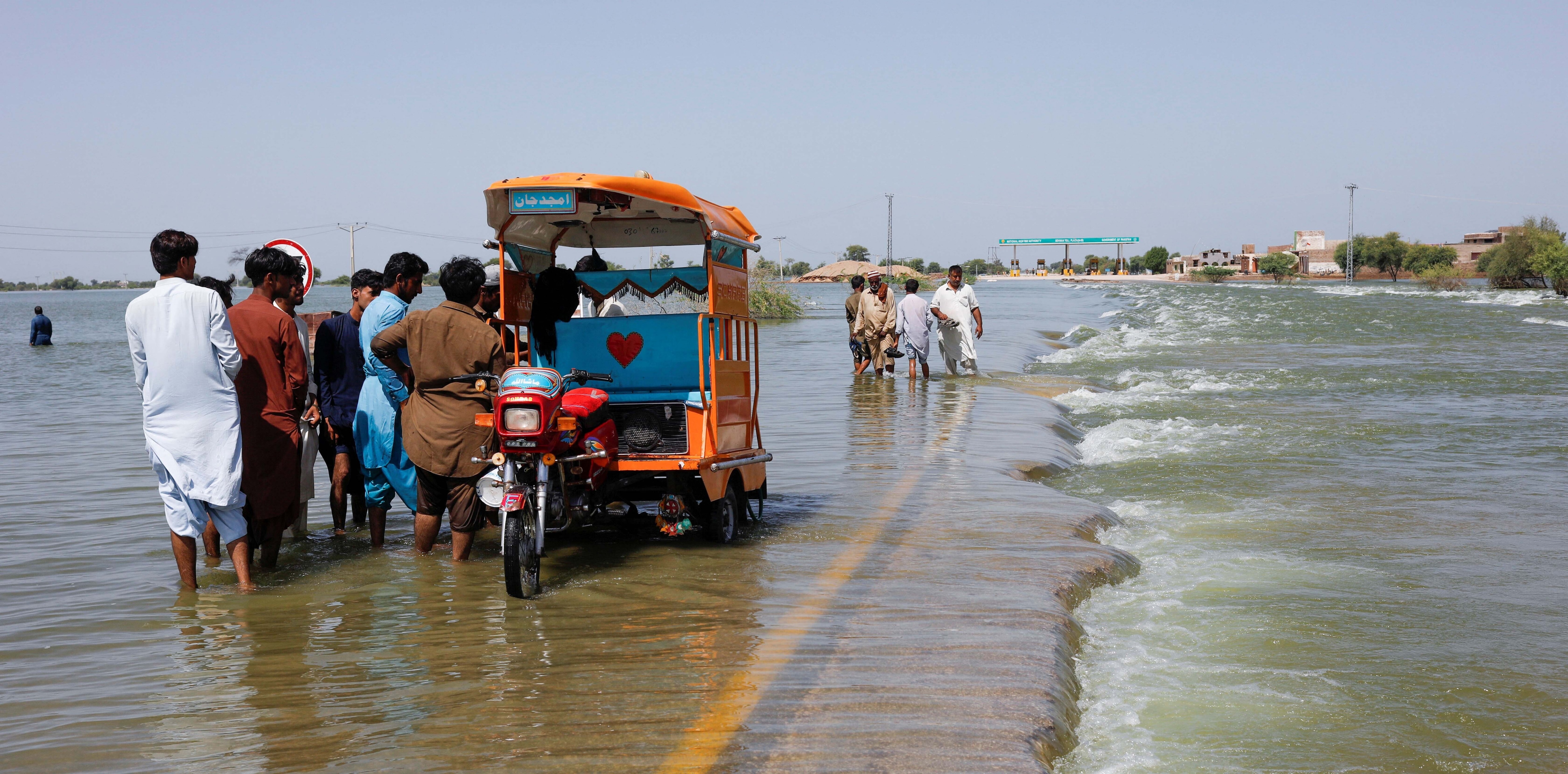
Southern Asian is particularly at risk from climate disasters, such as the floods which hit Pakistan in 2022.. Image: Reuters/Akhtar Soomro
- Southern Asia has a young population but whether this generation finds opportunity depends on policy decisions made now.
- The region faces challenges posed by the convergence of three risks: debt alongside critical changes to Earth systems and pollution.
- The resulting shocks become multiplicative in their effect and tackling them requires shared solutions across borders.
Southern Asia is one of the youngest regions on Earth. Hundreds of millions of young men and women reaching working age over the next decade, will shape its future. Whether that generation finds opportunity or frustration will depend on decisions being made right now, in government offices and corporate boardrooms across the region.
Each year, the World Economic Forum asks thousands of senior business leaders around the world about the risks they are most worried about in the Executive Opinion Survey.
In Southern Asia – a region that includes India, Pakistan, Bangladesh, Sri Lanka, Nepal, and their neighbours – the results reveal three challenges that are converging in ways that make each one harder to solve. These challenges are converging on each other, compounding their effects and crossing borders in their implications.
Debt and disasters collide and cluster
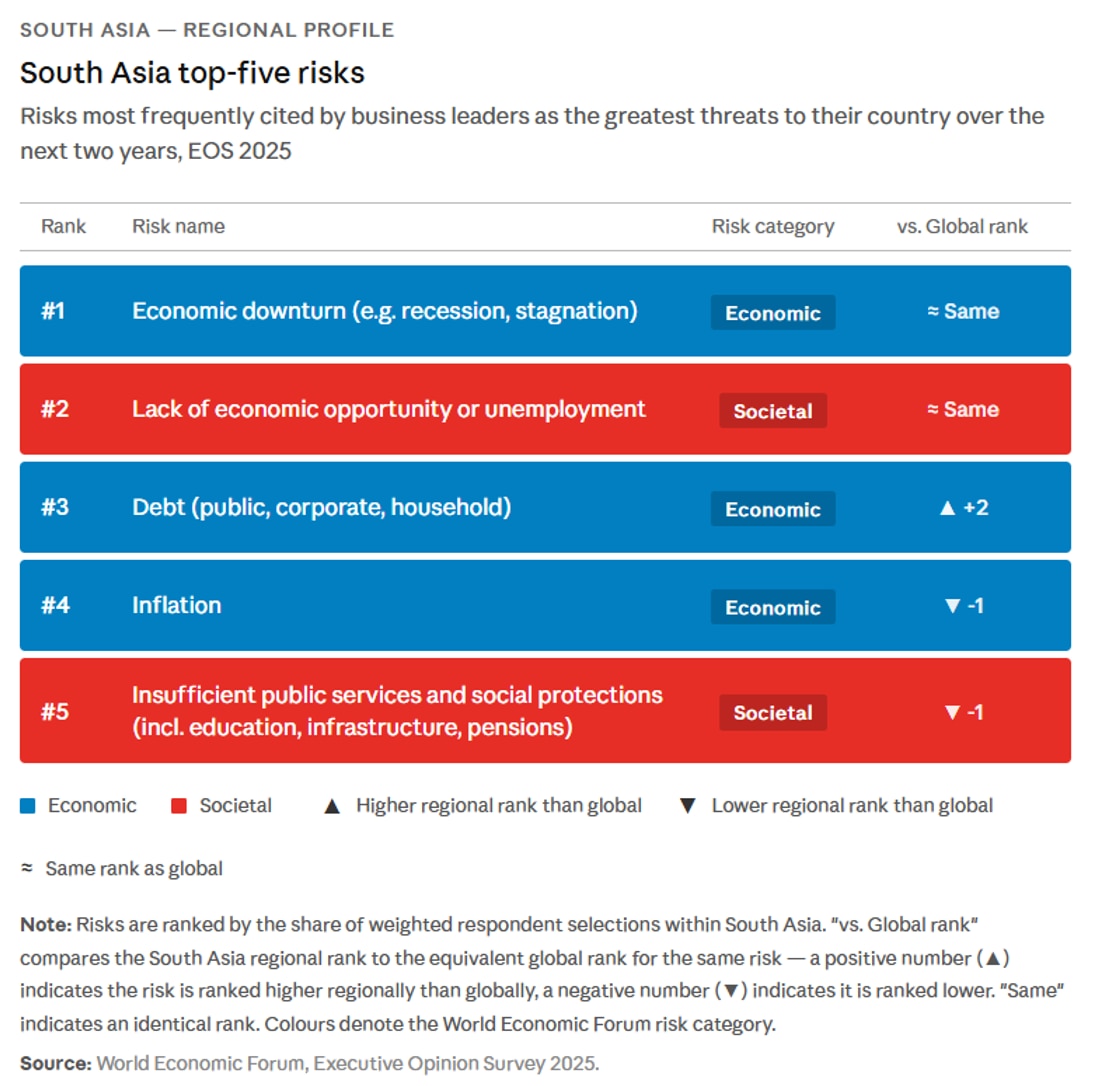
Business leaders in Southern Asia worry about debt more than their counterparts in most other parts of the world.
Debt (public, corporate, household) ranks as the third most serious concern in the region, compared to fifth globally. That alone would be manageable. But on top of it, the same groups of leaders flag environmental risks far more urgently than the global average: Critical changes to Earth systems and pollution (air, water, soil) do not stop at national borders.
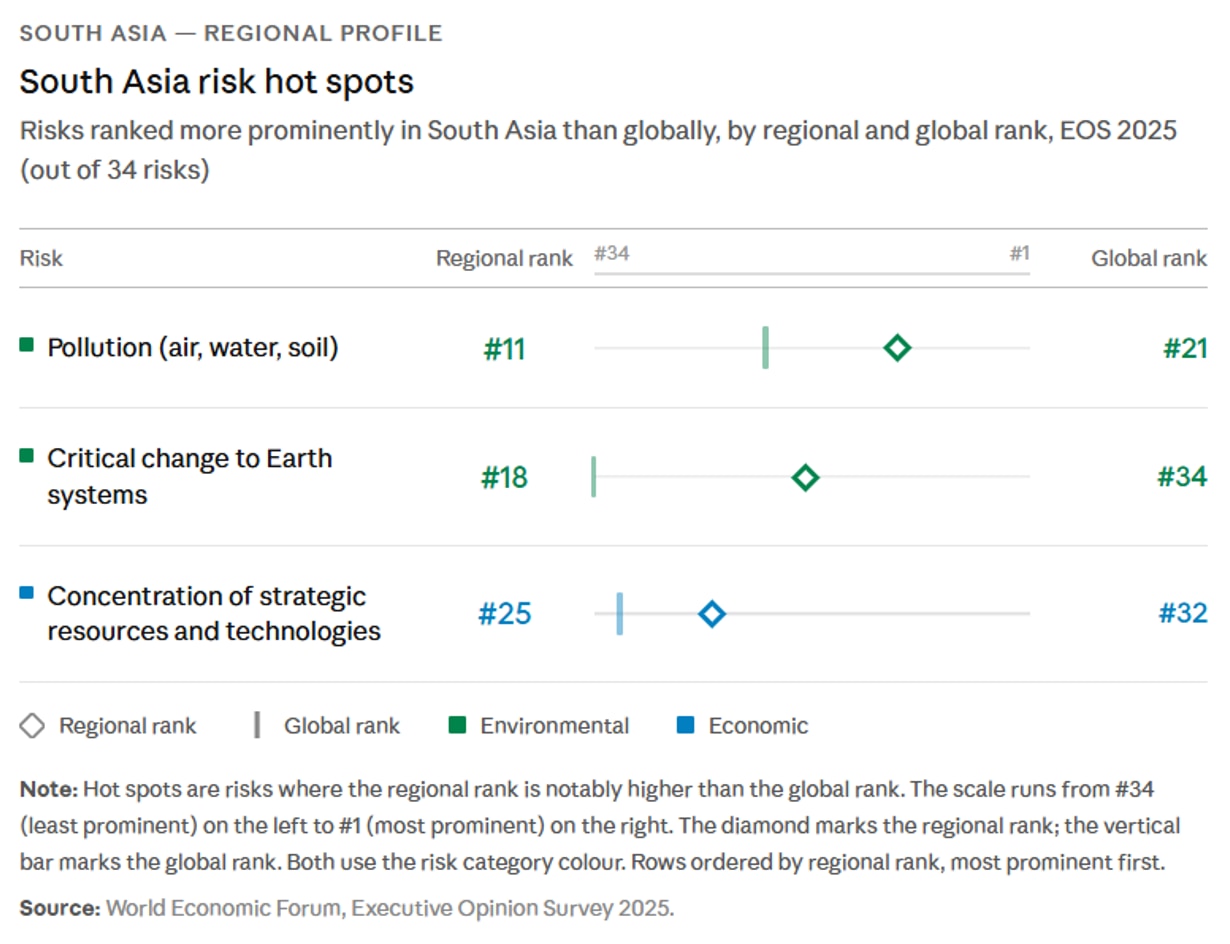
The collision between these two risks is where the real danger lies. When risks cluster and converge, the resulting shocks become multiplicative in their effect rather than simply additive.
In 2022, Pakistan experienced flooding so severe it caused more than $15 billion in total economic losses, at the very moment the country was negotiating emergency support from international lenders.
In Sri Lanka, roughly half of the entire government budget for 2026 goes just to paying interest on its debts, leaving almost no room to invest in the flood barriers, early-warning systems, or roads that would make the next disaster less catastrophic.
Have you read?
When a climate shock hits a country that is already stretched thin financially, the costs spiral. And the next disaster is more likely to happen, because the investment to prevent it never came.
Business leaders in the region are clearly diagnosing this problem. Their risk perceptions show they understand the connections. But diagnosis is not the same as treatment. Southern Asia currently receives a disproportionately small share of the global funding available for climate adaptation.
A reworking of how financial risk is shared internationally, including debt relief, affordable loans for resilience projects and better insurance tools, would help match the scale of the challenge that leaders are already describing.
A young region that needs quality jobs, fast
By 2035, Southern Asia could be home to around 300 million people aged between 15 and 24, the largest youth cohort the region has ever produced. That is an extraordinary opportunity, a generation ready to learn, work and build. But only if the jobs and the skills are there to meet them.
Right now, the gap is wide. More than half of young people in South Asia are not on track to have the education and skills they will need for the jobs available in 2030, according to UNICEF. Women face an especially steep barrier: in most countries in the region, women participate in the formal workforce at roughly half the rate of men.
Responses from the business leaders surveyed reflect this reality. They consistently rank economic downturn and lack of economic opportunity or unemployment among their top concerns. This shows the daily pressures felt by households and firms across the region.
When growth happens but does not translate into stable incomes or real career pathways, trust erodes. People feel left behind. Governments face pressure to offer short-term fixes rather than the structural investments – in schools, in skills training, in formal labour market pathways – that actually change long-term trajectories.
And a large cohort of economically excluded young people who are highly connected online is, as the region has already seen, more vulnerable to the kind of radicalization that deepens social divisions.
The region has already seen this dynamic in motion: youth-driven political upheavals have reshaped governments in Bangladesh, Pakistan and Sri Lanka in recent years, confronting new leaders with a daunting set of expectations they must now fulfil. The jobs question is now central to the region’s political stability.
Young people across Southern Asia have expressed clear aspirations: they want better education and the economic opportunities that should follow. Meeting those aspirations with real investment is the most durable way to reduce the knock-on risks that come from disillusionment.
Risk rankings across Southern Asia are strikingly similar
There is something striking in how similar the risk rankings look across Southern Asian countries. Business leaders in India, Pakistan, Bangladesh, Sri Lanka and Nepal are largely worried about the same things. That convergence is actually a rare opportunity: when people across borders share a diagnosis, coordinated action becomes possible.
The problem is that the risks travel across borders, but the political systems designed to address them mostly do not. Air pollution does not pause at checkpoints. River systems and monsoon patterns link upstream countries to downstream ones regardless of diplomatic tensions. Labour migration and remittances mean that job creation in one country affects household income in another.
Yet the political conditions in the region, with multiple countries navigating significant transitions in recent years, from Bangladesh to Pakistan to Sri Lanka and Nepal, naturally pull attention inward.
Managing a transition of government is hard and domestic priorities are legitimate. But if the political economy consistently rewards national responses over regional ones, appeals to shared interest are not enough. The fix must be built into the design of institutions and agreements, so that cooperation can survive political cycles rather than depending on them.
One structural reality shapes all of this: India is many times larger than every other economy in the region. Nonetheless, the case for regional cooperation rests on considerations of interdependence.
Climate shocks, youth unemployment and sovereign debt stress travel across borders regardless of economic size. No country in the region can be successful by itself to be insulated from its neighborhood. That mutual logic is what makes regional frameworks durable when design moves from principle to practice.
Some of that practice is already visible. There are already signs that more practical, sector-specific frameworks can make progress. The Bay of Bengal Initiative for Multi-Sectoral Technical and Economic Cooperation, a grouping that deliberately focuses on concrete sectors like trade, energy, connectivity and disaster management, is one example of coordination that separates technical work from political disputes.
In a region where political consensus is often elusive, quiet technical functionality will be of far greater practical value. If the region can do more of presenting unified positions when negotiating debt relief or climate finance with external partners, building shared infrastructure that makes every country more resilient, it will be better placed to tackle the challenges its own business leaders are already identifying.
The business leaders surveyed see the risks clearly. What the data reflects is a region that has accurately mapped its own vulnerabilities, and how they interact and cluster: the fiscal-climate collision, the youth opportunity gap and the coordination deficit. And the region is now working out how to act on that awareness before the risks compound further.
The decisions that matter are not being made in any single capital, but in finance ministries, at multilateral negotiating tables and in the boardrooms of companies deciding where to invest and who to hire. A region that already shares a diagnosis has everything it needs to start sharing the solution.
Additional insights and contributions by Mark Elsner, Tanoubi Ngangom and Kaushiki Singh Shrinet.
License and Republishing
World Economic Forum articles may be republished in accordance with the Creative Commons Attribution-NonCommercial-NoDerivatives 4.0 International Public License, and in accordance with our Terms of Use.
The views expressed in this article are those of the author alone and not the World Economic Forum.

Forum Stories newsletter
Bringing you weekly curated insights and analysis on the global issues that matter.


