What’s next for US–China relations? 5 areas ripe for cooperation

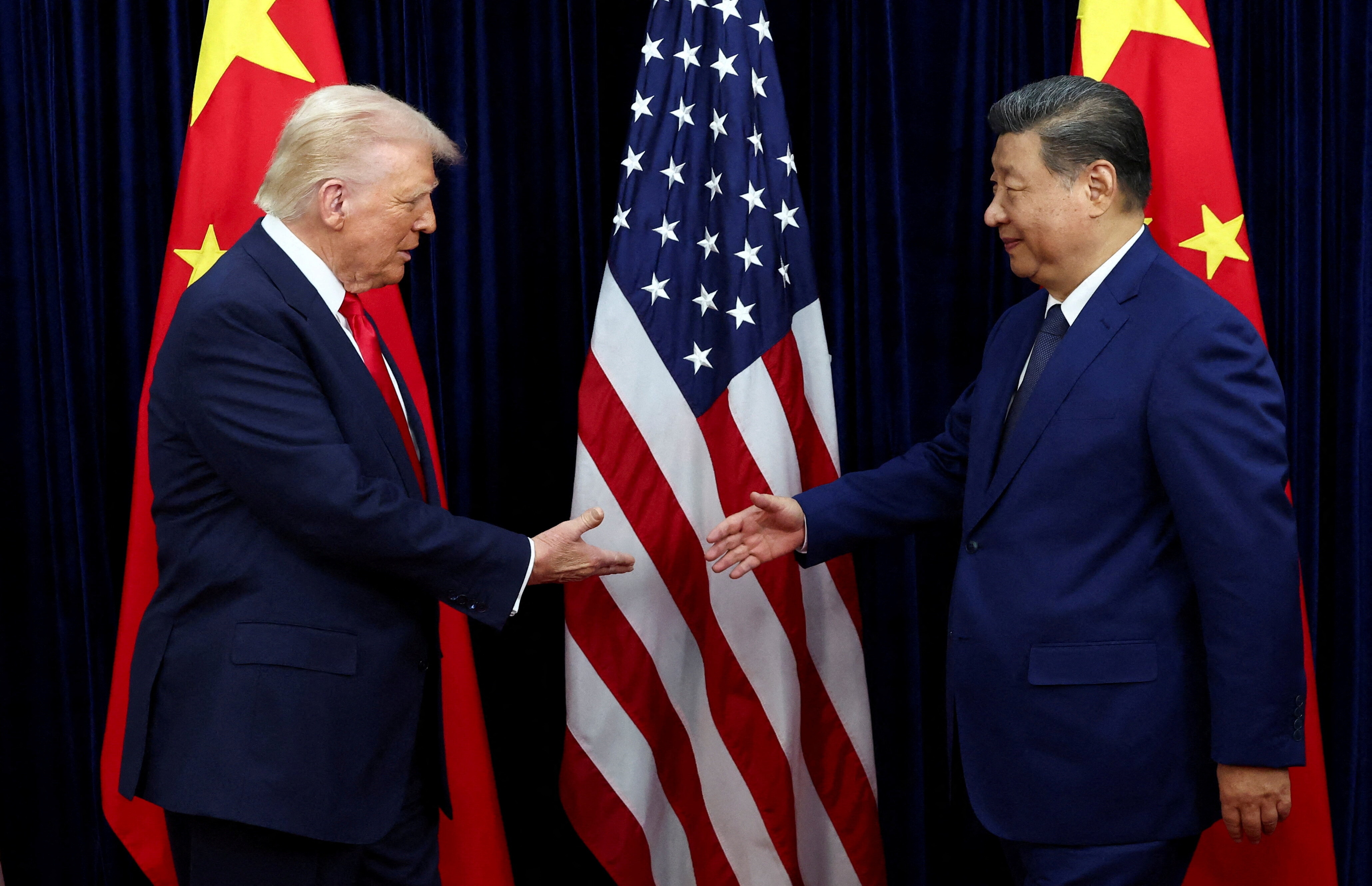
US President Donald Trump and Chinese President Xi Jinping are planning to meet in Beijing this month. Image: REUTERS/Tingshu Wang
- US President Donald Trump and Chinese President Xi Jinping are expected to meet in the coming weeks.
- The summit comes as the relationship between the world’s two largest economies is being significantly impacted by geopolitical shocks.
- We asked five experts where US–China cooperation may still be possible. Here's what they had to say.
As preparations proceed for the summit between US President Donald Trump and Chinese President Xi Jinping in Beijing, the relationship between the world’s two largest economies has been impacted by a particularly volatile global context.
Despite a recent détente between the two countries’ leaders, fundamental differences remain on some core issues and the war in the Middle East is adding a new layer of complexity.
When Presidents Trump and Xi met in Busan in October 2025, they negotiated a one-year truce and agreed on guidelines aimed at stabilizing what both sides described as mutually beneficial economic relations. The meeting followed a turbulent year in which Washington imposed tariffs of up to 145% on Chinese imports and Beijing restricted supplies of critical rare earth elements, rattling global markets and accelerating efforts on both sides to de-risk key economic dependencies.

The Busan meeting signalled an effort to move the relationship toward a more transactional and business-like equilibrium; one defined not by the absence of competition, but by managed strategic competition that allows space for cooperation where interests overlap. Yet recent geopolitical shocks, including the Iran war, highlight the limits of this approach: while both countries seek to insulate their economies and avoid direct confrontation, neither is positioned to fully contain the systemic risks emerging from an increasingly fragmented and contested global landscape.
Furthermore, both governments see the private sector as key to stabilizing US–China relations. Companies today, however, face a new reality where geopolitical risks such as energy disruptions and supply chain fragmentation are central to business strategy.
To explore where US–China cooperation is still possible, we asked five experts to examine the practical areas that are mutually beneficial and could offer stability to the global economy. Some areas involve relatively technical or operational cooperation – the so-called low-hanging fruit – that can proceed even during periods of tension. Others, such as nuclear cooperation, are politically far more difficult but carry much higher stakes for global security.
The overall message from the five experts is clear: broad political alignment may be unlikely, but focused cooperation on specific risks remains both possible and necessary.
Here’s what the experts had to say.
Zongyuan Zoe Liu, Senior Fellow for China Studies, Council on Foreign Relations
Financial stability and reciprocal risk
Despite efforts to de-risk, the US and Chinese economies remain interconnected enough and large enough that a serious financial shock in either would reverberate across global markets, making mutual exposure unavoidable. Even conflicts that do not directly pit the two countries against each other still transmit financial risk to both. The near-closure of the Strait of Hormuz has hit each side differently, but they face the financial volatility it creates.
This mutual vulnerability creates a powerful incentive for limited cooperation focused on risk management.
Yet the institutional channels that once facilitated such cooperation have significantly weakened. Meanwhile, new sources of systemic risk have emerged, especially in digital finance and diverging regulatory frameworks.
One promising area for cooperation is technical coordination on financial stability tools, including early-warning protocols for digital asset risks, information-sharing on reserve standards and parallel regulatory pilots to address emerging risks in tokenized finance.
Another potential avenue lies in sovereign debt restructuring. US and Chinese institutions are among the largest holders of emerging market sovereign debt. Fragmented restructuring processes, as seen in Zambia and Sri Lanka, have prolonged crises and deepened losses.
Even modest coordination through multilateral frameworks could accelerate recovery and stabilize global markets. The goal is not financial integration or policy alignment. Rather, the focus should be on pragmatic guardrails that recognize a basic reality: unmanaged financial shocks would harm both economies – and the global system. The window for building these guardrails is narrow: the Busan trade truce expires in November 2026, and with it, much of the political space that makes even limited cooperation possible.
Philip Reiner, CEO and Co-Founder, Institute for Security and Technology
Safeguards around AI ‘coopetition’
Artificial intelligence is often framed as the central arena of US–China technological competition. Yet it is also an area where shared risks are becoming increasingly evident.
AI is both a driver of rivalry and a source of systemic risk for global markets and societies.
Rapid deployment of AI systems is already affecting labour markets, operational stability and financial systems. These risks transcend national borders and cannot be managed by any one country alone.
Cooperation may be most realistic in “pre-competitive” areas – domains that reduce shared risks and potentially create opportunities for renewed trust and collaboration without exposing strategic capabilities.
One example is incident reporting. Establishing a common definition of an “AI incident” could allow companies to report system failures anonymously through neutral platforms such as international research consortia. The goal would be not to share technology, but to understand failure modes and prevent cascading risks.
Another potential area is benchmarking safety standards for AI models, including robustness, misuse resistance and interpretability. Voluntary evaluation frameworks hosted by neutral institutions could help multinational firms manage operational risks across both markets.
Even limited collaboration on creating and sharing safety fixes for widely used open-source safety tools or assessing labour-market impacts through anonymized research could improve the reliability of AI systems while reducing political sensitivities.
Certain areas will remain firmly off-limits. These include advanced semiconductor technologies, military applications and frontier AI capabilities. But targeted cooperation on safety and risk management could still help stabilize the global technology ecosystem without compromising national security or political redlines.
Stephen Kehoe, Executive Vice President and Chief Corporate Affairs Officer, PepsiCo; Chairman, PepsiCo Foundation
Shared resilience and food security
Food security is emerging as a domain in which US and Chinese interests overlap. Climate pressures, supply-chain fragility and rising food prices have transformed agricultural stability into a strategic concern for both governments.
Extreme weather events, water scarcity and soil degradation are increasingly acting as “risk multipliers” across the global food system. As the world’s largest producers and consumers of agricultural products, the United States and China play a central role in maintaining market stability.
Cooperation may be most feasible in practical, science-based areas that avoid sensitive technologies. These include shared research on soil health, fertilizer efficiency and climate-resilient farming practices. Improving post-harvest storage, logistics and cold-chain management could also reduce food losses while strengthening global supply resilience.
Multilateral institutions such as the Food and Agriculture Organization and the Consultative Group on International Agricultural Research provide politically neutral platforms where both countries can contribute to global agricultural resilience. Importantly, the aim is not to eliminate competition. Both countries will continue pursuing self-sufficiency strategies and diversifying supply chains.
Instead, the focus should be on predictability and stability – ensuring that policies affecting global food markets are transparent and well-signalled to avoid unnecessary disruptions.
Eric Luo, Vice President, and Grace Sun, Strategic Marketing Head, LONGi Green Energy Technology
Clean energy and competition
The global energy transition is an arena in which strategic rivalry and shared interests coexist.
Solar power, battery storage and critical minerals now sit at the intersection of climate policy, industrial strategy and national security. Tariffs, localization requirements and supply-chain restrictions have made competition in these sectors increasingly intense.
Yet both countries remain indispensable to global decarbonization.
China’s scale-driven manufacturing ecosystem and the United States’ capital markets and innovation networks together shape the global clean-energy landscape.
This interdependence creates space for cooperation in areas that improve transparency and resilience without undermining industrial strategies.
One opportunity lies in developing shared standards for supply-chain traceability, carbon intensity and environmental due diligence. Industry-led frameworks such as digital product passports and standardized reporting metrics could reduce regulatory fragmentation and help companies operate across markets.
Another area is supply-chain resilience. Mapping bottlenecks in materials such as polysilicon, quartz and battery inputs could allow industry to anticipate disruptions while diversifying production. Joint work on recycling technologies, green hydrogen standards and grid-integration research could also accelerate innovation in non-sensitive areas.
At the same time, structural competition will continue. Industrial policies such as the US Inflation Reduction Act and China’s manufacturing strategies are likely to drive long-term divergence in clean-energy supply chains. The challenge, therefore, is not to eliminate competition, but to manage it in ways that keep global climate progress on track.

David Santoro, President and CEO, Pacific Forum
Strategic stability and nuclear risks
Cooperation on strategic stability is among the most consequential – and perhaps the most difficult – areas for engagement.
Recent conflicts, including the war involving Iran, have renewed global concerns about escalation risks and the dangers posed by poorly managed or ambiguous nuclear capabilities. In such an environment, reducing uncertainty among major powers becomes even more important.
At the same time, the risk of misinterpreting missile launches is rising as new technologies such as hypersonic weapons and dual-use systems shorten decision timelines.
Unlike the Cold War, the United States and China currently lack robust notification mechanisms for missile tests. This increases the risk that routine tests could be misread as hostile actions, potentially triggering dangerous escalation.
One practical solution would be a pre-launch missile notification agreement similar to those that exist between other nuclear powers. Initial steps could focus on relatively low-sensitivity areas, such as space-launch vehicles or missile-defence tests, while gradually expanding transparency measures over time.
The private sector also has a stake in these efforts. Satellite operators, airlines, insurers and global logistics companies all bear economic costs when strategic instability disrupts airspace, shipping routes or supply chains.
By quantifying these risks and advocating for transparency measures, businesses could help build momentum for confidence-building agreements.
Cooperation in a competitive era
Taken together, these proposals reflect a broader shift in how business and think tank experts view US–China relations.
Large-scale diplomatic breakthroughs may be challenging in the current geopolitical environment. But smaller, practical steps – focused on shared risks rather than political alignment – can be achievable and deliver meaningful results.
For business leaders, this approach may feel familiar. Companies routinely compete fiercely while cooperating on safety standards, infrastructure and systemic resilience. A similar model of “coopetition” may now be emerging at the geopolitical level.
In an era of intensifying strategic rivalry, the most durable forms of cooperation may not come from grand bargains but from narrow, pragmatic efforts to manage the risks that both countries share.
License and Republishing
World Economic Forum articles may be republished in accordance with the Creative Commons Attribution-NonCommercial-NoDerivatives 4.0 International Public License, and in accordance with our Terms of Use.
The views expressed in this article are those of the author alone and not the World Economic Forum.
Contents
Zongyuan Zoe Liu, Senior Fellow for China Studies, Council on Foreign RelationsPhilip Reiner, CEO and Co-Founder, Institute for Security and TechnologyStephen Kehoe, Executive Vice President and Chief Corporate Affairs Officer, PepsiCo; Chairman, PepsiCo FoundationEric Luo, Vice President, and Grace Sun, Strategic Marketing Head, LONGi Green Energy TechnologyDavid Santoro, President and CEO, Pacific Forum
Forum Stories newsletter
Bringing you weekly curated insights and analysis on the global issues that matter.
More on Geo-Economics and PoliticsSee all

Akanksha Khatri
September 15, 2026