How China’s transition economy is redefining the corporate board

Boardroom governance quality is rapidly becoming a primary indicator of long-term corporate competitiveness in China. Image: Benjamin Child/Unsplash
- China’s 15th Five-Year Plan is pushing corporate boards to elevate climate governance to a core strategic priority.
- Boardroom governance quality is rapidly becoming a primary indicator of long-term corporate competitiveness in China.
- How promising ideas become scalable impact is a key focus at the World Economic Forum’s Annual Meeting of the New Champions, also known as Summer Davos, in China from 23–25 June.
China’s 15th Five-Year Plan (FYP), 2026–2030, marks a pivotal phase in the country’s economic transformation. As climate, industrial and economic policy become more closely integrated, corporate boards are being pulled into a fundamentally new leadership role. Decisions once treated as sustainability matters now shape competitiveness, market access, capital flows and financial costs, technological positioning, and strategic and long-term resilience.
The boardroom is emerging as a critical driver of China’s transition agenda. Over the next decade, governance quality may become as important to corporate competitiveness as technology capability, market scale or capital access.
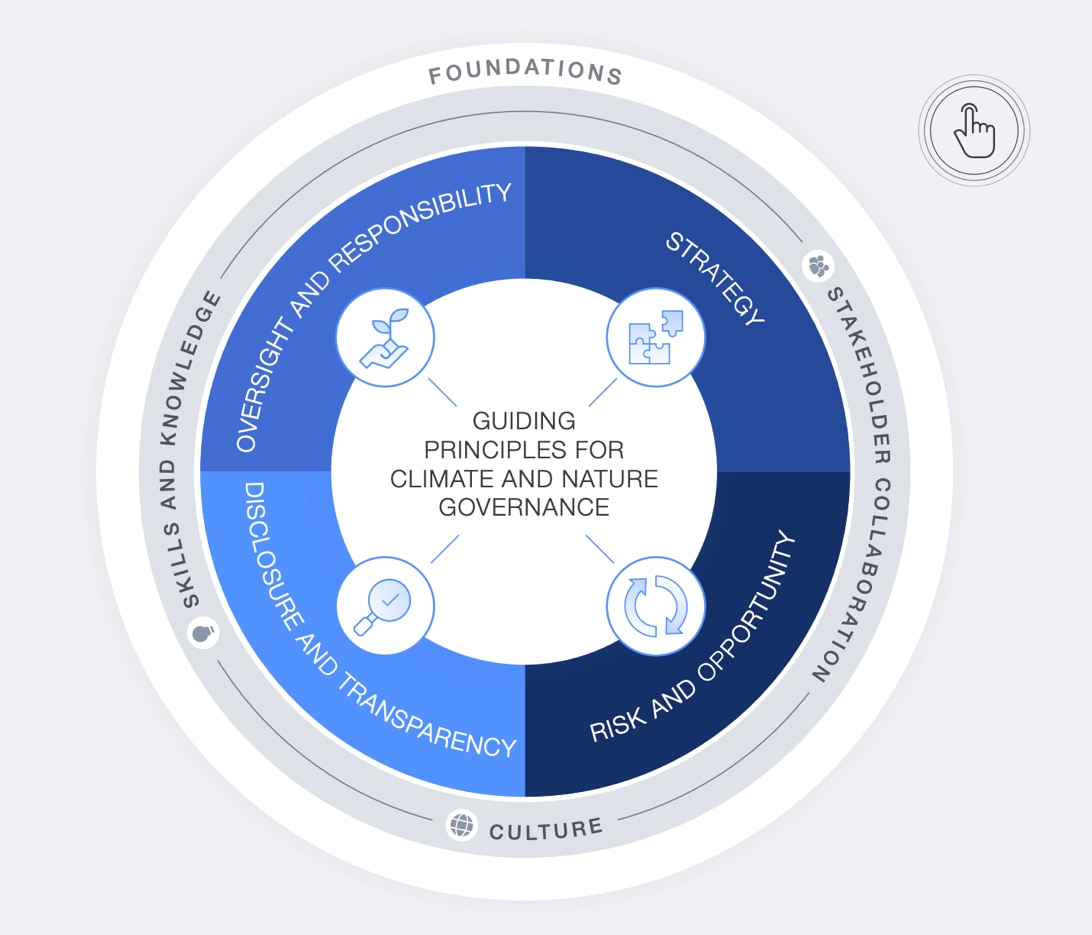
This is the central premise of the World Economic Forum’s Guiding Principles for Climate and Nature Governance, which frame climate and nature governance not as standalone sustainability issues, but as core business and governance challenges.
The governance shift behind China’s transition agenda
China’s 15th FYP reflects a broader shift towards coordinated structural transformation, where climate policy, industrial innovation, energy security and economic resilience are increasingly treated as interconnected priorities. Decarbonization is no longer viewed solely as an environmental objective; it is becoming a core component of China’s strategy for strengthening industrial competitiveness, technological leadership and long-term economic security.
This direction is reflected in several major policy developments, including the 15th FYP’s carbon and energy targets, the Environmental Code taking effect in August 2026, and the government’s 109 Key State Projects supporting clean energy, advanced manufacturing and green infrastructure. It is also evident in the accelerated rollout of product carbon-footprint management systems, supply-chain standards, and the growing integration of sustainability objectives into industrial finance, procurement and state capital allocation.
At the same time, evolving trade requirements and geopolitical fragmentation are increasing the importance of carbon competitiveness, supply-chain resilience and access to strategic industrial inputs. As climate and ecological considerations become embedded within the architecture of economic governance and industrial policy, boards face a more complex operating environment in which governance decisions increasingly influence market access, financing conditions, technology strategy and operational resilience.
Unlike many markets where the transition is driven primarily by investor or regulatory pressure, China’s transition is being shaped through coordinated industrial, financial and economic policy. This places boards at the intersection of national development priorities and corporate strategy.
In this environment, Chinese boards are increasingly serving as translators between national transition priorities and corporate decision-making. Their role is not only to oversee compliance or manage risk, but to interpret evolving policy signals, guide capital allocation, and ensure that business strategy remains aligned with emerging economic and industrial priorities.
For boards, sustainability governance is therefore evolving from a compliance exercise into a strategic leadership responsibility that will help determine how effectively organizations navigate China’s transition-oriented economy.
The Guiding Principles provide a practical governance framework for boards navigating this transition. In the context of China’s 15th FYP, four governance dimensions are becoming particularly important: oversight and accountability; strategy and capital allocation; risk and opportunity management; and disclosure and transparency.
Oversight and accountability
China’s evolving regulatory framework is placing greater emphasis on governance accountability. The Ecological and Environmental Code, effective August 2026, elevates ecological governance into a statutory duty with stronger enforcement and liability provisions.
For boards, this means:
- Clarifying oversight responsibilities for climate and nature-related issues.
- Ensuring management accountability for transition performance.
- Strengthening board-level governance structures and reporting mechanisms.
- Linking executive incentives to long-term transition objectives.
Strategy and capital allocation
China’s economic model is shifting from volume-driven growth towards value-driven growth centred on innovation, resilience and sustainability. Policy support and state capital are increasingly directed towards clean energy, advanced manufacturing, green materials, circular economy solutions and digital infrastructure.
For Chinese boards, strategic planning increasingly requires understanding how national priorities, industrial policy and capital flows are shaping future sources of competitive advantage.
For boards, key strategic questions include:
- How exposed is the portfolio to carbon-intensive assets and transition risks
- Which sectors and technologies are likely to benefit from policy support and market growth?
- How should capital allocation decisions incorporate transition opportunities
- How can supply-chain decarbonization, resource efficiency and circularity create long-term value?
The companies best positioned for the next decade may be those whose boards recognize climate and nature governance as a core driver of competitiveness and value creation.
Risk and opportunity management
China’s transition agenda is reshaping the corporate risk landscape. Climate and nature-related risks are becoming increasingly interconnected with trade policy, geopolitical fragmentation, technological change and supply-chain disruption.
For boards, material considerations include:
- Transition risks associated with changing technologies, regulations and market expectations.
- Physical climate risks such as extreme weather, flooding and water stress.
- Carbon competitiveness and evolving market-access requirements, including trade-related carbon measures.
- Competition for critical minerals and strategic industrial inputs.
- Potential asset-stranding risks as low-carbon alternatives scale.
These developments require boards to integrate climate and nature considerations into enterprise risk management, strengthen scenario analysis and stress testing, and improve long-range strategic planning capabilities.
While these risks are significant, the transition is also creating new growth opportunities in clean energy, advanced manufacturing, circular economy solutions, and low-carbon technologies that align with China’s industrial and innovation priorities. Boards that successfully navigate the transition may be better positioned to capture policy support, access emerging markets and strengthen long-term competitiveness.
Disclosure and transparency
Transparency is becoming a strategic differentiator in China’s transition economy. The 15th FYP places growing emphasis on data quality, standardized reporting, digital monitoring systems and product carbon-footprint management.
The Ministry of Finance, along with nine ministries and departments, issued the Corporate Sustainability Disclosure Standards No. 1 – Climate (Trial), and Sustainability Information Assurance Services Standards No. 6101 – Basic Standards (Trial) in 2026.
For boards, priorities include:
- Ensuring the quality, consistency and credibility of sustainability disclosures.
- Strengthening supply-chain traceability and emissions reporting systems.
- Preparing for greater interoperability with international disclosure frameworks.
- Using disclosure as a tool to build investor confidence.
High-quality disclosure is no longer simply a reporting exercise. It is increasingly becoming a source of trust, financing access and competitive advantage.
The new leadership challenge for boards
This is the central message of the Guiding Principles: governance quality is becoming a defining factor in organizational resilience, competitiveness and long-term value creation.
For Chinese boards, the principles are ultimately about more than climate and nature governance. They provide a framework for strengthening oversight, guiding capital allocation, managing interconnected risks and building trust through transparency during a period of profound economic transformation. As boards increasingly serve as a bridge between national development priorities and corporate competitiveness, their ability to translate China’s transition agenda into strategy and execution may determine which organizations lead in the next phase of economic development.
To learn more about some of the issues discussed in this article, read the full briefing paper, Climate and Nature Governance in China’s 15th Five-Year Plan.
Don't miss any update on this topic
Create a free account and access your personalized content collection with our latest publications and analyses.
License and Republishing
World Economic Forum articles may be republished in accordance with the Creative Commons Attribution-NonCommercial-NoDerivatives 4.0 International Public License, and in accordance with our Terms of Use.
The views expressed in this article are those of the author alone and not the World Economic Forum.
Stay up to date:
Corporate Governance


Forum Stories newsletter
Bringing you weekly curated insights and analysis on the global issues that matter.