Gender parity in senior leadership: progress at a turning point

Gender parity has still not been reached across leadership positions. Image: Getty Images for Unsplash+
- Women are present in senior leadership, but remain scarce in the most powerful positions, such as CEO roles and board chair positions.
- Progress at the top is losing momentum: Hiring of women for C-suite roles has stalled since 2022, while board appointments show early signs of regression.
- Closing gender gaps at the top requires redesigning leadership systems and sustained collaboration between the public and private sectors.
Over the past decade, there have been gradual gains for women in corporate leadership. Yet the pace of progress is slowing and, in some areas, beginning to slip.
This comes at a pivotal moment for business. Artificial intelligence, economic volatility and demographic change are reshaping how organizations operate, compete and lead. As traditional career models and leadership structures evolve, companies have an opportunity to broaden the pathways to the top, rather than reproduce the patterns of the past.
The World Economic Forum’s Insight Report: Closing the Gender Gap in Senior Leadership, produced as part of the Global Gender Parity Sprint initiative and in collaboration with the LinkedIn Economic Graph Research Institute and Egon Zehnder, examines where progress has been made, where it is stalling and how organizations can redesign leadership systems to draw on the full range of available talent.
Why aren't women advancing across all leadership pathways?
Women’s representation in top management has grown over the past decade, slightly outpacing gains in the overall workforce. But the progress is uneven and the closer roles sit to traditional enterprise authority and technology, the thinner women’s representation becomes.
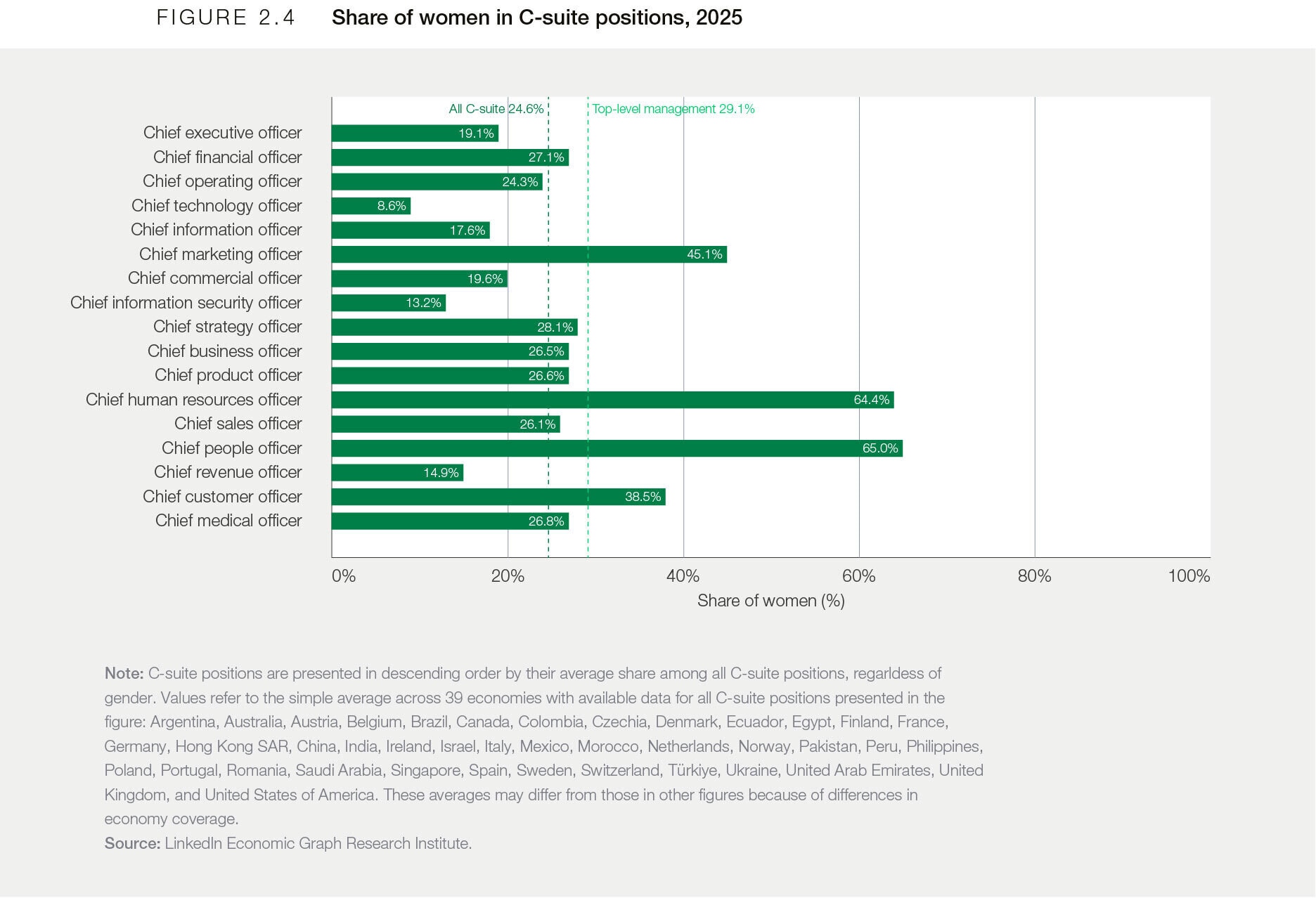
LinkedIn data shows that women hold 24.6% of C-suite roles, but only 19.1% of CEO positions. Their representation is strongest in people-focused and market-facing roles: women account for around two-thirds of chief human resources officer (CHRO) and chief people officer (CPO) roles and just under half of chief marketing officer (CMO) roles.
Yet they remain far less represented in roles that more often serve as pathways to the CEO seat or sit at the centre of technological transformation. Women hold only around one-quarter of chief financial officer (CFO) and chief operating officer (COO) roles, positions with direct links to revenue, operations and enterprise performance and they are further underrepresented in technology leadership, accounting for fewer than one in five chief information officers and only 8.6% of chief technology officers (CTO).
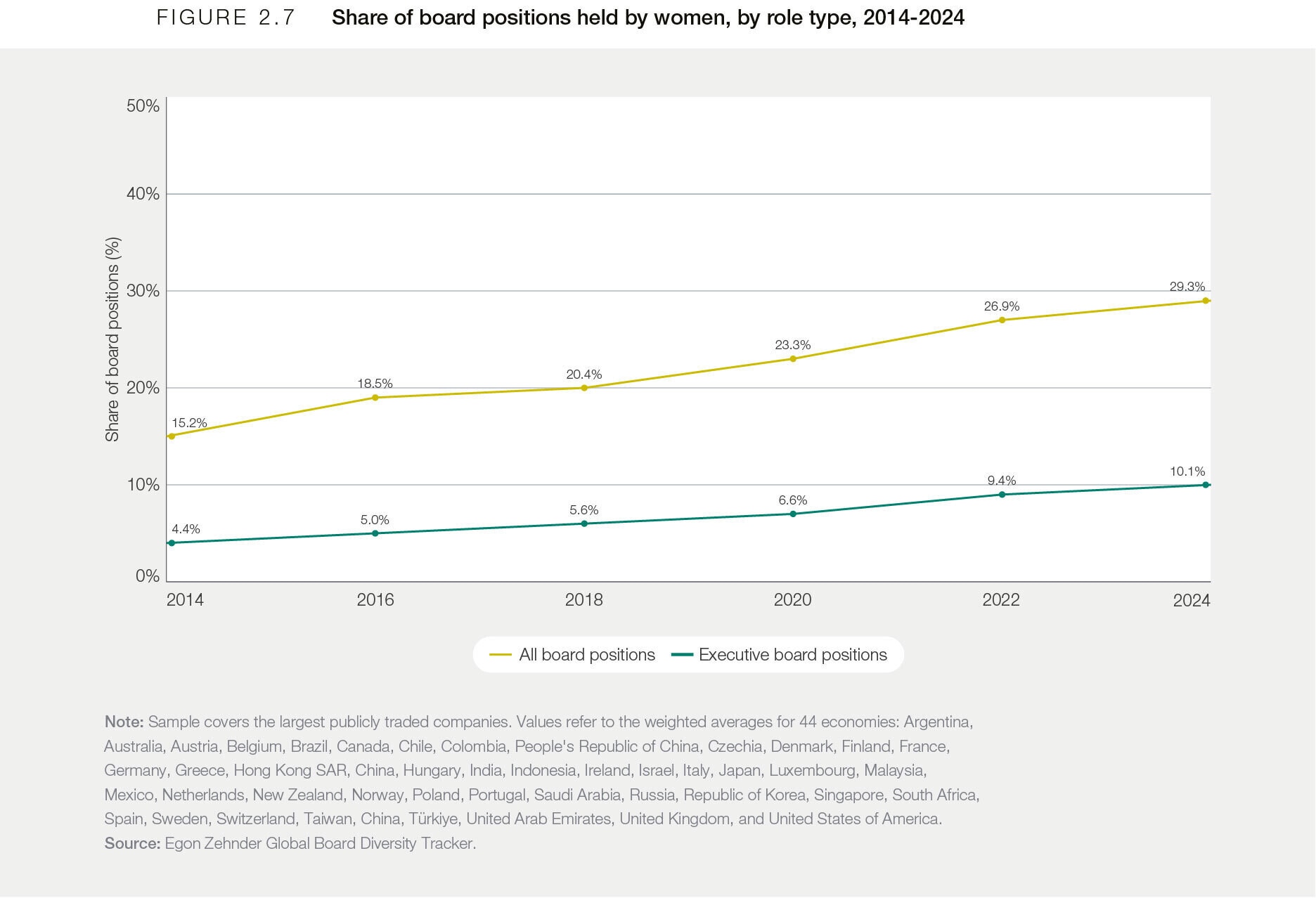
Boards show a similar distinction between representation and power. According to Egon Zehnder, more than nine in ten boards now include at least one woman and women hold 29.3% of board seats across the largest publicly traded companies, nearly double the share of a decade ago. Yet, women account for only one in ten executive board roles and around 5% of board chair positions. In other words, representation has improved, but influence remains unevenly distributed.
Tenure and age data point to a further divergence in leadership trajectories. Across the largest publicly-traded companies, Egon Zehnder data shows that women CEOs serve an average of 3.7 years, compared with 5.2 years for men; among CFOs, women serve an average of 3.4 years, compared with 4.1 years for men.
At the same time, women board members are, on average, younger than their male peers: 59.8 years old, compared with 62.3 years for men. Taken together, women’s shorter tenures in powerful C-suite roles and earlier entry into board positions may suggest a shift away from operational leadership at an earlier stage. While board service remains an important form of influence, it differs from the direct executive authority associated with CEO, CFO and COO roles.
Progress at the top is losing momentum
Hiring data from LinkedIn suggests that progress in the C-suite is losing pace. The share of women among new C-suite hires rose from 20.2% in 2015 to 26.6% in 2022, but has since plateaued at around 27%.
The same pattern appears across individual C-suite roles. Women’s share of CEO hires increased from 15.3% in 2015 to 20.1% in 2022, an annualized growth rate of 3.9%. Between 2022 and 2025, it rose only slightly, to 21.1%, slowing to an annualized rate of 1.7%.
The chief technology officer role shows a similar stall. Women’s share of CTO hires rose from 6.0% in 2015 to 9.0% in 2022, the fastest increase among the major C-suite roles examined. Since then, however, it has fluctuated to around 9%.
Board appointments show early indications of a slowdown. Egon Zehnder data shows that women’s share of new board appointments declined slightly, from 35.2% in 2022 to 34.9% in 2024. While not yet conclusive, this trend signals that gains cannot be taken for granted.
Why do gender gaps in senior leadership persist?
Gender gaps in senior leadership are not the result of too few women willing to step up, but are driven by system-level barriers that shape how leadership potential is recognized and advanced. The report examines five system-level factors that continue to influence women’s progression:
1. Pathways to the top
Routes to CEO remain heavily anchored in CFO and COO roles, where women account for less than one-third of positions. At the same time, women who reach the C-suite often have broader experience across functions and industries than their male peers, but this experience is more likely to have been gained at lower levels of seniority. This points to a mismatch between how women build careers and how organizations define readiness for the most senior roles.
2. Professional networks and sponsorship
Men tend to have larger professional networks and form new connections at a faster rate than women. This gap is especially visible among non-senior professionals, where men have substantially more connections to C-suite leaders than women. These differences can limit women’s access to senior networks and sponsorship early in their careers, reinforcing promotion disadvantages in systems that still rely heavily on informal relationships.
3. Career breaks and caregiving responsibilities
Women are 55.2% more likely than men to take career breaks, largely due to parenting responsibilities. This gap does not narrow at higher levels of seniority, suggesting that women’s paths to leadership more often include periods of full-time caregiving. Leadership models built around uninterrupted career progression, therefore, risk overlooking capable talent with more varied or cyclical career trajectories.
4. Selection and evaluation systems
Search, selection and promotion processes can reinforce existing assumptions about who belongs in leadership. When evaluation systems rely on subjective judgments or outdated criteria, bias can enter at key decision points and compound barriers linked to career pathways, networks and caregiving. Experiences of exclusion or limited recognition can also affect how women assess their own leadership potential.
5. Normative and policy environment
Broader institutional conditions also shape women’s leadership trajectories. Unequal labour market rules, social protection policies, parental leave provisions, mandatory retirement ages and access to flexible work arrangements can create structural constraints that accumulate across the life course. Over time, these factors narrow the pipeline of women eligible for senior leadership.
Making leadership fit for the future
Together, these factors show that closing gender gaps at the top requires redesigning leadership systems, supported by sustained collaboration between the public and private sectors. The report’s Future-Fit Leadership Framework sets out four pillars for action:
- Redefine leadership capabilities
- Rewire power pathways
- Build fair selection systems
- Redesign conditions for leadership
To ensure that actions across each pillar are visible, accountable and sustained over time, each pillar is underpinned by two internal process enablers: data-driven decision-making and the responsible use of AI.
This is where collective action becomes critical. The World Economic Forum’s Global Gender Parity Sprint aims to help accelerate this collaboration by convening leaders across sectors to share evidence, build commitment and coordinate action. At this turning point, organizations and policy-makers have an opportunity to convert existing evidence into sustained progress.
Don't miss any update on this topic
Create a free account and access your personalized content collection with our latest publications and analyses.
License and Republishing
World Economic Forum articles may be republished in accordance with the Creative Commons Attribution-NonCommercial-NoDerivatives 4.0 International Public License, and in accordance with our Terms of Use.
The views expressed in this article are those of the author alone and not the World Economic Forum.
Stay up to date:
Global Gender Gap
Related topics:


Forum Stories newsletter
Bringing you weekly curated insights and analysis on the global issues that matter.
More on LeadershipSee all

Mykhailo Bno-Airiian
September 18, 2026


