Housing, resilience and competitiveness – urban transformation stories to read this month

The World Urban Forum has released a roadmap to address the global housing crisis. Image: REUTERS/Maxim Shemetov
Jeff Merritt
Head of Centre for Urban Transformation; Member of the Executive Committee, World Economic Forum- This monthly round-up brings you some of the latest news on local economies and experiences.
- Top stories: UN's World Urban Forum warns of global housing crisis; Inside the intelligent infrastructure transformation; World Cup 2026 host cities roll out extreme weather plans.
- For more on the World Economic Forum’s city-focused work, visit the Centre for Urban Transformation.
1. UN’s World Urban Forum issues ‘Baku Call to Action’ on global housing crisis
Affordable, secure housing is a foundation for dignity and quality of life. But it is also an economic issue, shaping where workers can live, whether cities can attract and retain talent and how local economies grow.
The World Urban Forum has released a roadmap to address the global housing crisis, following a landmark gathering of more than 57,000 participants in Azerbaijan.
Shaped by voices from 176 countries, the Baku Call to Action outlines a shared path forward to support governments, cities, and communities in acting collectively to overcome a challenge affecting 3.4 billion people worldwide.
Speaking at the forum, UN Deputy Secretary‑General Amina Mohammed said, “Home is where dignity begins”.
She added, “Adequate housing leads to clean water and sanitation. Energy to cook a meal, or heat and light a room. It’s about affordability. Safety. Security of tenure."
Exploring the challenges that need to be addressed, the call to action highlights several key issues, including the “financialization and commodification of housing” driving deeper urban inequality and poverty.
It goes on to call for the protection of respect, human rights and homes, improvements in climate resilience and for housing to be made affordable for all.
The message is that housing policy cannot be separated from wider questions of urban resilience, competitiveness and inclusion. When people are priced out of secure homes, cities risk weaker labour markets, reduced productivity and lower quality of life.
“We are at a decisive moment for the future of housing," UN‑Habitat Executive Director Anacláudia Rossbach said. "We can no longer afford the luxury of inaction.”
2. What is intelligent infrastructure, and how could it transform cities and economies?
The next wave of urban competitiveness will depend not only on whether cities can build enough infrastructure, but whether those systems can become more efficient, adaptive and resilient over time. Intelligent infrastructure can help cities reduce downtime, manage energy and mobility more effectively and improve services for people and businesses.
Until recently, infrastructure was defined by how well countries could build and connect physical assets. Now, roads, buildings, power supplies and other assets increasingly need to sense, communicate, learn and act within integrated systems.
In a new report, Intelligent Infrastructure: A primer, the World Economic Forum has worked with global leaders to provide a framework to support the development and deployment of physical assets that integrate AI and feedback loops.
At a practical level, this could mean buildings that automatically reduce energy demand, transport networks that adjust to congestion in real time or power systems that detect faults before outages spread. The opportunity is not just technical efficiency but stronger economic performance and better everyday urban experiences.
“Intelligent infrastructure is not merely a technology investment”, the report says. “It is a determinant of national competitiveness. The ability to embed systems-level intelligence and autonomy into the systems that power economies will increasingly separate those that lead from those that follow.”
The authors' DNA+ framework is a practical, three-layer architecture designed to enable agentic operations, cognitive assets, hyper-adaptive services and symbiotic ecosystems. These consist of:
- Devices that interact with the physical world and capture real-time data.
- Networks that provide secure high-speed connectivity for data to flow across organizations and sectoral boundaries.
- Artificial intelligence spanning the full stack – from data platforms and analytical models to AI orchestration that governs how interconnected systems operate.
- The + represents cyber resilience, a cross-cutting layer, embedded throughout by design rather than appended after deployment.
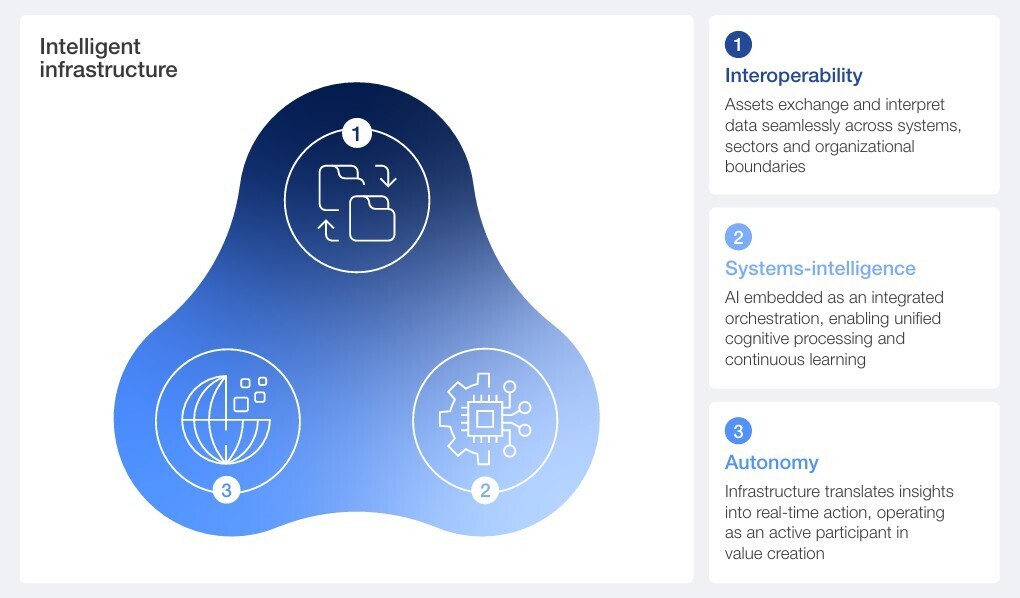
The report also brings together examples of how, when deployed effectively, intelligent infrastructure can drive value for Companies, Clusters, Cities and Countries (the 4Cs).
In fact, it can even have a reinforcing effect, where success in one area can also drive improvements in another, the authors explain: “Company transformation strengthens cluster capabilities; cluster infrastructure and city transformation amplify national competitiveness and national frameworks enable all.”
3. News in brief: More top city stories
US cities roll out extreme heat plans ahead of 2026 World Cup tournament: With high temperatures expected across North America, cities hosting the FIFA World Cup 2026 are introducing measures to protect fans and players from extreme heat. Research cited by officials suggests 14 of the 16 host locations could experience potentially dangerous conditions during matches. Plans include temporary drinking fountains and misting stations in Vancouver, a public heat dashboard in Los Angeles and multilingual WhatsApp alerts in New York, alongside on-field measures for players such as mandatory hydration breaks, adjusted kick-off times and an increased substitution allowance. The preparations underline how climate resilience is becoming central to hosting major events and protecting urban quality of life.
55 global cities issue joint climate resilience pledge at Tokyo summit: Leaders from 55 cities across five continents have issued a joint commitment to strengthen cooperation on climate-linked disasters and urban sustainability challenges following a summit hosted by the Tokyo Metropolitan Government. The communiqué outlines specific resilience measures cities will take, ranging from emissions reductions to flood defence projects.
California to begin ticketing driverless cars that violate traffic laws: California has approved new regulations allowing law enforcement agencies to issue citations to autonomous vehicle companies. The rules from the California Department of Motor Vehicles will also allow local emergency responders to issue directives requiring manufacturers to direct their fleets to leave areas within two minutes during active emergencies.
Seoul expands urban design programme to encourage more distinctive architecture: Seoul Metropolitan Government is widening access to an urban and architectural design initiative aimed at encouraging more creative buildings and public spaces, while also shortening planning procedures for developments. The programme, first launched in 2023, will now extend beyond Gangnam and include smaller sites. The expansion reflects a wider push to improve the quality, identity and liveability of urban spaces.
What is the World Economic Forum doing to promote sustainable urban development?
4. More on urban transformation on Forum Stories
Compromising on quality in the built environment can lead to long-term liabilities, such as expensive retrofits, faster deterioration and social disruption. “Baukultur” focuses on lifecycle value, meaning buildings should deliver economic, social and environmental benefits over time. This article demonstrates how quality is a strategic advantage, generating returns, trust and competitiveness for the places that embrace it.
As AI is increasingly used in urban systems to optimise transport, energy and mobility – and even simulate policy decisions in real time – can efficiency gains be delivered without deepening existing inequalities? Read more about how cities such as Amsterdam and Helsinki are testing approaches to make AI-driven systems more transparent, accountable and socially equitable.
License and Republishing
World Economic Forum articles may be republished in accordance with the Creative Commons Attribution-NonCommercial-NoDerivatives 4.0 International Public License, and in accordance with our Terms of Use.
The views expressed in this article are those of the author alone and not the World Economic Forum.

Forum Stories newsletter
Bringing you weekly curated insights and analysis on the global issues that matter.
More on Built Environment and InfrastructureSee all

Lucas Gobatti
September 4, 2026


