Why the world's biggest battery maker isn't worried about AI's energy demand
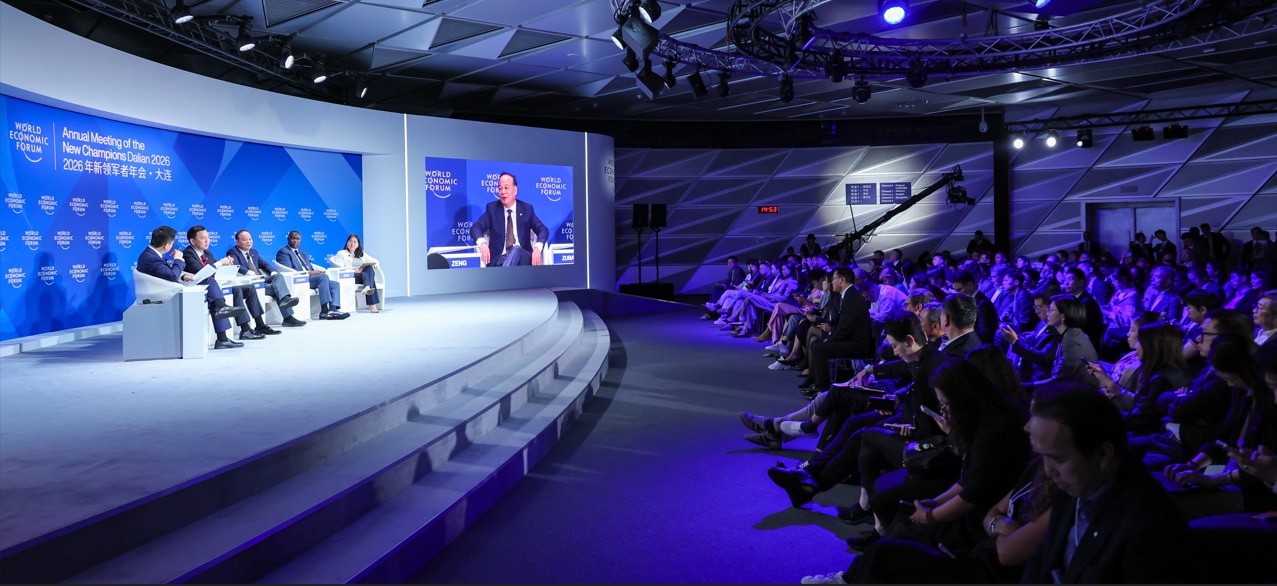
How can large users, like data centres, consume less to ease rising energy demand? Image: World Economic Forum
- Managing AI’s data usage has rapidly become a significant resource and policy issue worldwide.
- CATL's Robin Zeng pushes back on the prevailing anxiety that AI data centres will overwhelm power grids (at least in China).
- Engaging the whole system and co-designing from the outset are increasingly regarded as key to long-term success.
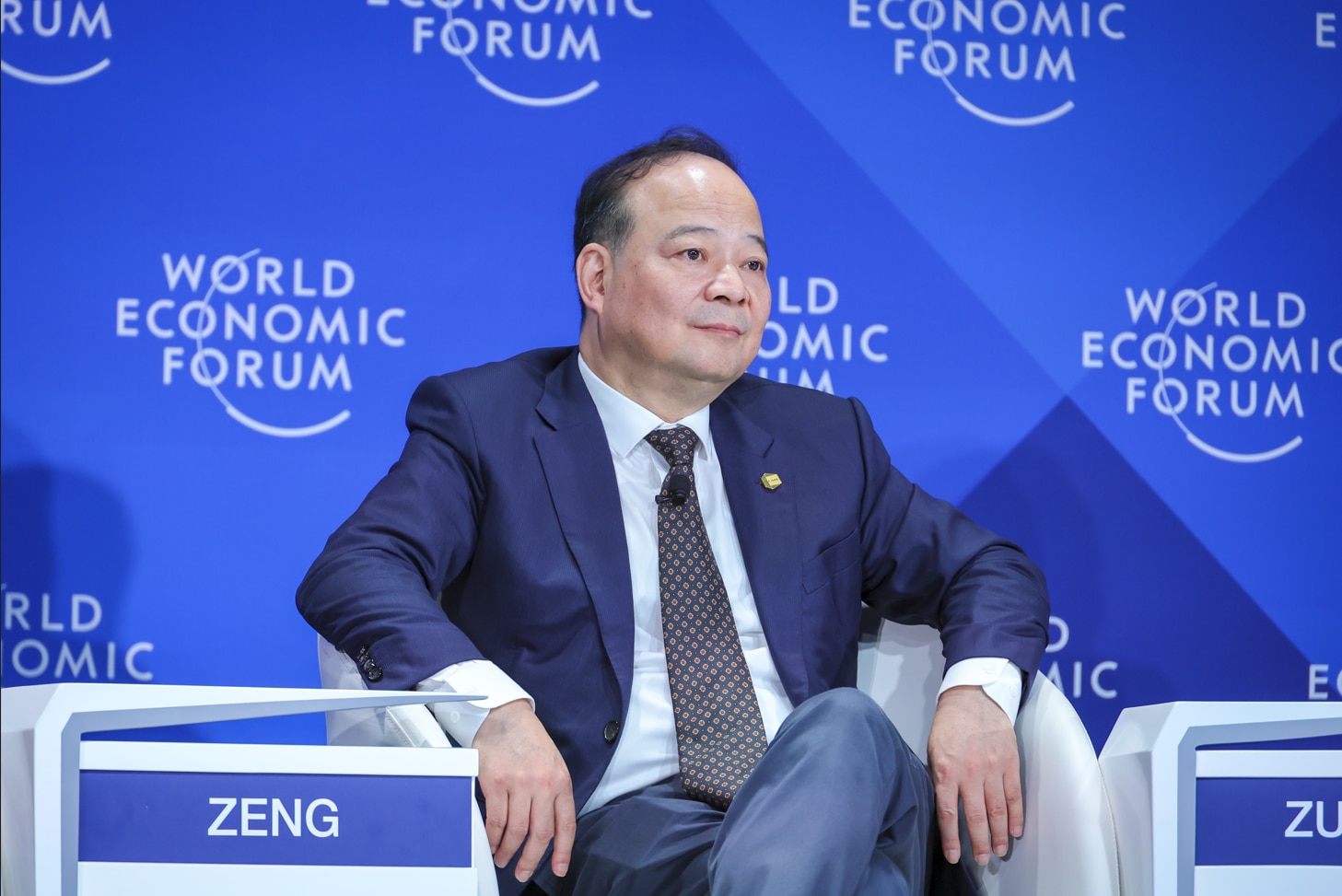
For many leaders, businesspeople and policy-makers worldwide, the future of AI, including how it will be powered, is one of uncertainty, high costs, and some degree of anxiety. Pushing back against this prevailing sentiment is Robin Zeng, Founder, Chairman and Chief Executive Officer, Contemporary Amperex Technology (CATL), who provided a very different vision while speaking at the Annual Meeting of the New Champions in Dalian, China.
Data centre energy demand growth is (relatively) small
In “No Power, No AI”, Zeng revealed that in China the demand on the grid from the country’s burgeoning number of data centres is small, relative to the country’s grid growth.
“The energy system is so mature… the AI data centre consumes not much electricity compared to China's growth. So, the grid is no problem.”
Instead, he argued that the real question for China’s business and political leaders isn’t one of capacity, it’s how the power is sourced. Regulation in China dictates that all new data centres must employ 80% renewable energy, a situation that is accelerating research into grid stability and battery technology, with energy storage a key issue.
Batteries and energy storage are the new frontiers
According to Zeng, there are three phases to consider when assessing the maturity of energy storage solutions: technology capability – can the supplier provide a reliable and constant supply of energy to support a big data centre (1 gigawatt of power year-round); is it cost-effective (cost must be equal or lower than traditional energy to be competitive); and long-term reliability and performance. Currently, nearly one in five large-scale energy storage power stations worldwide are underperforming, underscoring why continuing innovation in this area is vital.
Concurrently, supply chain reliability is another pressing issue. CATL is developing sodium-ion batteries to help reduce China’s dependence on lithium (defined as a critical mineral). Zeng revealed that his company has already produced a sodium-ion battery that can be deployed on a large scale, and in three to five years, he expects these batteries will be able to reach 100 gigawatt-hours every year. In doing so, they will be able to fully support a modern data centre.
“We can produce a large-scale sodium battery for energy storage, so we get rid of the lithium dependence.”
How the Forum helps leaders make sense of AI and collaborate on responsible innovation
Where AI is being used and what’s next
China is already using AI to optimize the efficiency (particularly energy usage) of its data centres. AI systems purchase electricity when prices are low, while also maintaining operational stability at facilities. Speaking about CATL’s AI usage, Zeng revealed that the company is already making savings of approximately 30% on its electricity bills:
“We're already using [it] for some data centres. We can have the AI auto-bidders buy… low-cost electricity from grid supply to our manufacturing plants, and also keep the manufacturing plants very stable.”
Zeng’s vision for the not-so-distant future is one of even greater integration. Vehicle-to-grid technology already allows EVs to supply electricity back to the grid, which for a country where, according to Zeng, there are already more than 40 million EV cars, is a very attractive proposition.
At battery swapping stations, there are batteries with large capacities that can store energy, particularly overnight, helping to balance renewable energy and supply. Zeng revealed a future where EVs are a lot more than just a transport option, but instead become “tokens” with their valuable battery and computing resources used in energy and digital systems when not in use by the owner.
“You didn't use your battery, didn't use your chips, didn't use your computing power – so you can use that as a token, if you do the technology right.”
This becomes a societal win-win, with EV car ownership supporting wider grid and digital stability and power, while also benefitting the car owner.
The view from the US
Zeng is certainly not alone in envisioning a future where AI and the data centres that power them return power to the grid.
Vanessa Chan, Inaugural Vice-Dean Innovation and Entrepreneurship, University of Pennsylvania, raised the issue of “new architectures”, which focus on innovation in the way in which systems are approached, communities engaged, regulation and taxation addressed, and technology applied.
Like Zeng, Chan argued that we shouldn’t regard data centres as a drain on the grid, but instead a dynamic system, which can “flex”.
“We think too much about the wires and all that, but flexibility itself becomes an actual asset. An AI centre could be a flexible place to bring energy back into the grid.”
Starting with energy demand not supply
For Chan, however, a starting point is the re-evaluation of not just energy supply but also demand. How can large users, like data centres, consume less? Chan and her colleagues are researching ways to make data centres more efficient, for example, by replacing general AI models responding to tasks with specialized ones that are more energy efficient.
Chip configurations are also being studied, including researching monolithic 3D configurations, which are four times faster than the current 2D ones, while battery technology – particularly storage and distribution – is being doggedly pursued.
BYOC – bring your own clean energy
In the US, policy-makers are increasingly demanding that tech giants such as Google develop local energy infrastructure and support grid modernization, as well as “start funding batteries, heat pumps and electric vehicle charging”. In Virginia, state authorities have been creating “complicated and sophisticated” large load tariffs, while in Georgia, large customers help fund new clean energy resources, receiving energy value credits in return.
“We need to think about how distributed energy resources are not just market participants, but are actual planning assets that are helping with the grid and… some of the load challenges.”
There’s also been a shift towards “grayscaling,” where data centres take on stranded assets like retired coal plants and transform them into digital hubs designed to serve the local community.
“If there’s ways to repurpose assets that are stranded, that’s another win for a community.”
This shift to engaging far wider ecosystems requires much broader thinking. Reflecting this, co-designing is becoming more common. Instead of designing everything in isolation, power, storage and computing need to be co-designed from the outset, a situation that participants agreed would boost energy affordability, ideally in a way that’s beneficial to the wider community.
Don't miss any update on this topic
Create a free account and access your personalized content collection with our latest publications and analyses.
License and Republishing
World Economic Forum articles may be republished in accordance with the Creative Commons Attribution-NonCommercial-NoDerivatives 4.0 International Public License, and in accordance with our Terms of Use.
The views expressed in this article are those of the author alone and not the World Economic Forum.
Stay up to date:
AI and Energy Use
Related topics:


Forum Stories newsletter
Bringing you weekly curated insights and analysis on the global issues that matter.
More on Artificial IntelligenceSee all

Jacob Nathan
September 25, 2026


