Summer Davos: Leaders on how to make the AI payoff happen for everyone
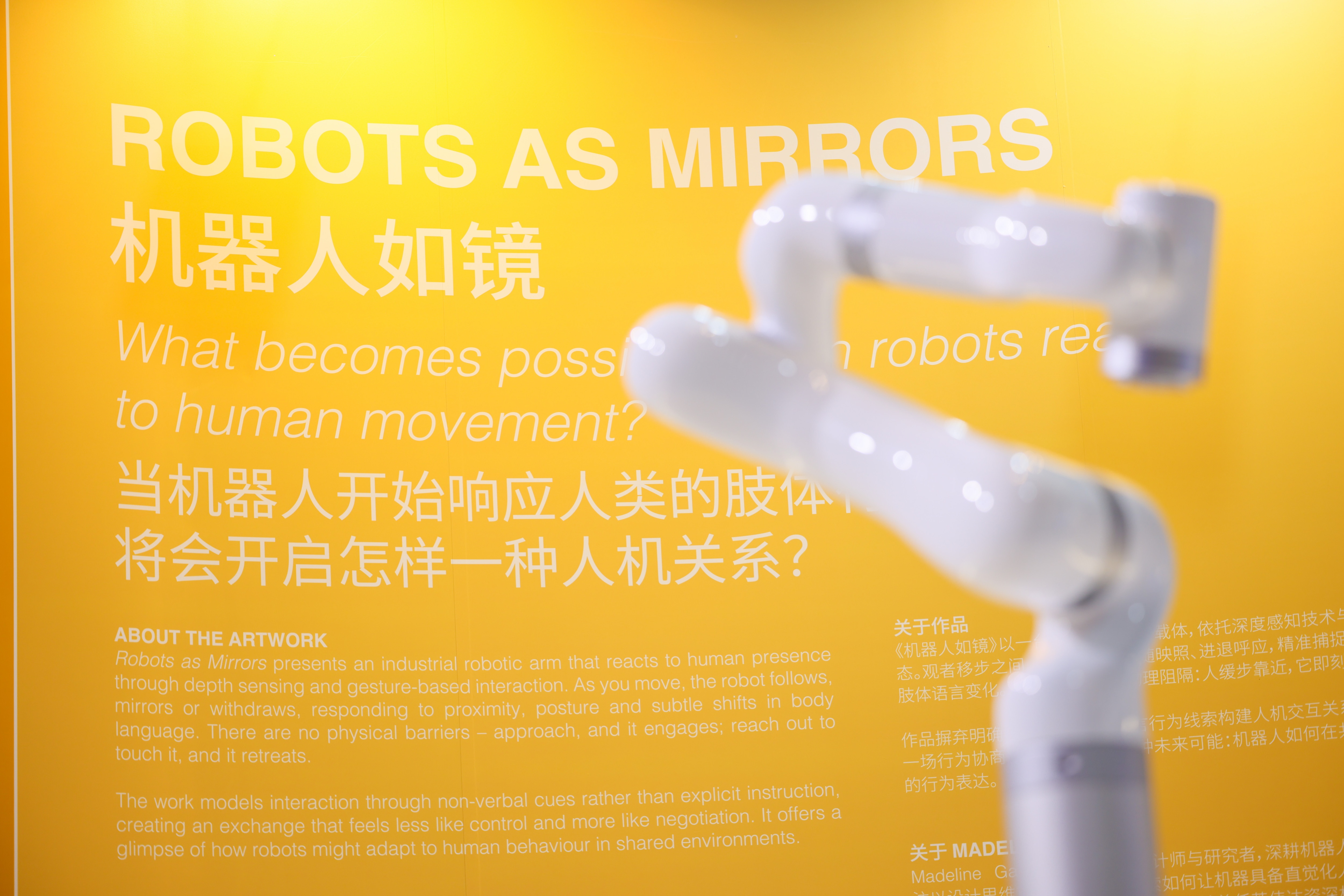
Global leaders discussed AI transformation challenges at the Annual Meeting of the New Champions 2026 in Dalian, China Image: World Economic Forum
- Throughout the Annual Meeting of the New Champions 2026, leaders considered the AI transformation challenges faced by businesses.
- From deploying infrastructure to data readiness, organizations must overcome multiple barriers in order to deploy the technology at scale.
- Here are four takeaways shared by leaders during the event.
AI technology is ready to transform business, but most organizations are not.
This was one of the most frequent discussion points at the World Economic Forum’s Annual Meeting of the New Champions 2026 in Dalian, China (23-25 June).
Throughout the gathering, leaders in business, academia and institutions considered the biggest gaps identified – and some of the solutions that may help organizations bridge them.
Here are four key takeaways shared by leaders over the course of the event.
1. The car is ready, but the road needs building
Xue Lan, Dean, Schwarzman College, Tsinghua University, compared the introduction of AI to the early days of automobiles. When first introduced, widespread application was impossible because the infrastructure simply didn’t exist. Roads were set up for horses and carts, and even when these were adapted, gas stations were needed to allow people to travel further.
“We really want technology to diffuse into society, but you need both hard infrastructure – data centres, energy – and softer infrastructure, regulations and so on,” he said. “That is catching up much slower compared to frontier model development.”
Mehdi Ghissassi, Chief Product and Technology Officer, AI 71, noted that truly AI-first companies must take a similar approach to redesigning their internal processes. Extending the automotive analogy, he said, “If you were planning the streets of a city, and you knew that we would have self-driving cars, you probably wouldn't organize it the same way as we have them now.
“Companies that do the hard work of redesigning processes enable the use of AI.”
2. Easy as 1-2-3-4?
AI technology is only as good as the data that feeds it. Without clear information sets, organizations will only be able to make mistakes more quickly, warned Roli Agrawal, Chief Strategy Officer, NTT DATA. “A lot of times, the data that we see in our clients is super fragmented,” she explained. “And if you build AI on top of chaos, it will still be chaos, just super-fast on GPUs.”
Agrawal shared her organization’s 1-2-3-4 rule: for every $1 spent on building AI agents, they encourage clients to spend $2 on change management, $3 on architecture, governance and guardrails and $4 on data readiness. Doing so, she said, allows enterprises to scale AI and become truly intelligent.
3. People as predictors
To fully understand where AI is taking us, we must consider how humans use it, rather than its raw capabilities, according to Jonas Prising, Chair and Chief Executive Officer, ManpowerGroup.
“Mankind has seen these kinds of technological evolutions many times, and ultimately what humans do with the technologies is a much greater predictor of what will eventually happen than what the technology itself can do,” he explained.
“The debate centres so much on compute, talent and capital, and is not sufficiently focused on what we need to do to get employees, workers and organizations adopting this at scale in a way that benefits organizations and society, but also the people using the technology.”
4. Don’t wait to dive in
While each of these challenges needs to be addressed, waiting for perfect conditions is not the solution. Feng Junlan, Chief Scientist at China Mobile, believes that while many architectural roadblocks will take time to solve, building AI skillsets and familiarity must happen in parallel.
“The enterprise is not ready in terms of data, in terms of their system, their sensing technology … you shouldn't try to solve all those basics because it will take you probably a couple of years to solve them,” she said.
“If AI is the ocean, we are now on the surface. If you want to swim in the ocean, you have to jump in.”
Quotes have been lightly edited for length and clarity.
Have you read?
License and Republishing
World Economic Forum articles may be republished in accordance with the Creative Commons Attribution-NonCommercial-NoDerivatives 4.0 International Public License, and in accordance with our Terms of Use.
The views expressed in this article are those of the author alone and not the World Economic Forum.

Forum Stories newsletter
Bringing you weekly curated insights and analysis on the global issues that matter.
More on Artificial IntelligenceSee all

Luna Atamian Hahn-Petersen and Silje Hansen Eeg
September 24, 2026


