Beyond the AI pilot: Why workflows matter more than software

Real enterprise value relies on redesigning workflows rather than purchasing software licenses. Image: Kaleidico/Unsplash
- AI adoption has surged worldwide yet firm-wide labour productivity gains remain largely flat.
- Real enterprise value relies on redesigning workflows rather than purchasing software licenses.
- Long-term success demands stronger management capability and disciplined financial measurement.
The integration of generative AI into the workplace is no longer a futuristic concept – it is today’s reality. Yet the most revealing data point of 2026 is not a productivity statistic, but a productivity paradox: organizational adoption of AI has surged, yet broad enterprise labour productivity remains largely flat outside of a few specialized sectors. That paradox is why the issue deserves attention now, and why the honest answer to whether the technology has actually delivered on its promise is: not yet.
The scale is no longer in question
Let’s start with what is settled. AI could add up to $15.7 trillion to global GDP by 2030, according to research from PwC – which translates to roughly 14% higher global output than a world without AI, split between productivity gains and AI-enabled consumer demand. On the labour side, research from the World Economic Forum found that AI and information-processing technologies are expected to touch the vast majority of businesses by 2030, displacing 92 million roles while creating 170 million new ones – a net gain, but one that requires nearly 40% of core job skills to change in the process.
The automation figures are just as striking, though they deserve more precision than they usually get. Research from the McKinsey Global Institute found that AI could push automation potential from 21.5% to nearly 30% of hours worked in the United States economy by 2030. Comparable studies put the global range lower, but the direction, everywhere, is the same: upward and faster than earlier forecasts assumed.
The uncomfortable middle: adoption without transformation
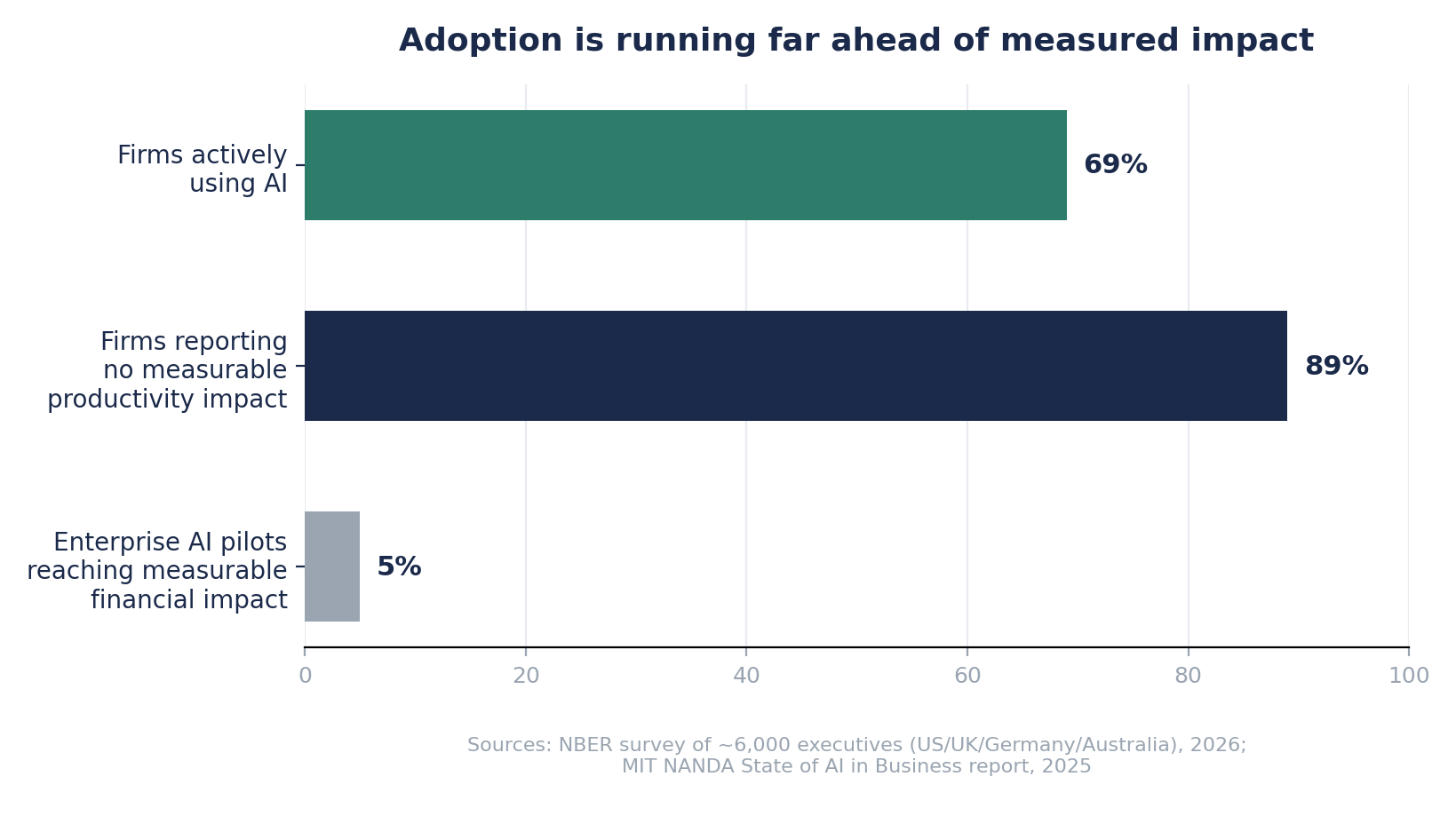
But now back to the paradox. A 2026 National Bureau of Economic Research survey of nearly 6,000 CFOs, CEOs and senior executives across the US, UK, Germany and Australia found that while about two-thirds of firms actively use AI, roughly 89% reported no measurable improvement in labour productivity over the past three years.
Elsewhere, MIT researchers examining hundreds of enterprise AI deployments found that only about 5% of generative AI pilots ever reach measurable financial impact – not because the models are inadequate, but because most enterprise tools and workflows never retain feedback or adapt to context well enough to move past the pilot stage.
Meanwhile, employees are not waiting for their organizations to catch up. The same research documents a shadow AI economy in which large majorities of workers use personal, unsanctioned AI tools for job tasks – often getting more value from them than from whatever their employer has officially rolled out.
And despite record AI investment, Gallup’s 2026 workplace data shows employee engagement essentially flat year over year, with Gallup noting explicitly that access to AI tools alone does not improve – or worsen – the employee experience. What moves the needle is whether leaders introduce the technology with clear expectations, real implementation planning and active manager support.
The gap shows up at every scale
It would be convenient to treat this as a large-enterprise problem – the natural friction of getting a 50,000-person company to change how it works. But the same pattern shows up among small businesses, which have far less bureaucracy to fight through.
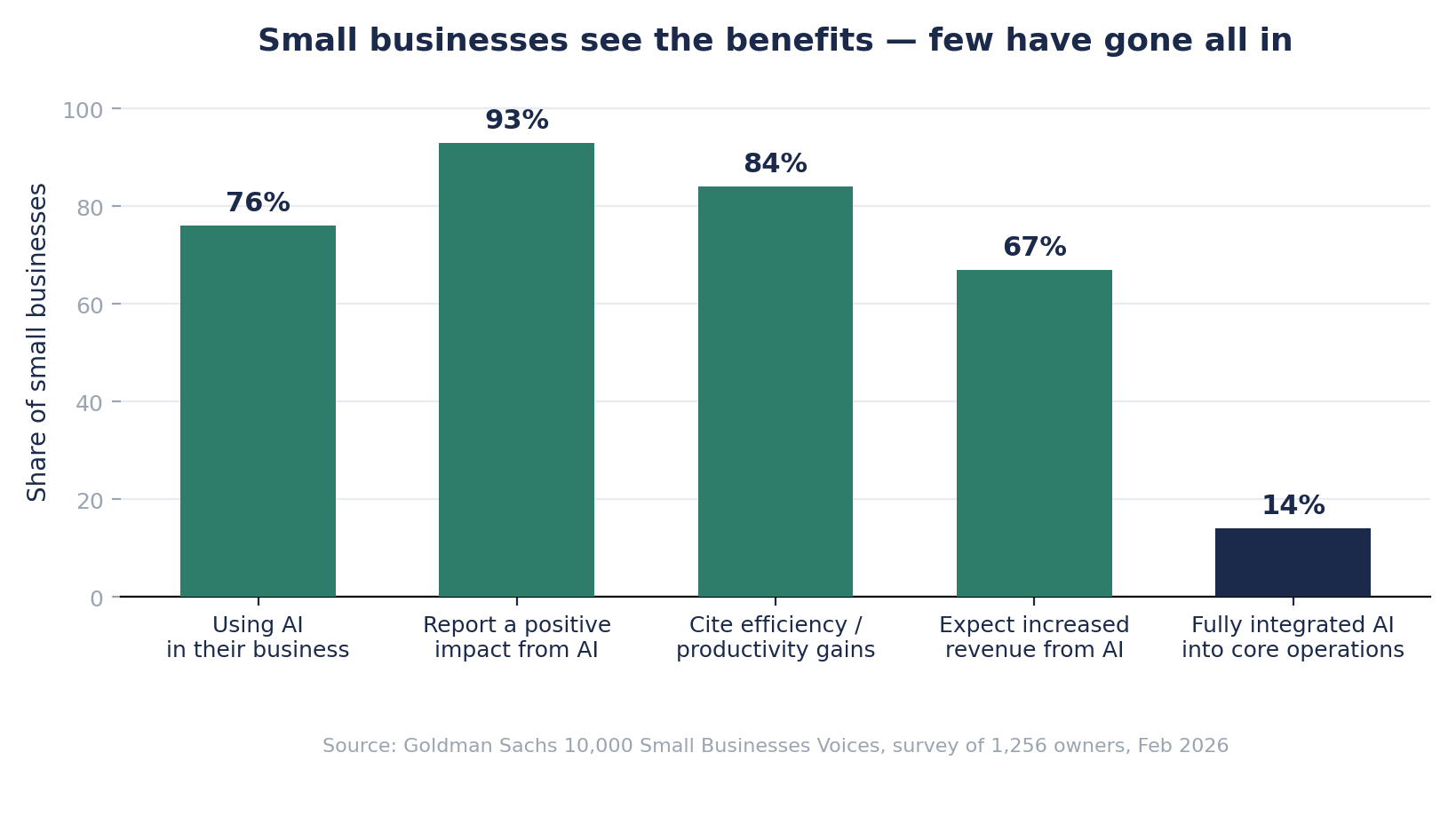
A Goldman Sachs 2026 survey of its 10,000 small businesses network found that 76% of small business owners are already using AI, and the results among them are genuinely strong: 93% report a positive impact, 84% cite gains in efficiency and productivity and 67% expect AI to increase revenue. Yet only 14% say they have fully integrated AI into their core operations - nearly identical, in spirit, to the enterprise-level gap between AI usage and measured impact described above.
The barriers small business owners cite are practical rather than philosophical: concerns about data privacy (50%), a lack of technical expertise (49%) and difficulty choosing the right tools among a crowded field (48%). Indeed, as vast majority – 73% – say they would benefit from more structured training and support.
The texture of that gap is visible in individual cases. MIT Technology Review profiled a London-based tutor who now uses Notion AI as a kind of secretarial layer across his business – summarizing client sessions, drafting invoices and turning vague goals into concrete next steps – freeing up hours he previously spent on administration. A quilting shop in Arizona, cited in the same reporting uses an industry-specific AI tool to write inventory descriptions and pricing, cutting listing time by 60–80%.
These are not transformational reinventions of the business; they are narrow, well-scoped automations bolted onto existing workflows. That, it turns out, is precisely where AI delivers the most reliable value at any size of organization. And it is precisely what most large enterprises have not yet done systematically.
What changes for leaders
This reframes the question for leaders. The task executives face is not to answer the question “which AI tool should we buy”; in fact, it’s something closer to what earlier waves of technological change demanded of them: redesigning how decisions get made, not merely which software sits on top of the old process. When AI can draft the report, summarize the data or flag the anomaly, a manager’s distinct value shifts towards judgement – knowing which outputs to trust, which to interrogate, and which decisions genuinely require human accountability. That is a different skill from the one most management training was built around.
It also changes how leaders evaluate productivity. Executives in the NBER survey who saw real gains achieved them by redesigning specific, well-scoped workflows around AI, rather than layering new tools onto old processes. Measurable gains cluster in tasks with a clear right answer and an easy way to verify it – such as customer support, software development or structured drafting – and drop off sharply in work that relies on open-ended judgement. Leaders who fail to distinguish between these categories tend to either over-promise or, increasingly, quietly stop measuring altogether.
Three things organizations actually need to do
To bridge the gap between AI adoption and real impact, leaders must shift from buying technology to changing how work gets done. Three priorities stand out.
First, treat AI adoption as an organizational design problem, not a procurement decision. Buying licenses is not the same as redesigning workflows, and the data above shows the latter is where the value sits.
Second, invest in manager capability before – or at least alongside – employee tool access. Gallup’s finding that engagement tracks leadership behaviour, not tool availability, suggests that the bottleneck is rarely the software.
Third, build a genuine measurement discipline. Two-thirds of enterprises are still using estimates like “time saved” rather than measured financial outcomes to judge AI’s return –which means most organizations cannot actually tell whether their AI investment is working. Fixing that isn’t glamorous but it is the pre-condition for everything else.
AI didn’t wait for anyone’s permission to change the workplace – it just did. The only real choice left is whether organizations redesign themselves on purpose or get redesigned by default.
Don't miss any update on this topic
Create a free account and access your personalized content collection with our latest publications and analyses.
License and Republishing
World Economic Forum articles may be republished in accordance with the Creative Commons Attribution-NonCommercial-NoDerivatives 4.0 International Public License, and in accordance with our Terms of Use.
The views expressed in this article are those of the author alone and not the World Economic Forum.
Stay up to date:
Artificial Intelligence


Forum Stories newsletter
Bringing you weekly curated insights and analysis on the global issues that matter.
More on Artificial IntelligenceSee all

Ahmed Al Shamsi and Najwa Aaraj
October 9, 2026


