Why some board meetings inspire and others fizzle, according to those in the room
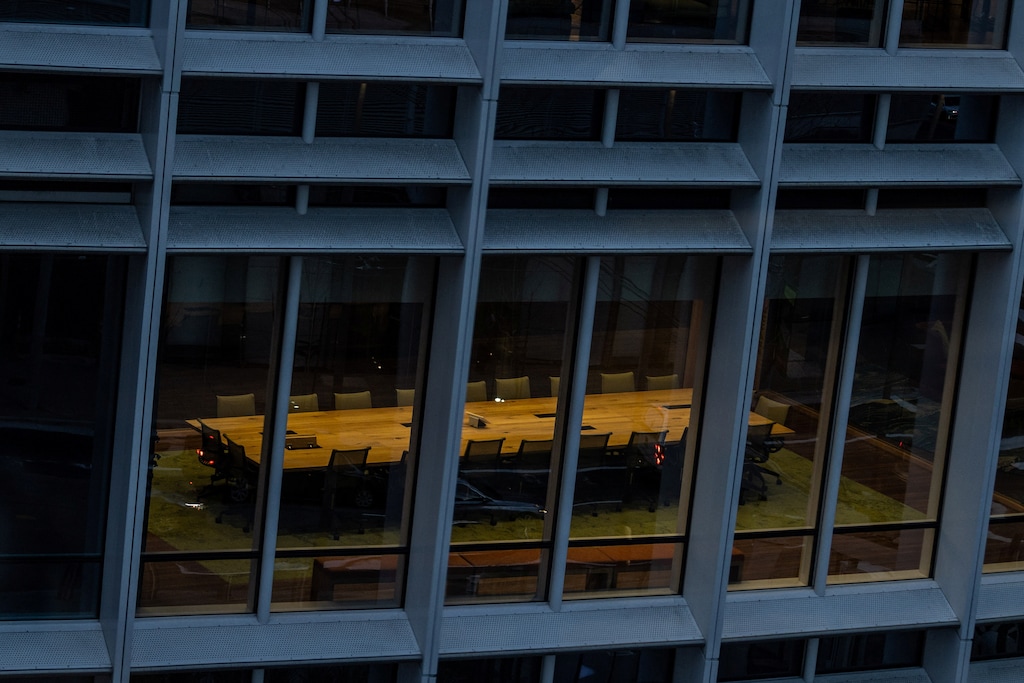
Not all board meetings are built the same – the difference, these CEOs said, is in the details. Image: REUTERS/Carlos Barria
Marie-Hélène De Coster
Partner in charge of Heidrick & Struggles’ Belux region and a partner in the Brussels and Paris offices, Heidrick & StrugglesTobias Petri
Partner in charge of Heidrick & Struggles’ Copenhagen office and Nordic region lead, Heidrick & Struggles- Over 20 European CEOs, chairs and board members shared their views on the difference between productive and inefficient board meetings, based on their own experiences.
- The most productive boards join discussions early, stay small and ask open questions.
- Clear agendas, short presentations and disciplined pre-reads leave more time for strategy and scenario planning.
A senior executive once compared board meetings to a visit to the dentist. Something to be endured, rather than enjoyed. Ask around and you will hear a version of that more often than you might expect, from inside a room that is supposed to be one of the most valuable that a CEO has access to.
That gap between what a board meeting could be and what it usually is came up again and again in our conversations with over 20 European CEOs, chairs and board members. The pattern behind the complaints was consistent. Management shows up with a decision already made, asks the board to sign off and calls that governance.
One CEO summed up the test he applies to every meeting: did he leave more energized than when he walked in, and did he feel wiser for it? Most meetings fail that test, but the ones that pass share a few traits worth setting out.
Between January and May 2026, we interviewed 24 European business leaders about how the CEO and board relationship works in practice. Nine were CEOs, and 15 were chairs and members of board. They came from large European companies of varying sizes in industries like healthcare, manufacturing, telecoms and industrials, including some of the largest and most well-known in Europe.
Here’s what those leaders said makes for a productive board meeting.
Avoid coming with a decision already made
The boards getting the most out of their time are not the ones rubber-stamping a finished strategy. They are brought in while the strategy is still being worked out, while the trade-offs are still open, and the assumptions still testable.
“Don't come with the baked cake,” one board member said. Go in with an open mind and be prepared to discuss rather than present.
This requires mutual ambition. CEOs have to be willing to show up with a level of uncertainty and be open to being challenged. Boards have to treat that uncertainty as useful rather than a sign of weakness.
Several of the leaders interviewed described splitting big strategic questions across meetings, exploring a topic deeply in one session and refining it in the next, rather than trying to land it all at once. The effect, they said, was a discussion that was more constructive and often came to sharper outcomes.
Pick the right team and keep it agile
Board composition came up as one of the biggest levers for a good meeting, and judgment matters more than pedigree.
“At any time, I would prefer a well-functioning board with less experienced members than one composed of what looks right on paper,” one leader said. A board that looks strong on paper but has the wrong attitude in the room was described by another as destructive.
Directors who have run a company bring something different. They understand what it costs to lead and they challenge from that mindset. Size matters, too. The boards that felt most agile tended to stay small; nine or ten members at most, with committees kept to the essentials like audit and remuneration. Tenure limits, often somewhere around ten years, were credited with keeping the room from going stale.
Spend the meeting on what you can influence
Boards are now operating in what one director called a permacrisis, and the temptation is to spend the meeting reacting to everything happening in the world rather than what the company can do about it.
The more useful meetings stay grounded in specific scenarios, specific assumptions and responses the company can actually execute. Some boards use regular benchmarking against competitors to keep the conversation pointed to where the company can improve, rather than what it cannot control.
“The board rhythm should not constrain the speed of the company,” one director said. Balancing responsiveness to short-term volatility with long-term discipline came up as the hardest part of the job.
Boards that can manage this give their CEO room to navigate uncertainty, without losing sight of where the company is heading.
Ask opens questions, don't run an interrogation
How a board asks its questions shapes the meeting as much as what gets asked.
Many board meetings still feel like an interrogation. Open, well-framed questions signal that the board is prepared to be surprised and willing to learn, which one CEO described as a form of respect.
For management, the discipline is to actually listen to what the board is asking rather than just answering it. The pattern in the questions often says as much about what is on a director's mind as the answer. And the traffic should flow in both directions. CEOs asking questions of their board, not only fielding them, turns the meeting from a one-way examination into a constructive conversation.
Design the meeting, don't just hope for good chemistry
Good meetings are built and require planning. A basic but often skipped step is a clear agenda that separates what is for information, what is for discussion and what requires a decision. Presentation time should be kept short to leave room for conversation, and several leaders pointed to disciplined pre-reads as the difference between a meeting that repeats slides and one that builds on them.
“Be efficient on governance. Be brutal on pre-reads,” one leader said.
One board member called administrative items a hygiene factor, nothing more. The time saved goes to the scenario and foresight discussions that are harder to have, and worth more.
None of this is complicated in principle. What separates the boards that work from the ones that don't is whether the people in the room treat the meeting as a genuine chance to think together, or as a formality to get through.
The CEOs who genuinely look forward to their next board meeting are the ones getting a real return on the time they put into it.
Don't miss any update on this topic
Create a free account and access your personalized content collection with our latest publications and analyses.
License and Republishing
World Economic Forum articles may be republished in accordance with the Creative Commons Attribution-NonCommercial-NoDerivatives 4.0 International Public License, and in accordance with our Terms of Use.
The views expressed in this article are those of the author alone and not the World Economic Forum.
Stay up to date:
Corporate Governance


Forum Stories newsletter
Bringing you weekly curated insights and analysis on the global issues that matter.
More on BusinessSee all

Karolina Anda Juodpusytė
October 14, 2026


