Chief economists see both big AI data-centre benefits and ‘significant’ local pushback yet to come

More meaningful pushback on AI data centres is coming, experts say. There's a long history of backlash at the dawn of tech revolutions. Image: REUTERS/Joel Angel Juarez
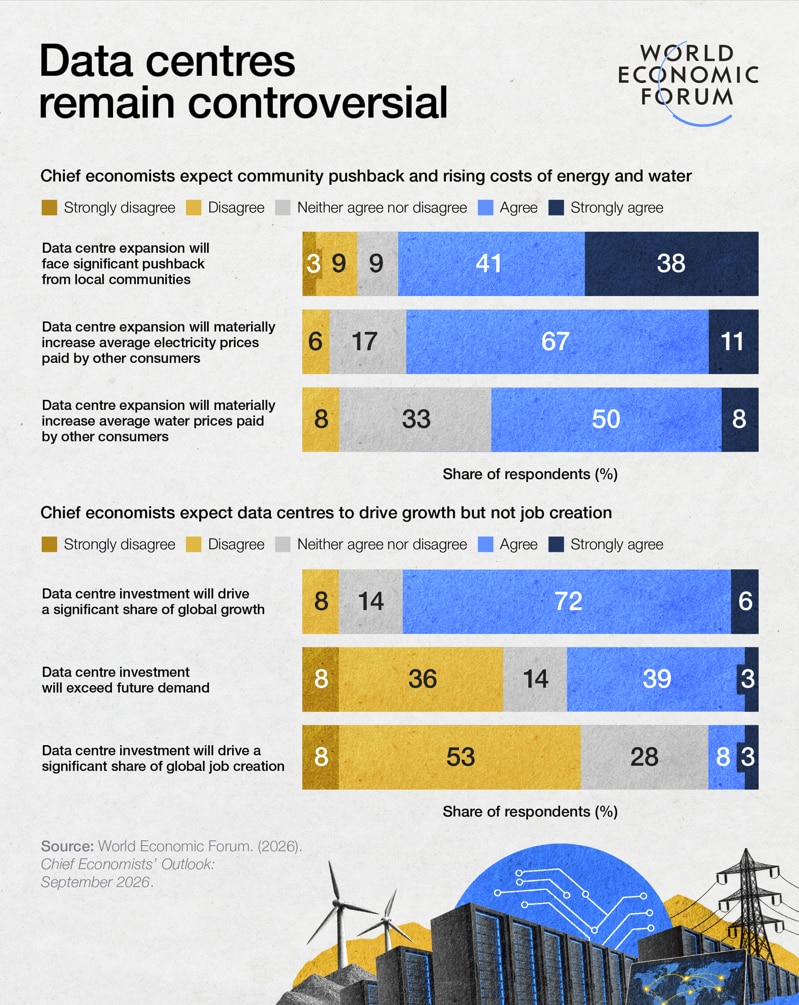
- 79% of respondents in the latest Chief Economists’ Outlook expect meaningful local resistance to artificial-intelligence data centres in the year ahead.
- The ire directed at these engines of AI development is the latest wrinkle in a long history of technology revolutions initially greeted with fierce opposition.
Income per person in Gary, Indiana is about half of the figure for America as a whole. Its poverty rate is three times higher. And a current renewal effort involves obliterating a not-insignificant portion of its city centre.
So when concerns recently emerged there about bigger electricity bills for an already-struggling community thanks to AI data centres, it squarely lodged Gary in a debate that stretches far beyond America’s borders.
AI resistance can take different forms, though data centres have proven to be a particularly ripe target for public outrage. It’s one thing to survey sceptical communities about them, however. It’s another when that discontent merits space in a scan of the global economy’s prospects.
Nearly eight in ten of the respondents surveyed for the most recent Chief Economists' Outlook published this week anticipate “significant” pushback to data centre expansion from local communities in the year ahead.
By way of context, other possible developments that merited a similar degree of confidence: that the cost of food will rise (88% of Outlook respondents), and geopolitical conflict will remain a source of uncertainty (97%).
Have you read?
One of the chief economists surveyed for the Outlook offered some historical context. “What we are currently seeing is the first phase of any technological revolution,” EY’s Gregory Daco said during an appearance on the latest episode of Radio Davos. “And that first phase is very intensive in capital investment.”
“From the Industrial Revolution to the electricity revolution to the computer age,” Daco said, “that tends to strain resources, which leads in some cases to pushback.”
A railroad-building boom during the Industrial Revolution did indeed trigger public backlash. It was the backdrop for a passage featuring angry villagers and pitchforks in a George Eliot novel published at the time.
The initial electrification of parts of the world in the 19th century also sparked deep unease in the public while igniting labour unrest. And the dawn of the computer age saw a rash of mainframe sabotage. In each case, an argument can be made that economies ultimately benefitted from having these things. The adjustment process was not always pretty.
Nearly the same percentage of chief economists surveyed for the recent Outlook who foresee pushback to new data centres, or 78%, think data centre investment will drive a significant share of global economic growth in the year ahead. That’s because they’re positioned to be the engines of a sweeping overhaul.
If productivity is essential for healthy growth, no one wants to be caught shorthanded. Nearly seven in 10 of the chief economists think AI adoption will unleash “meaningful” productivity gains in the next 12 months. The infrastructure enabling that sits in endless rows of chilled server racks, and may prove as vital as navigable roads or indoor lighting.
So, is it possible that the people up in arms just aren’t seeing the bigger picture?
Here’s what they have seen, so far: sprawling new buildings liable to consume massive amounts of electricity and water. This voracious appetite is one reason several states in the US have been rethinking tax exemptions granted to facilitate their construction.
In Europe, opponents have targeted projects in Austria, France, Italy, and Ireland – a country where data centres accounted for about a fifth of all electricity usage by 2024. In Latin America, Indigenous people protested the building of the biggest data centre in Brazil; “data centres are being given priority over the population,” an activist in Chile complained. In Australia, a non-profit warned that the most populous state could see wholesale electricity prices rise 26%, if renewable energy isn’t used to meet growing data-centre demand.
Data centres are not a new phenomenon. They’ve been facilitating internet use for decades. But AI’s next-level need for computing power has inspired a historic data-centre spree. Having more is now widely viewed as a competitive advantage.
In terms of raw numbers, the US has over 5,000 data centres at some stage of development, or about ten times more than any other country, according to research published earlier this year. Germany followed with 529, the UK with 523, and then China with 449. Globally, the facilities were consuming enough energy by late last year to power New York state at peak demand, according to the research, and the amount of water used annually for cooling them may top the equivalent of the drinking water needs for 1.2 million people.
It’s not just the added computing power that makes these facilities seem like a worthy investment, though. There’s also the promise of added employment every time a new one appears.
The chief economists surveyed for the latest Outlook took a measured view of this benefit. 61% of them do not expect data centre investment to drive a significant share of global job creation in the year ahead. A recent news report cited estimates that a single centre only directly requires between a few dozen and a few hundred permanent employees.
Their environmental footprint is a work in progress. Some are now tapping into seawater for cooling, and renewable energy for electricity, while putting their “waste heat” to other use.
In the meantime, the rise of data centre disillusionment has been a “rare hiccup” in AI's otherwise relentless march forward.
“It's not necessarily going to be all good or all bad,” Gregory Daco said of the AI boom, “there are going to be nuances.” Data centres are one prominent area where more collaboration between governments and private companies makes sense.
Gary, Indiana doesn’t actually have any data centres. A recent study suggested that building a particularly big one in the region of northwest Indiana that includes Gary could create nearly 3,000 jobs per year, including external support roles.
But the government there has spoken, at least when it comes to within city limits, and at least for now. Last week, Gary's mayor established a one-year moratorium on new data centre facilities.
Don't miss any update on this topic
Create a free account and access your personalized content collection with our latest publications and analyses.
License and Republishing
World Economic Forum articles may be republished in accordance with the Creative Commons Attribution-NonCommercial-NoDerivatives 4.0 International Public License, and in accordance with our Terms of Use.
The views expressed in this article are those of the author alone and not the World Economic Forum.
Related topics:

Forum Stories newsletter
Bringing you weekly curated insights and analysis on the global issues that matter.
More on Economic GrowthSee all

Simon Zadek and Eric White
September 23, 2026





_03.jpg)