The data centre boom won't succeed without sustainability. Here's how to build it in
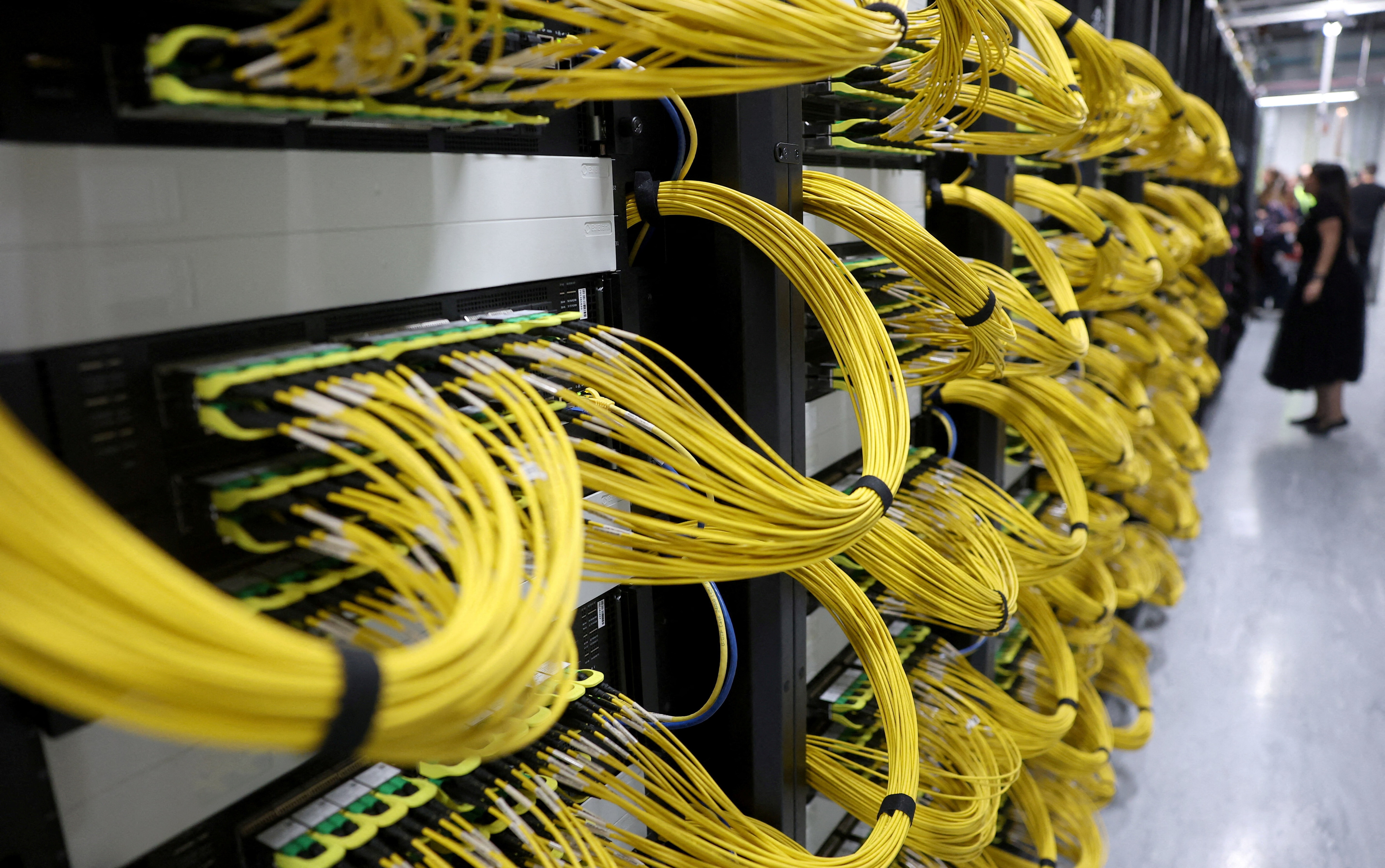
Organizations should embed sustainability and resilience early in data centre planning. Image: Reuters/Toby Melville
- Implementing practices to support data centre sustainability and resilience could help unlock $700 billion to $1 trillion in global data centre investment by 2030.
- The best approach to data centre sustainability depends on local resource conditions, including power and water, as well as infrastructural, technological, regulatory and community considerations.
- Five considerations can help decision-makers embed sustainability and resilience across the data centre life cycle.
The World Economic Forum’s latest report, developed with Oliver Wyman, a Marsh business, Data Centre Sustainability and Resilience: A Decision Playbook for AI Infrastructure, provides a practical decision framework to support more sustainable and resilient artificial intelligence (AI) infrastructure.
AI is driving one of the largest infrastructure build-outs in modern history, with global investment potentially reaching $7 trillion by 2030. With this expansion comes the opportunity to ensure that the infrastructure developed today remains viable in the face of evolving technologies, resource constraints and stakeholder expectations.
As AI infrastructure expands, sustainability and resilience are becoming increasingly important to long-term business success. They shape the business case for investment, influencing whether projects can proceed, how reliably facilities operate, how investors assess risk and whether assets retain long-term value. Organizations that embed these considerations early can make capital decisions that strengthen stakeholder confidence and reduce execution risk, while preserving the flexibility needed to adapt as operating conditions change.
Against this backdrop, the World Economic Forum estimates that adopting sustainable and resilient practices could help unlock $700 billion to $1 trillion in planned global data centre investment by 2030 by reducing delays and cancellations through improvements to community relations and greater adaptability of infrastructure to local resource constraints, regulatory changes and technological advances.
Constraints on AI infrastructure growth
Data centre growth depends on resources, infrastructure and communities that extend beyond the facility itself. As investment accelerates, constraints across these interconnected systems increasingly influence where, when and how projects can proceed.
Electricity is rapidly becoming a defining constraint for AI infrastructure, with the International Energy Agency (IEA) projecting that global data centre electricity consumption could more than double by 2030, placing increasing pressure on generation, transmission and grid capacity.
Water is also emerging as a critical consideration, with around 45% of global data centres already located in areas experiencing high water stress.
Cooling requirements are increasing as AI workloads become more power-dense, but adoption of advanced cooling technologies remains limited. An Uptime Institute survey found that approximately 22% of operators deploy direct liquid cooling, with cost, standardization and reliability concerns constraining wider adoption.
Community acceptance is becoming a major determining factor for project delivery. In the United States alone, 75 projects representing $130 billion were blocked or delayed during the first quarter of 2026.
Land is increasingly constrained by infrastructure readiness rather than physical space, with an estimated 160 square kilometres of additional powered land required globally by 2030 to support expected expansion.
Regulatory complexity is also increasing as governments balance AI growth with electricity, water, land and community priorities, making permitting and environmental approvals especially important factors in determining project viability.
Together, these constraints illustrate why assessing data centre sustainability and resilience requires looking beyond operational efficiency to consider the broader systems on which facilities depend and the impacts they have on those systems. Power Usage Effectiveness (PUE), for example, remains an important metric for measuring how efficiently a facility uses electricity, but it reflects only what happens during data centre operation.
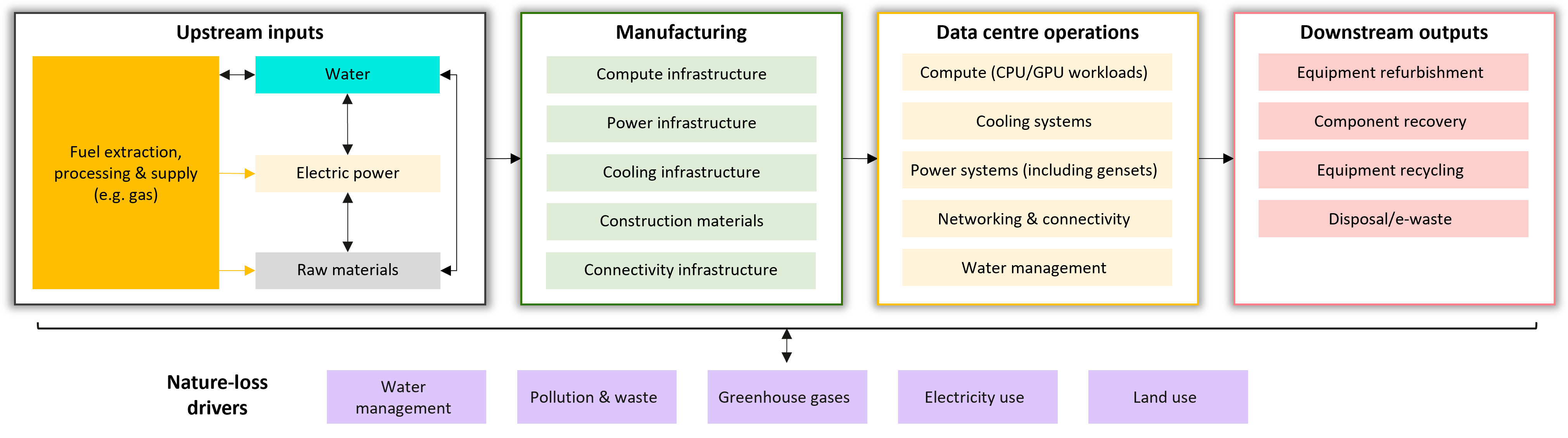
PUE does not account for upstream energy requirements, electricity sources, downstream life-cycle impacts or the resilience of the wider systems on which data centres depend. Understanding data-centre sustainability and resilience therefore requires a broader perspective that considers life-cycle impacts, local resource conditions and long-term adaptability alongside operational performance.
How stakeholders shape sustainability and resilience
Developers, operators, enterprise customers, financial institutions and policy-makers make and influence decisions at different points across the data centre development pathway. Each faces distinct questions and trade-offs related to sustainability and resilience:

- Developers and operators: How can we plan, design, build and operate data centres using sustainable and resilient practices that respond to local conditions and remain adaptable over time?
- Enterprise customers: How can we use procurement and workload decisions to drive demand for sustainable and resilient practices across AI infrastructure?
- Financial institutions: How can we incorporate sustainability and resilience into investment and financing decisions to identify and support infrastructure positioned for long-term value?
- Policy-makers: How can we enable data centre growth, while managing pressure on shared resources, infrastructure and communities?
Five considerations for sustainability and resilience in AI infrastructure
Responding to these challenges requires more than incremental improvements to individual facilities. It requires coordinated action across the AI infrastructure life cycle. Drawing on industry research and stakeholder consultation, the report identifies five considerations for embedding sustainability and resilience in the planning, financing, operation and use of AI infrastructure.
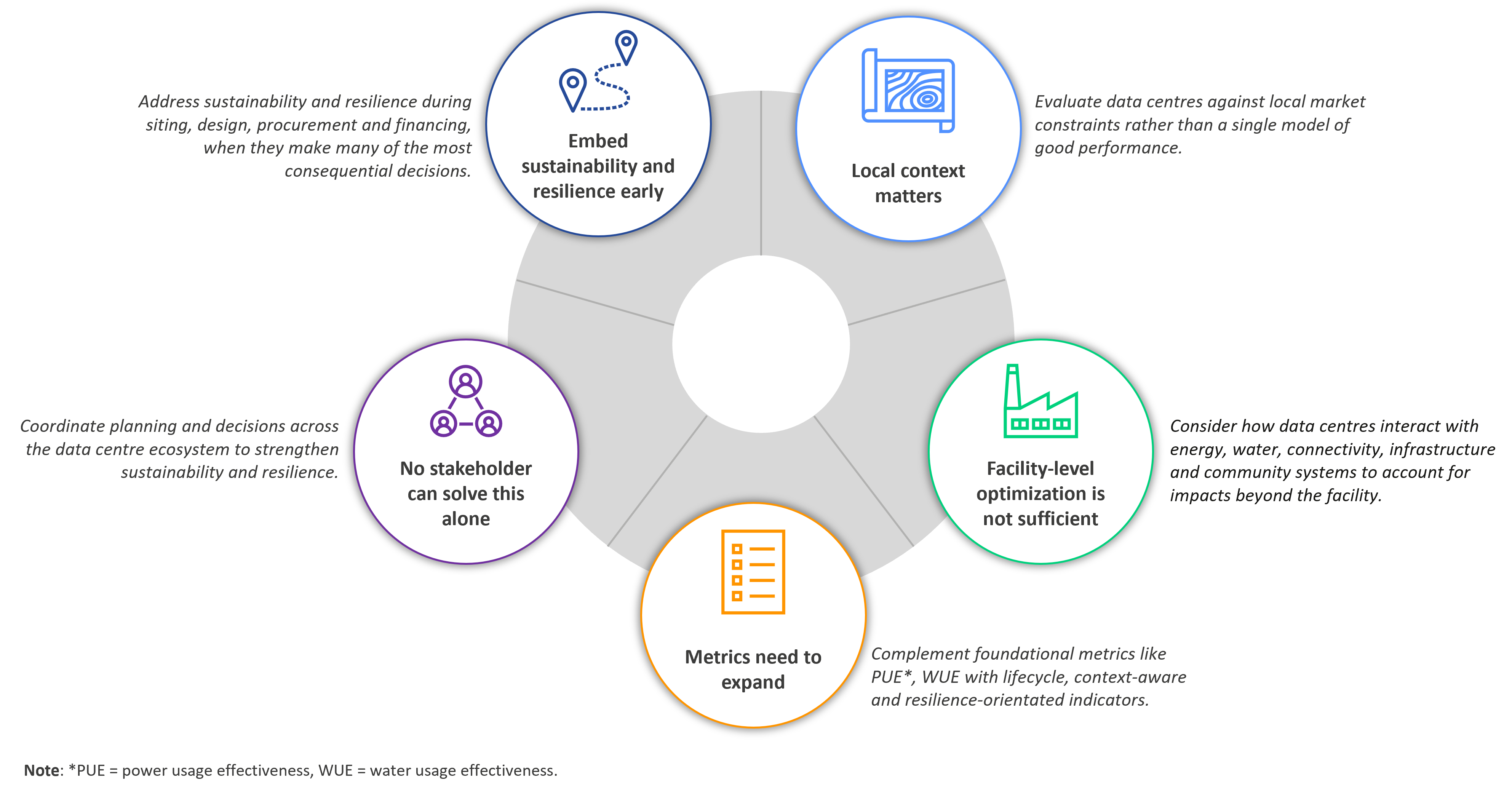
Recognizing that no single approach works everywhere, the report also provides tools to help stakeholders apply these considerations across different markets, roles and stages of development. These include a data centre development pathway, universal decision principles, recommended metrics, market constraint profiles and stakeholder-specific guidance.
How the Forum helps leaders make sense of AI and collaborate on responsible innovation
Advancing data centre sustainability and resilience is both a business imperative and a growth opportunity. Infrastructure built today will support digital economies for decades, and its success will depend on matching the speed of investment with the quality of the decisions behind it. The time to shape that outcome is now.
Maiya Mao, Senior Consultant, Oliver Wyman, a Marsh business, also contributed to this article.
Don't miss any update on this topic
Create a free account and access your personalized content collection with our latest publications and analyses.
License and Republishing
World Economic Forum articles may be republished in accordance with the Creative Commons Attribution-NonCommercial-NoDerivatives 4.0 International Public License, and in accordance with our Terms of Use.
The views expressed in this article are those of the author alone and not the World Economic Forum.
Stay up to date:
Sustainable Computing
Related topics:


Forum Stories newsletter
Bringing you weekly curated insights and analysis on the global issues that matter.
More on Artificial IntelligenceSee all

Sophia Mendelsohn
September 21, 2026


