Catch up on the key stories and developments shaping the financial world.
Top stories: Global bond sell-off deepens; Fintech funding rebounds; Macro risks stack up for autumn.
For more on the World Economic Forum's work in finance, visit the Centre for Financial and Monetary Systems.
1. Bond sell-off keeps global markets and borrowers on edge
A broad sell-off in government bonds this month has pushed borrowing costs to multi-year highs across major economies, increasing pressure on governments, companies and households.
The move has been unusually widespread. Bloomberg reports that global bond yields rose to their highest level in almost two decades in early September. And Reuters' overview of the sell-off shows how the pressure has spread. Japan’s 10-year government bond yield rose above 3% for the first time since 1996; German and French benchmark yields climbed to their highest levels in more than a decade; and long-term UK borrowing costs reached levels last seen in the late 1990s.
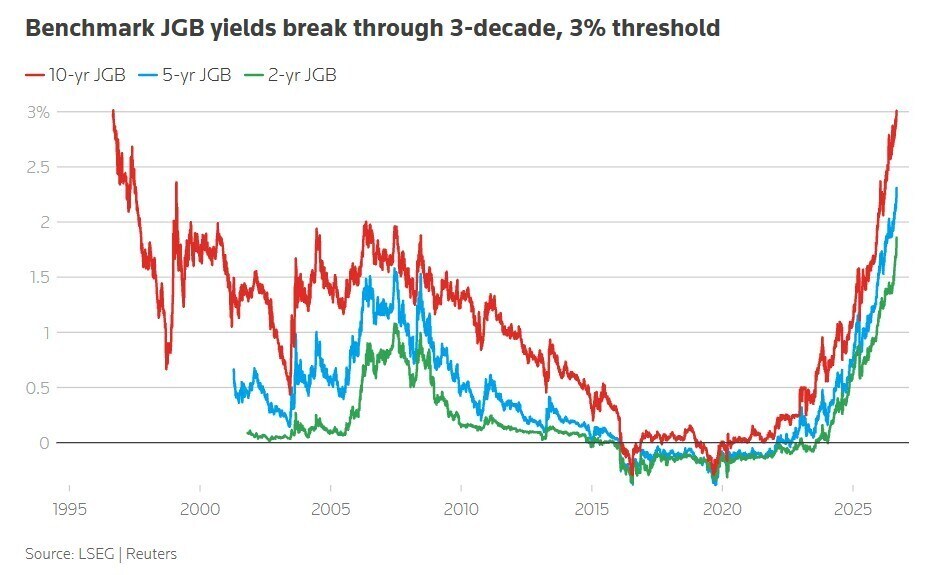
Higher government-bond yields filter through to financing conditions across the economy, affecting everything from public debt costs to mortgages and corporate borrowing.
Several forces are driving the rise. Higher energy prices have revived concerns that inflation could remain persistent, according to Bloomberg, making rapid interest-rate cuts less likely. Governments are also issuing more debt, while large tech companies are borrowing to finance investment in AI and digital infrastructure, Reuters' analysis shows. As investors absorb increased issuance, the US Treasury has expanded buybacks of longer-dated debt to support market liquidity.
Equities have also come under pressure. US shares fell as Treasury yields and oil prices increased. Higher government-bond yields can make bonds more attractive relative to equities, prompting investors to reassess riskier assets.
Investors have been moving into more defensive assets. Global money-market funds attracted $46.1 billion in the week to 2 September, LSEG Lipper data cited by Reuters shows, while short-term bond funds recorded their largest inflow since July. Government- and corporate-bond funds saw outflows over the same period.
The latest move is still smaller than the 2022 bond-market rout. Global government-bond yields rose 17 basis points over the 20 trading days through late August versus 62 basis points over a comparable stretch in 2022. The broader fixed-income market was down 4.2% for the year, compared with a peak-to-trough loss of 23% in 2022.

2. Fintech funding hits a four-year high, but only for the biggest players
A similar trend towards caution is unfolding in private markets. KPMG’s latest Pulse of Fintech report shows investors are stepping back from early-stage start-ups to concentrate capital on large, established companies with proven revenue models.
Global funding for financial technology reached $103.1 billion in the first half of 2026 – its highest level in four years – even as the overall number of completed deals fell by 16%.
Rather than funding new ventures, investors focused on a small number of massive buyouts and mergers, particularly in the US. Geographic gaps widened significantly. The Americas absorbed over 80% of global funding ($86.9 billion, driven almost entirely by $80.8 billion in the US), while investment across EMEA ($11.3 billion) and Asia-Pacific ($4.6 billion) dropped sharply amid geopolitical tensions and rate uncertainties.
Most of the capital flowed into payments companies ($44.2 billion) and AI tools ($21.4 billion). Meanwhile, digital asset infrastructure attracted $11.1 billion as traditional banks build out the systems needed to handle digital currencies safely.
KPMG notes that while capital remains concentrated in high-quality megadeals, growing institutional adoption and regulatory clarity point to a steady long-term recovery, with H2 investment expected to prioritize core infrastructure upgrades, sovereign tech resilience and AI transaction security.

3. More finance news to know
Global markets face a tight convergence of headwinds this month, testing investor appetite across major asset classes:
Central bank volatility: Back-to-back rate decisions from the Federal Reserve and Bank of Japan threaten market turbulence as policymakers signal higher borrowing costs to curb inflation.
Anthropic IPO test: A potential $100 billion listing for the AI firm will test whether public markets can absorb a new mega-cap without draining liquidity from existing tech leaders.
Fiscal and geopolitical strain: High sovereign debt levels across G7 economies and volatile energy prices leave governments with little fiscal room to cushion economic shocks.
Wall Street positions for US midterms: Ahead of November’s US midterm elections, analysts suggest institutional investors are betting on a divided Congress, expecting policy gridlock to shield AI infrastructure and defence spending from regulatory shocks.
China shores up its financial sector: Beijing is injecting around $54 billion into banks and insurers as it seeks to support lending and investment amid weak economic growth. The move will replenish capital at major state institutions and strengthen their ability to support the stock market.
Climate Week NYC targets credit risk and climate tech scaling: Financial leaders at Climate Week NYC 2026 (20-27 September) are highlighting practical priorities for lenders, including adopting AI-powered geospatial tools in underwriting to price physical climate risks and structuring financing to help early-stage climate tech qualify for standard bank debt.
BIS flags AI financing risks: The Bank for International Settlements (BIS) has warned that the AI investment boom is increasingly being financed through debt and private credit, creating potential vulnerabilities if expected returns fall short.
How the Forum helps leaders understand change in global financial systems
The Centre for Financial and Monetary Systems convenes leaders to make sense of transformation across global financial systems, from sustainability and resilience to innovation and digitalization.
By fostering cooperation and insight, the Centre helps partners align financial systems with long-term economic stability and shared prosperity.
4. Read more on Forum Stories
What does the bond sell-off mean for the global financial system? This article examines why government bonds are under pressure and what the latest moves reveal about changing investor confidence, fiscal pressures and the role of Treasuries in global markets.
A more fragmented world is changing where investors find value. Geopolitical risks, AI-driven demand and constraints on energy and critical infrastructure are widening the gap between markets and companies. This analysis explores why long-term investors may need to look beyond traditional diversification toward assets and businesses with resilient cash flows, strategic importance and exposure to structural bottlenecks.