Four shifts that could adapt agrifood innovation for a warming world
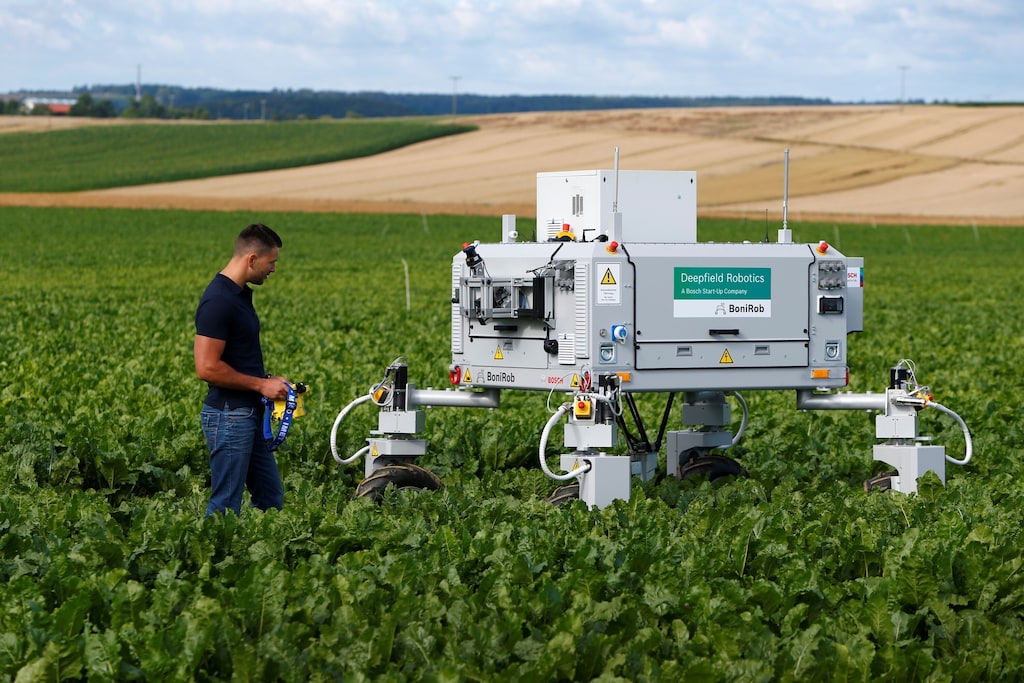
Innovation is crucial to the global agrifood sector, but there's a danger that new inventions cannot make up for the seismic changes underway in the climate. Image: REUTERS/Michaela Rehle
Vincent Martin
Director, Office of Innovation, Food and Agriculture Organization of the United Nations (FAO)- Global hunger fell for a third consecutive year in 2025, to 645 million people – 43 million fewer than at its 2022 peak, but the decline remains fragile.
- Mounting climate shocks and water stress are testing this progress, and incremental fixes to an already strained food system risk becoming a trap.
- Shifts isolated fixes to innovation bundles, from efficiency to robustness and from rigid rules to agile leadership could make agrifood systems more efficient, inclusive, resilient and sustainable.
Agrifood systems are entering what might be called the world after: not a temporary disruption we can recover from, but a lasting shift in the conditions under which food is grown, moved and eaten.
The latest State of Food Security and Nutrition in the World (SOFI) report shows global hunger has declined for a third consecutive year, to 645 million people in 2025. That is real progress, but it is still fragile, and is being tested by shocks like climate extremes. Western Europe recorded its hottest June–July on record, 2.79°C above the 1991–2020 average. By late August, the European Commission's JRC MARS Bulletin highlighted drops in EU yield forecasts for every summer crop by up to 14% below the five-year average in several countries. Water availability, temperatures and growing seasons are no longer varying around a stable baseline; the baseline itself is moving."
The instinct is to respond to this emerging challenge with more innovation: better sensors, more resilient varieties, more artificial intelligence. But marginal improvements to a system we already know is unsustainable risk becoming a trap. We improve efficiency rather than questioning the purpose, and add a technology instead of changing a rule or the system itself.
This October, as the world marks World Food Day under the theme "Innovate today. Nourish tomorrow," and governments, scientists and farmers gather in Rome for FAO’s Science and Innovation Forum, one question deserves more attention than it usually gets: not whether we are innovating enough, but whether we are innovating in the right way.
We protect today’s production from heat instead of asking whether it will remain viable tomorrow. Agrifood systems need a shift in how we think about innovation itself and that shift has four implications.
From isolated solutions to innovation bundles
A technically excellent innovation rarely transforms a system on its own. A drought-resistant seed variety still needs financing, extension services, water governance and market access to matter. This is why coherent combinations of innovations across technology, policy, finance, institutions and behaviour tend to succeed where single-point technical solutions fail.
AI illustrates the point well. It can either entrench an old paradigm, optimizing yesterday’s systems and deciding in place of farmers and institutions, or help organize a new one: equipping farmers to anticipate risks, adapt practices and make better-informed decisions, while helping explore alternative futures and test combinations of solutions. Its value depends less on its raw capability than on who shapes how it is used, and in whose interest.
From efficiency to robustness
A second shift means learning from living systems. A forest is resilient not because every tree is perfectly adapted to today’s conditions, but because it maintains diversity, redundancy and multiple response strategies that look unnecessary until the environment changes. Applied to agriculture: a less productive variety today may carry a trait that becomes indispensable tomorrow; diverse cropping spreads climate risk; soils rich in organic matter retain water better.
This is not about nostalgia for the past, nor about turning away from science. It is about recognizing that innovation can also mean observing more closely and learning from nature, recombining what exists, and valuing traditional knowledge that the pursuit of pure performance had marginalized.
The same is true of knowledge. We tend to seek rapid alignment and eliminate disagreement, yet some friction allows innovative solutions to emerge that no single actor would have imagined alone. The opportunity is to inhabit tensions between different forms of knowledge long enough for them to become creative.
From rules unchanged to rules rewritten
A single technology can improve how a system functions, but transforming the system requires deciding what we want it to become, and that is a question of policy, incentives and institutions, not only of science. A technically sound innovation often goes unadopted: not for lack of merit, but because of inaccessible financing, unsuitable regulation, fragmented institutions or simply habits and incentives that pull the other way. Taking the behavioural dimension of change seriously is as much a part of innovation as the technology itself.
A few concrete efforts point in this direction. FAO’s Innovation Policy Labs, active in Colombia, Ethiopia, Madagascar and Uzbekistan, bring governments, researchers, farmers and the private sector together to co-create and test policy responses. FAO’s Science, Technology and Innovation Portal connects knowledge and innovation actors across the wider ecosystem leveraging the ATIO - Agrifood System Technology and Innovation Outlook knowledge base. The FAO IMPACT Behavioural Design Toolkit, meanwhile, helps understand human decision-making and design interventions that support sustainable change in agrifood systems.
The World Economic Forum’s Food Innovation Hubs Global Initiative offers another example of a country-led, public-private model for agrifood innovation.
These initiatives show that innovation is not just about technology; it is also about changing how decisions are made, moving from reacting to problems towards transforming the conditions that create them.
From answers to agility
This points to a final, often overlooked shift: in leadership itself. Our leadership models were built for a world that rewarded forecasting, control and quick convergence on a single right answer. Those qualities still matter in a crisis, but they are not enough when no one knows the exact path ahead. A leader is no longer simply the person who provides the answer, but the one who creates the conditions in which new answers can emerge, organizing diversity rather than uniformity. Leading under uncertainty means keeping multiple options open, and making decisions today whose consequences may only be visible decades from now.
This is also where AI becomes most consequential: it can help more people make better decisions in a more uncertain world, surfacing risks and exploring possible futures without displacing farmers’ and institutions’ own agency.
The question, then, is no longer simply what technology we should develop, but what transformation we want to achieve, and what combination of science, technologies, practices and institutions will take us there. What agrifood systems lack is not a miracle solution, but the capacity to integrate these forms of innovation: with living systems, with technology, in our policies and institutions, and in the way we lead, not as competing choices but as dimensions to combine, building systems that can adapt and endure as the conditions around them change.
This is the paradigm shift behind this year’s call to innovate today: spending less effort trying to know the future with certainty and more effort building the capacity to perceive what is changing, imagine multiple possible futures and transform before circumstances force us to, so that we can nourish tomorrow.
Don't miss any update on this topic
Create a free account and access your personalized content collection with our latest publications and analyses.
License and Republishing
World Economic Forum articles may be republished in accordance with the Creative Commons Attribution-NonCommercial-NoDerivatives 4.0 International Public License, and in accordance with our Terms of Use.
The views expressed in this article are those of the author alone and not the World Economic Forum.
Stay up to date:
Agritech
Related topics:


Forum Stories newsletter
Bringing you weekly curated insights and analysis on the global issues that matter.
More on Food, Water and Clean AirSee all

Matt Barnard
October 15, 2026