A new competitive landscape is emerging as technological acceleration, geoeconomic fragmentation and the shifting energy landscape reshape global industries.
A World Economic Forum report explores four possible futures for how evolving energy systems could redefine growth and economic advantage by 2035.
We asked business leaders to identify the biggest uncertainties and the related strategies they’re adopting in an increasingly complex operating environment.
Dramatic advances in artificial intelligence and shifting energy appetites are redrawing the map of global economic growth.
They are driving increased demand and industrial electrification, reshaping supply chains, and creating new sources of competitive advantage. Meanwhile a more fragmented global economy, infrastructure constraints, and volatility are raising the stakes – and exposing new vulnerabilities.
As economies become more energy-intensive and global competition grows more complex, businesses and governments face a defining challenge: how to secure the energy, infrastructure and resilience needed to compete in the new economy. The choices made today will shape the competitive landscape of 2035.
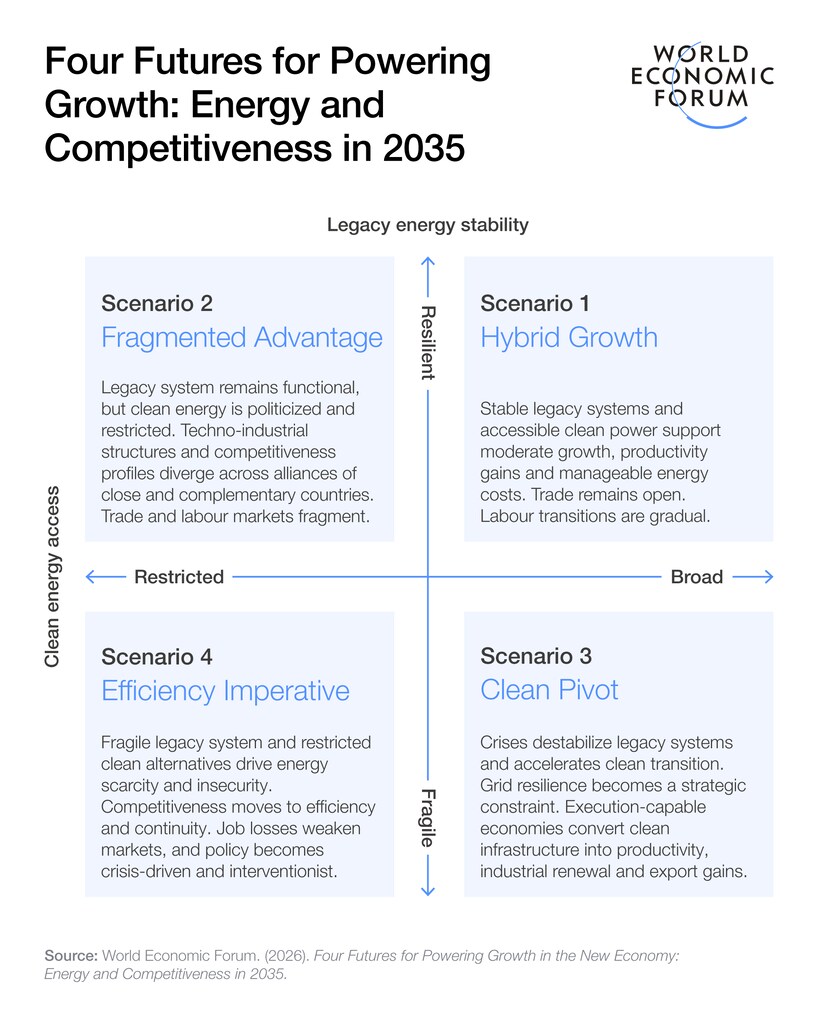
The third edition of the World Economic Forum’s Scenarios for the Global Economy Dialogue Series, Four Futures for Powering Growth in the New Economy: Energy and Competitiveness in 2035, explores four plausible futures for how the interplay between legacy and new energy systems could reshape economic growth, business strategy and competitive advantage.
These scenarios are not forecasts. They are a strategic lens applied to challenge assumptions, anticipate disruption and identify opportunities.
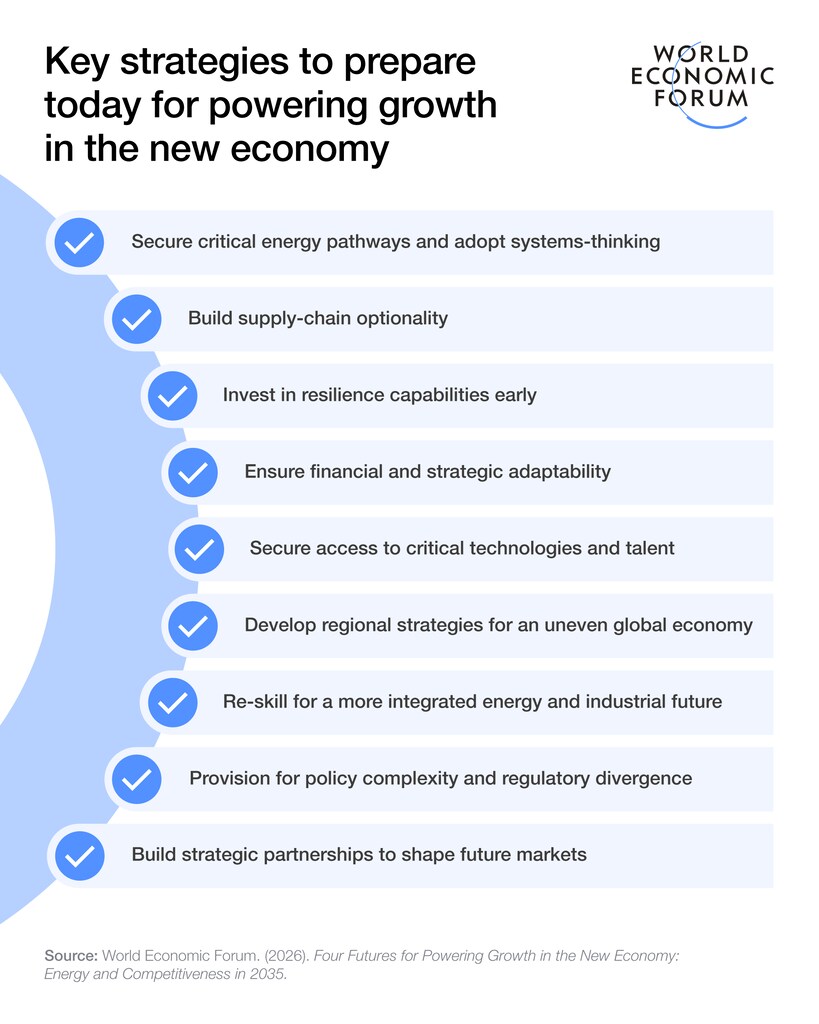
We asked business leaders how organizations in their industries and regions are adapting their strategies in response to shifting energy dynamics and intensifying geoeconomic competition.
Atul Arya, Chief Energy Strategist, S&P Global Energy
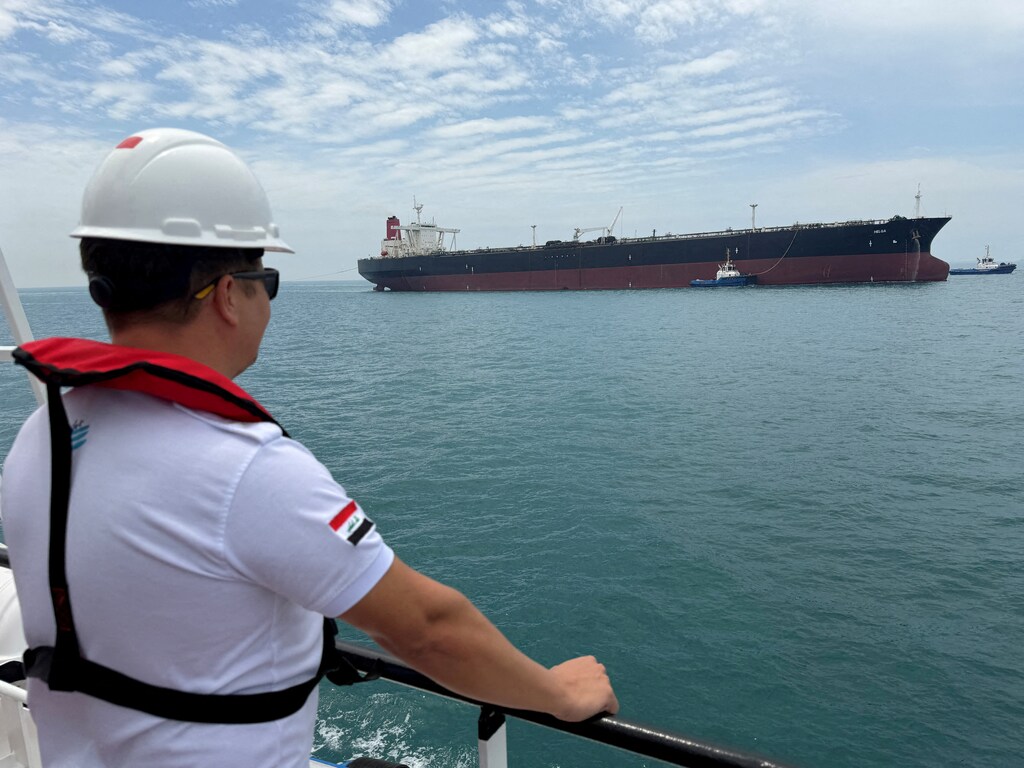
“While the closure of the Strait of Hormuz represents the largest disruption to energy supplies since World War II, the impact has fallen most heavily on Asian economies. This is particularly acute for emerging and developing Asia, which has limited domestic reserves of oil, refined products and gas, as well as far less economic capacity to absorb the resulting price shocks.
“Asian economies rely on resilient energy systems that are affordable, reliable, and secure in the face of evolving risks. For most Asian economies, particularly those still industrializing and urbanizing, energy security remains the overriding priority. Resilience in these markets is built on diversified energy systems – a mix of renewables, gas, coal, hydropower, and emerging technologies like hydrogen and carbon capture. Regional grid interconnection in places like Viet Nam, Laos, Thailand, Malaysia and Singapore offers promise for optimized, resilient systems but requires robust political will, harmonized policy frameworks, and cross-border infrastructure investments. Policymakers face a balancing act: reducing emissions without compromising affordability, reliability, and industrial competitiveness.
“Collaboration in Asia’s energy transition cannot remain aspirational. It must be specific, operationalized, cross-sectoral and realistic, and involve governments, corporates, financiers, and technology providers. Effective collaboration requires aligned incentives, shared risk-taking, and mechanisms to convert regional initiatives into actionable projects. Public-private partnerships and regional cooperation are essential enablers for scaling solutions. The Hormuz crisis is a timely reminder to act on these initiatives.”
Stephen Wackerle, Group Chief Risk Officer, TAQA
“The energy sector is operating in an increasingly complex and uncertain macro environment. Much of it driven by the transition to a more electrified, lower-carbon energy system at a time of heightened geopolitical tension, demand growth, affordability challenges and intense competition for equipment, resources and economic advantage.
“These competing tensions have required governments to revisit the balance between energy security, affordability and decarbonization, in order to stabilize a complex energy transition and uphold first principles. These adjustments are reshaping the landscape of risks and opportunities.
“In the midst of this ongoing change, companies like ours are reminded of the reality that to manage risk, thrive and grow, we must be resilient and agile. That requires a diverse, far-sighted and nimble investment thesis that limits overexposure to any single income stream, technology choice, market or supplier. It requires an approach that continues to move beyond transactional relationships, building deep trust and strengthening strategic long-term partnerships with governments, suppliers and investors.”
Ji Huishu, former Chief Risk and Compliance Officer, Green Climate Fund
“The energy transition remains imperative, because access to secure, affordable and increasingly clean energy is a fundamental determinant of competitiveness, productivity and resilience – regardless of how the global energy landscape evolves. Investing in energy transition is therefore a "no-regret" strategy that strengthens resilience and positions organizations to capture growth opportunities across any possible future.
“Investors need to support the broader energy ecosystem, recognizing that energy security, affordability, industrial competitiveness and decarbonization are mutually reinforcing. Meanwhile resilient supply chains have become strategic assets; diversifying sourcing and reducing dependence on concentrated suppliers is central to managing investment risk and ensuring the pace of the energy transition.
“Strategic foresight and scenario analysis is not only a risk management tool for value preservation, but also a source of competitive advantage and value creation. Investors can identify opportunities under different geopolitical, regulatory, and market conditions, while reducing exposure to concentrated supply chains, shifting industrial policies, and energy market volatility.
“Investors that integrate this approach into capital allocation strategy and investment decision-making, and test their portfolio against multiple energy futures, will be better positioned to navigate uncertainty and identify new opportunities – regardless of which particular future ultimately unfolds.”