How Africa can build leverage in the era of 'minilateral' global trade
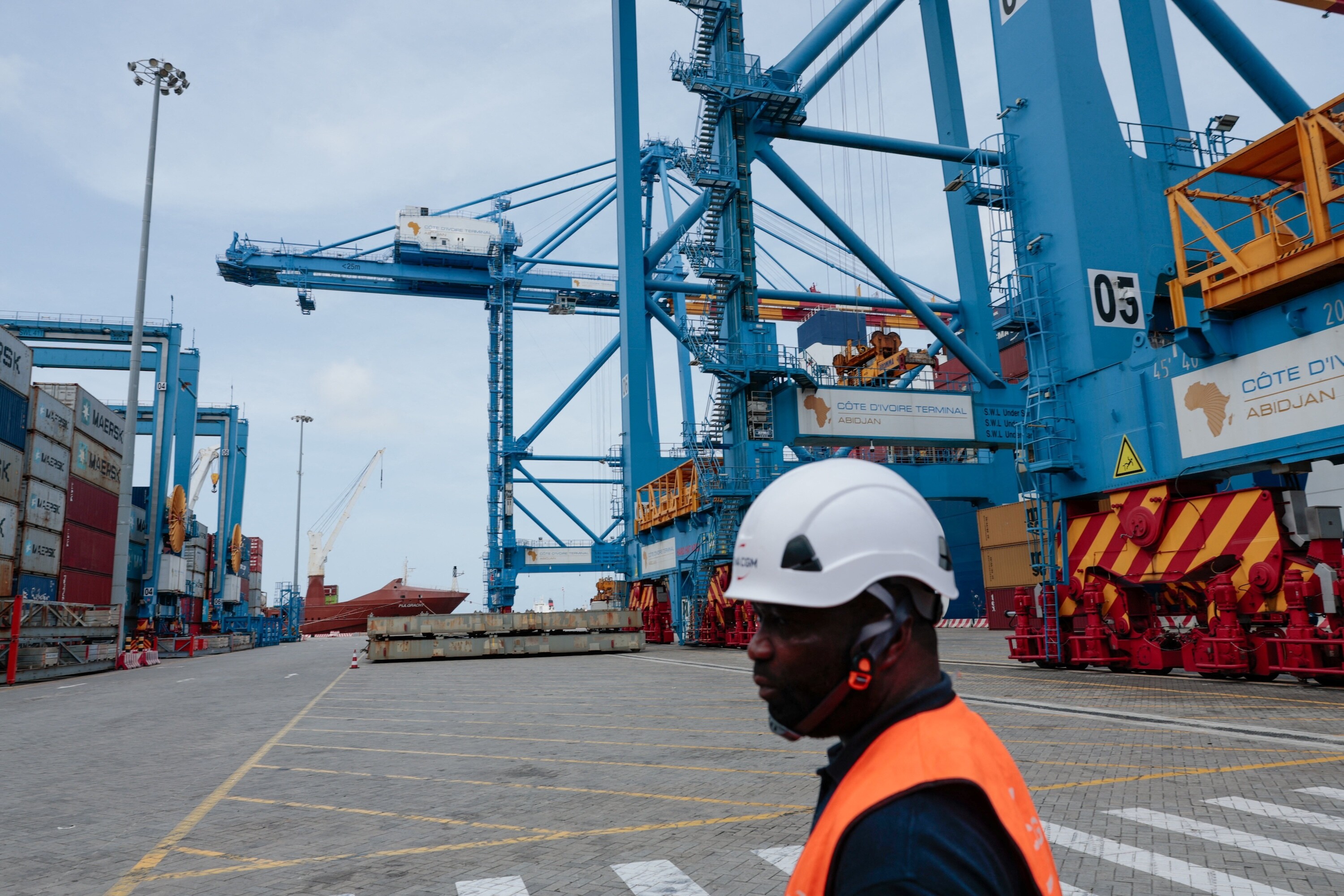
Minilateralism presents an opportunity for Africa – but only if the continent negotiates in coordination. Image: Luc Gnago/Reuters
Mark-Alexandre Doumba
Minister of Digital Economy and Innovation, Ministry of Digital Economy and Innovation of Gabon- Africa's share of global merchandise exports fell from 4.8% in 1973 to 2.7% in 2025, despite the continent holding a third of the world's mineral reserves.
- As multilateralism stalls, minilateral coalitions of countries with aligned interests are becoming the new arena of trade.
- Mark-Alexandre Doumba, Gabon's Minister of Digital Economy and Innovation, explains how the era of minilateralism could work in Africa's favour.
Africa has spent decades becoming more integrated into the global trading system. Yet integration has not translated into a larger share of global value creation.
As the rules of trade are now being reshaped around technology, industrial policy, energy security and strategic supply chains, the question is no longer simply how Africa can participate. It is whether it can participate on terms that allow it to capture more value.
At this year's Summer Davos, a key topic of conversation was the erosion of multilateralism and the rise of minilateralism; the idea that trade among smaller groups of countries with aligned interests can produce better outcomes than unwieldy global negotiations.
The growing number of bilateral and plurilateral agreements across income levels suggests the world is already voting for minilateralism with its feet. Since the global financial crisis, multilateral negotiations on trade, industry, the green transition and emerging technologies have stalled. Countries everywhere have quietly concluded that multilateralism, in its current form, no longer optimizes collective interest.
Africa's position in global trade is slipping
Nowhere are the stakes in this higher than in Africa. Over the past five decades, Africa's share of global merchandise exports fell from about 4.8% in 1973 to 2.7% in 2025. During the same period, China’s share of global merchandise exports grew from 1% to 14.8%, even as world merchandise trade expanded from $579 billion to $25 trillion. Africa became more integrated into the global trading system, yet captured a steadily shrinking share of global trade. Africa holds roughly a third of the world's mineral reserves, including the largest known deposits of cobalt, platinum, manganese and chromium on earth – and one of the largest consumer markets by population. The continent watched from the sidelines as others captured global trade.
The pattern sharpens further up the value chain: Africa's share of manufactured exports sits at 1.4%, and in digitally-delivered services, the fastest-growing category in world trade, its share is below 1%. The more complex the goods and services, the less African countries produce what they consume. As AI-related investment becomes an increasingly important driver of growth in global merchandise trade, these patterns will accentuate if left unaddressed.
As my fellow panelist the Honorable Cody Blois put it, middle powers need to "coalesce around specific shared interests in smaller, more purposeful groupings." The question is not whether minilateralism is rising – it clearly is. The deeper question is whether African countries can enter these smaller rooms with enough leverage to produce outcomes different from what the multilateral system delivered.
That requires confronting an uncomfortable reality. The continent now has the political will and institutional maturity to engage the world on more assertive terms, just as those terms are being rewritten to raise the cost of entry considerably. The AI-driven economy is structurally different from previous industrial transitions: more capital-intensive, more technically demanding, more energy and resource-intensive, and dependent on infrastructure concentrated in a handful of geographies, principally the United States and China. In earlier transitions, openness and comparative advantage could deliver meaningful participation over time. Today, the capacity to produce or secure critical inputs domestically, or through trusted partnerships, has become the determining factor in who captures value and who remains at the extractive end of the chain.
How Africa can catch up in global trade
Africa's challenge is not simply to trade more. It is to capture more value from what it trades. Two actions are necessary.
The first is beneficiation: processing strategic raw materials at home before export, rather than shipping the inputs of someone else's industrial value chain and re-importing the finished product. In Gabon, President Oligui Nguema's decree prohibiting the export of raw manganese takes effect in 2031. The policy illustrates how resource policy can be used not simply to regulate exports, but to deliberately reposition an economy within a value chain and create incentives for greater domestic processing to increase the share of value captured before commodities leave the country. Its success will depend on whether the necessary infrastructure, energy, capital and industrial capabilities are developed alongside the policy.
The second is digital diffusion. Routing more economic activity through digital infrastructure and platforms does more than improve government efficiency; it formalizes economic activity, increases productivity, expands the tax base and gives governments the fiscal capacity to support industrial upgrading. Countries that digitize can build better economic data, more efficient institutions and more sophisticated markets – and, increasingly, create the conditions to export value-added digital services rather than merely physical commodities.
Together, these two shifts fundamentally change Africa's negotiating position. African countries, organized in minilateral coalitions, arriving at the table with processed minerals, digitized economies and growing domestic markets can become negotiating partners with greater bargaining power.
A more industrialized and digitally connected Africa would not only improve outcomes for the continent. It would also strengthen the global economy by making supply chains more resilient, diversifying the production of critical inputs, expanding markets for innovation and contributing to more balanced and sustainable growth. Africa's structural transformation is therefore not only an African imperative; it is a global economic opportunity.
Why Africa needs to negotiate as a bloc
But leverage alone is not enough. Smaller rooms do not automatically produce fairer outcomes; they produce more efficient ones, which is not the same thing. African countries with significant mineral wealth have too often been approached individually, precisely because bilateral negotiations are easier to tip in one side's favor. The antidote is to agree on common negotiating principles, shared red lines and the patience to walk away from deals that do not generate the spillovers the continent needs. Minilateralism works for Africa only if African countries treat it as a bloc strategy, not a series of individual transactions.
The multilateral system is not under strain because global cooperation is the wrong idea. It is challenged because countries at every income level competed to capture higher-end segments of the value chain, often with a zero-sum mindset that left little room for the structural transformation Africa needed. The lesson is not that openness was a mistake. It is that openness without productive capability rarely produces structural transformation.
The next era will reward leverage as much as openness. Africa has spent decades participating in global trade without sufficient bargaining power. The question is no longer whether Africa will have a seat at the table. It is whether, when it takes that seat, it arrives not simply as a supplier of inputs or as a co-creator of the industries that will define the global economy.
Don't miss any update on this topic
Create a free account and access your personalized content collection with our latest publications and analyses.
License and Republishing
World Economic Forum articles may be republished in accordance with the Creative Commons Attribution-NonCommercial-NoDerivatives 4.0 International Public License, and in accordance with our Terms of Use.
The views expressed in this article are those of the author alone and not the World Economic Forum.
Stay up to date:
Africa
Related topics:


Forum Stories newsletter
Bringing you weekly curated insights and analysis on the global issues that matter.
More on Trade and InvestmentSee all

Per Kristian Hong, Guillaume De Lescluze, Memia Fendri and Hendrik Gaens
September 7, 2026


