The Strait of Hormuz disruption highlights how the global economy's resilience depends on access to interconnected systems.
Food security is now shaped beyond the farm field by external factors such as energy, fertilizer, logistics, finance and geopolitics.
The question now is not only whether enough food, energy or materials exist, but who can secure them when markets tighten.
The disruption in the Strait of Hormuz is not simply another energy shock. It reminds us that the global economy’s resilience increasingly depends on access to interconnected systems, not individual commodities.
Food security is no longer shaped primarily in the farm field, but rather upstream across energy, fertilizer, logistics, finance and geopolitics.
As climate volatility increases and geopolitical fragmentation weakens the world's ability to absorb shocks, resilience itself is being redefined, and food security will depend on countries’ and companies’ ability to secure and reallocate critical inputs.
How global disruption is impacting food commodities
The Hormuz crisis has most immediately affected energy. But the subsequent high fuel prices affect food commodities in several ways – from diesel powering farmers’ machinery and irrigation systems to freight costs for both inputs and crops.
Beyond energy, natural gas provides the hydrogen and energy needed to produce ammonia and urea, both critical building blocks for nitrogen and phosphorus fertilizers. Meanwhile, sulphur, a by-product of oil and gas refining, is key to processing phosphate rock into phosphorus fertilizers.
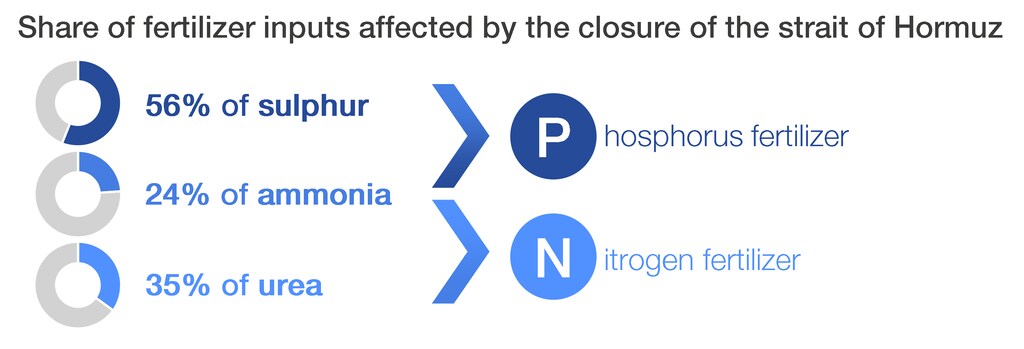
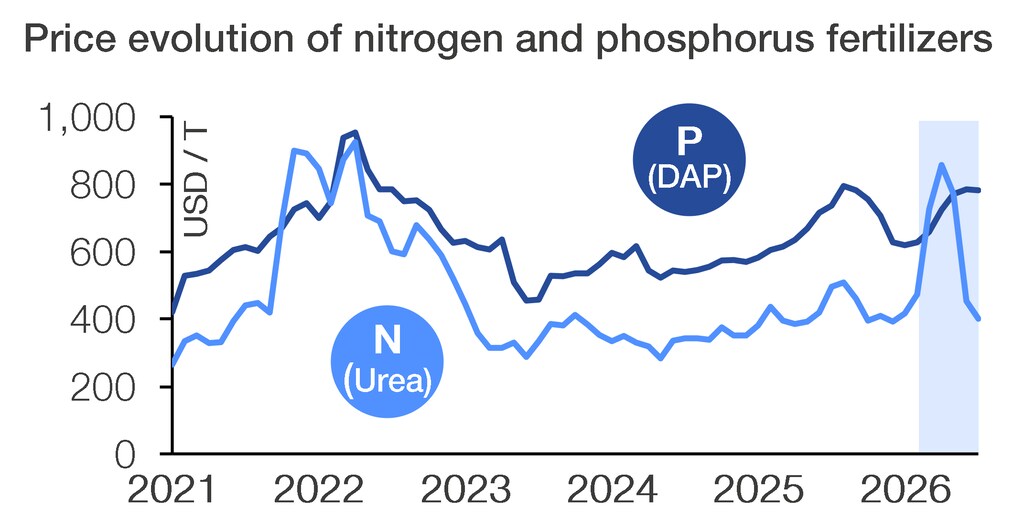
The shock has significantly increased nitrogen- and phosphorus-linked fertilizer prices over the past months. Synthetic fertilizers have become indispensable to growing the staple crops that feed billions around the world, so high fertilizer costs put food prices and availability at risk.
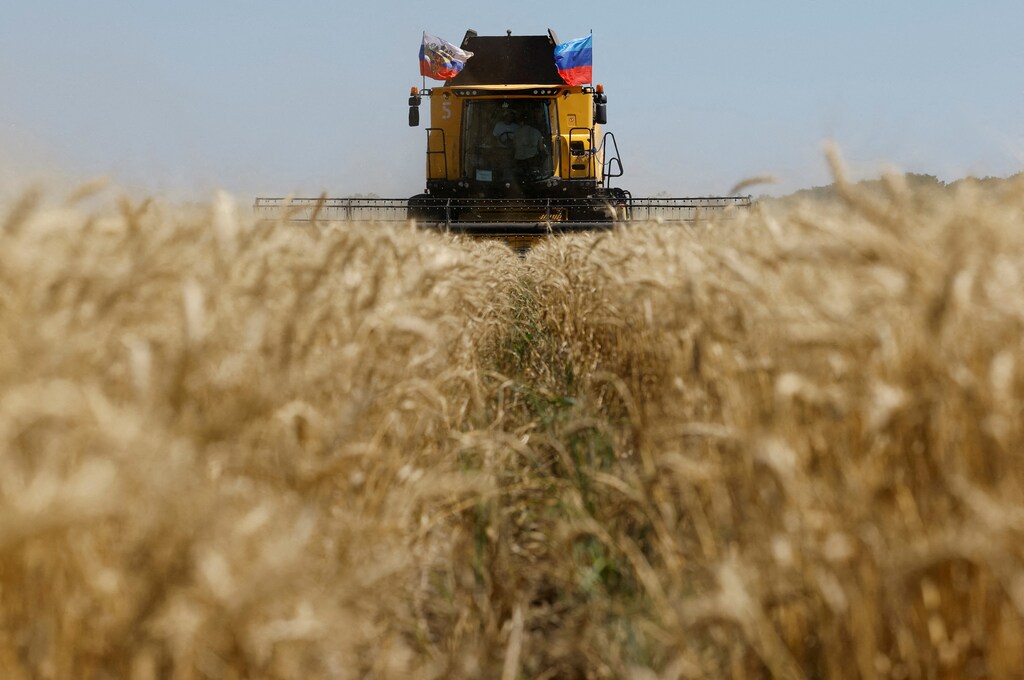
In Russia and Ukraine, the world’s largest and fifth-largest wheat exporters respectively, strikes on refineries and port infrastructure have caused nationwide fuel crises and all but halted grain exports at the dawn of the harvest season.
At the same time, scientists predict this year’s El Niño – a cyclical climate phenomenon fuelled by unusually warm ocean waters in the Pacific – might be one of the strongest on record. Such a ‘super’ El Niño can severely affect global temperatures and rainfall and increase the risk of extreme weather. Over the next months, this could mean severe droughts and extreme flooding, further reducing yields across producing regions.
Economic impact on farmers and how they can respond
For farmers, the economic impact is significant. Fertilizer represents roughly one-third of their production costs. Add higher diesel and transport costs, as well as greater uncertainty over yields due to El Niño, and margins can deteriorate rapidly – impacting decisions on which fields and crops to plant and on how much fertilizer to apply.
Among the possible decisions farmers can take, a significant reduction in fertilizer application is unlikely, particularly in maize, where yield response is high. Farmers are more likely to save on fungicides or seed variety.
Fertilizer price spikes can also encourage substitution toward less fertilizer-intensive crops. However, rotations, equipment, contracts, local agronomy, market demand, and policy constrain these shifts. In 2022, soybeans were widely discussed as a corn substitute, particularly in the United States; in practice, however, soybean acreage increased only marginally.
Acreage reduction is another possible response, especially in the US where land is often rented on relatively short-term contracts. In 2022, amid fertilizer and fuel price shocks following the conflict in Ukraine, US maize production was down 9%, mostly due to a 7% decrease in harvested area, contributing to an increase in domestic food prices and a 35% reduction in exports.
How shocks reshape crop competitiveness
Exposure to shocks such as the Hormuz crisis varies, as the risk to the food supply is highest for crops most sensitive to fertilizer and weather and for which substitution options exist.
Among the largest crops by global yield, maize is the most exposed. It is highly nitrogen-dependent, mechanized and vulnerable to heat and moisture stress. Substitution options like soybean, which require less nitrogen, exist, though just like in 2022, large-scale switching is unlikely.
Higher fuel prices could also shift demand towards biofuels, raising food prices.
Wheat is also fertilizer-sensitive, but farmers have fewer practical alternatives: it is a core food staple, often embedded in established food systems. Rather than switching crops, farmers are more likely to reduce fertilizer application, putting yield directly at risk.
Rice responds strongly to nitrogen, especially in irrigated systems, but is often tied to paddy infrastructure and local consumption needs. Fertilizer scarcity, droughts or floods are therefore more likely to reduce yields rather than prompt farmers to reduce acreage.
How compounding pressures become food crises
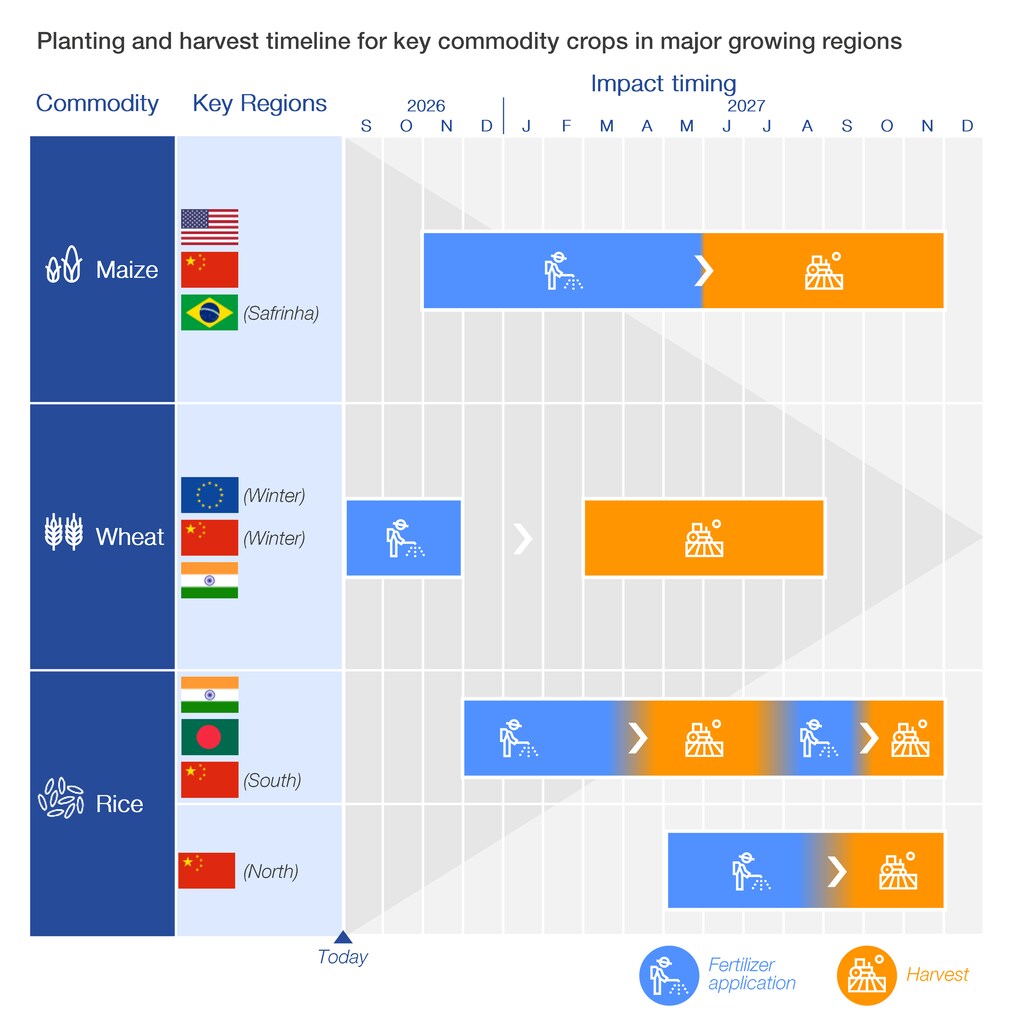
Timing is also a factor. Food systems move slowly: gas is extracted, fertilizer is produced, shipped and stocked, farmers act during specific windows, weather affects crops throughout the season, and the effect on food commodities only truly materializes after harvest.
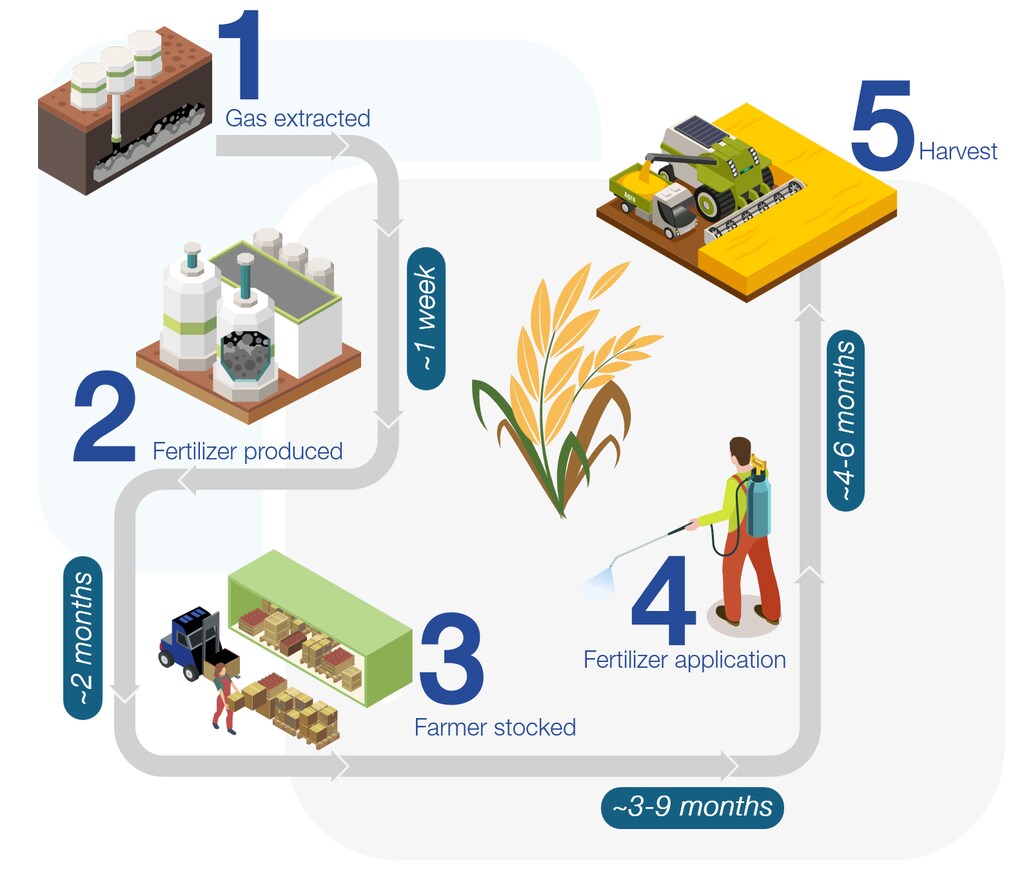
As fertilizer stocks run out and disruption persists, planting seasons are already being affected. Fuel shortages and the war in Ukraine are already putting spring wheat harvests at risk and could make wheat the first commodity to be severely affected.
One more month of fertilizer constraints will affect global winter wheat planting seasons and tighten wheat supply as early as the first half of 2027.
Rice production could also soon be impacted, as another three months of fertilizer disruption would hit planting in most tropical regions. El Niño-related rainfall would further reduce yields expected in the first half of 2027.
In the US, top-dressing windows for maize at the end of 2026 are already at risk. Six more months of fertilizer shortages threaten harvests in the second half of 2027. Droughts in the US and Brazil would likely put further pressure on corn yields, further stretching food supply.
Regardless of the crop, reduced harvests would matter most for regions dependent on imports. Export restrictions by major producers can protect domestic consumers but further price out importers in Southeast Asia, South Asia and Africa.
Resilience is reshaping competitive advantage
Resilience cannot just be managed at the farm. It requires end-to-end visibility across feedstocks, fertilizer production, shipping routes, inventories, planting calendars and demand signals.
For farmers and food companies, the key imperative is building optionality. That means diversified fertilizer and commodity suppliers, better up- and downstream visibility through data sharing with suppliers, distributors and customers, and scenario planning that links fertilizer and commodity price thresholds, and planting windows.
For policy-makers, the priority is not just emergency subsidies. It is targeted support that keeps fertilizer accessible where yield losses would be most damaging, while avoiding export restrictions that amplify global volatility.
The pressures converging around food point to a broader shift in how competitive advantage is built. In a more fragmented and volatile world, the central question is not only whether enough food, energy or materials exist, but who can secure them when markets tighten, and established routes fail.
Across food systems and beyond, resilience is increasingly defined by agility: the ability to keep resources moving, preserve choice and respond quickly as shocks become more frequent and interconnected.


