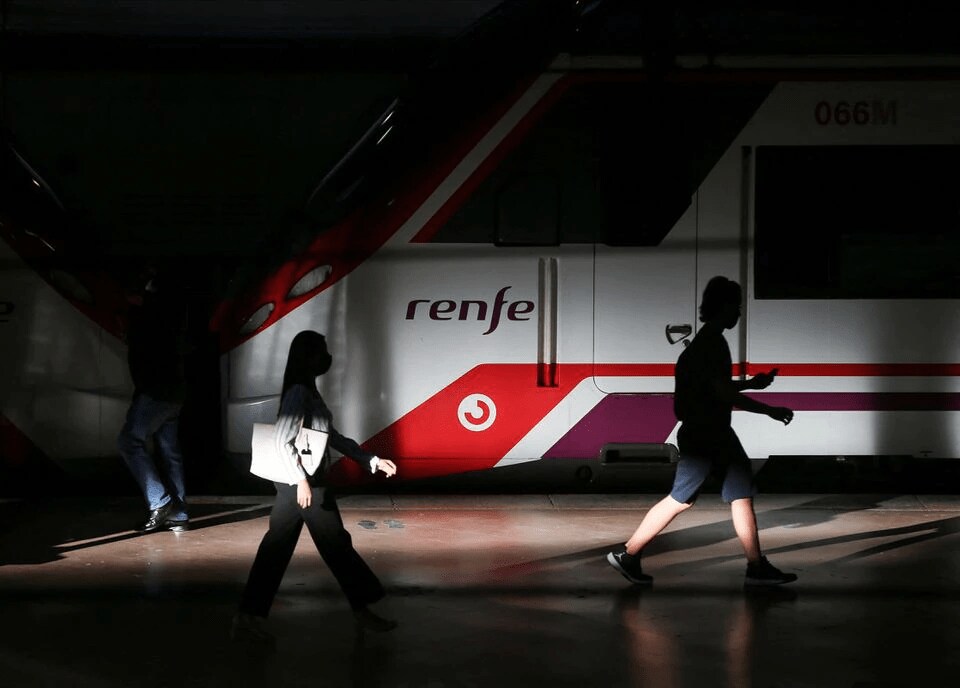
Spain's government is trying to reduce people’s living expenses at a time of high inflation by providing free monthly railway passes.
Almost half a million people have already pre-ordered the free travel cards, with some families potentially saving more than €80 a month.
The move is part of a package of measures to mitigate price rises, which also includes value-added tax reductions.
After struggling a bit with the ticket machine at Madrid's grand 19th century Atocha railway station, 26-year-old Jennifer Bernard Quintana and her sister became the happy owners of free travel passes valid from Thursday.
With inflation near record highs of above 10% year-on-year, Spain's Socialist-led government hopes to alleviate living expenses and encourage more people to take public transport by providing them with free monthly passes for all local and medium-range intercity routes. Long-haul trips and single tickets are excluded.
"I think it's a great initiative," Jennifer, who works in social media, told Reuters.
"I'd love this to be a permanent thing as it would help to make things in general less expensive and we'd have more mobility... this is a good way for the government to invest the money we pay in taxes."
Her mother Toni, 55, said the discount would help the family save more than 80 euros ($80) a month on her two daughters' transport cards.
"We need more initiatives like this," she said. "We parents can't pay anymore. We don't have the same budget for doing the same things with our children as we did before."
Almost half a million people have already pre-ordered the free transportation cards, and state-owned railway operator Renfe expects the scheme, in force until year-end, to result in 75 million free railway journeys.
How is the World Economic Forum promoting safer, cleaner and more inclusive transportation systems?
The World Economic Forum’s Platform for Shaping the Future of Mobility works across four industries: aerospace and drones; automotive and new mobility; aviation travel and tourism; and supply chain and transport. It aims to ensure that the future of mobility is safe, clean, and inclusive.
Through the Clean Skies for Tomorrow Coalition, more than 100 companies are working together to power global aviation with 10% sustainable aviation fuel by 2030.
In collaboration with UNICEF, the Forum developed a charter with leading shipping, airlines and logistics to support COVAX in delivering more than 1 billion COVID-19 vaccines to vulnerable communities worldwide.
The Road Freight Zero Project and P4G-Getting to Zero Coalition have led to outcomes demonstrating the rationale, costs and opportunities for accelerating the transition to zero emission freight.
The Medicine from the Sky initiative is using drones to deliver vaccines and medicine to remote areas in India, completing over 300 successful trials.
The Forum’s Target True Zero initiative is working to accelerate the deployment and scaling of zero emission aviation, leveraging electric and hydrogen flight technologies.
In collaboration with the City of Los Angeles, Federal Aviation Administration, and NASA, the Forum developed the Principles of the Urban Sky to help adopt Urban Air Mobility in cities worldwide.
The Forum led the development of the Space Sustainability Rating to incentivize and promote a more safe and sustainable approach to space mission management and debris mitigation in orbit.
The Circular Cars Initiative is informing the automotive circularity policy agenda, following the endorsement from European Commission and Zero Emission Vehicle Transition Council countries, and is now invited to support China’s policy roadmap.
The Moving India network is working with policymakers to advance electric vehicle manufacturing policies, ignite adoption of zero emission road freight vehicles, and finance the transition.
The Urban Mobility Scorecards initiative – led by the Forum’s Global New Mobility Coalition – is bringing together mobility operators and cities to benchmark the transition to sustainable urban mobility systems.
Contact us for more information on how to get involved.
"It's very easy to apply and to use. Given the economic situation, for us this is a great help," said 18-year-old student Anastasia Adamova.
Germany has promoted a similar initiative, starting in June and ending in September, which was a huge success and reduced traffic jams in major cities.
The Spanish scheme, which also includes discounts on other types of public transport, will cost 221 million euros. It is part of the latest aid package to mitigate price rises, approved in June, worth a total of 9.5 billion euros, including value-added tax reductions and Social Security exemptions.