How to power Europe’s industrial competitiveness in an era of uncertainty
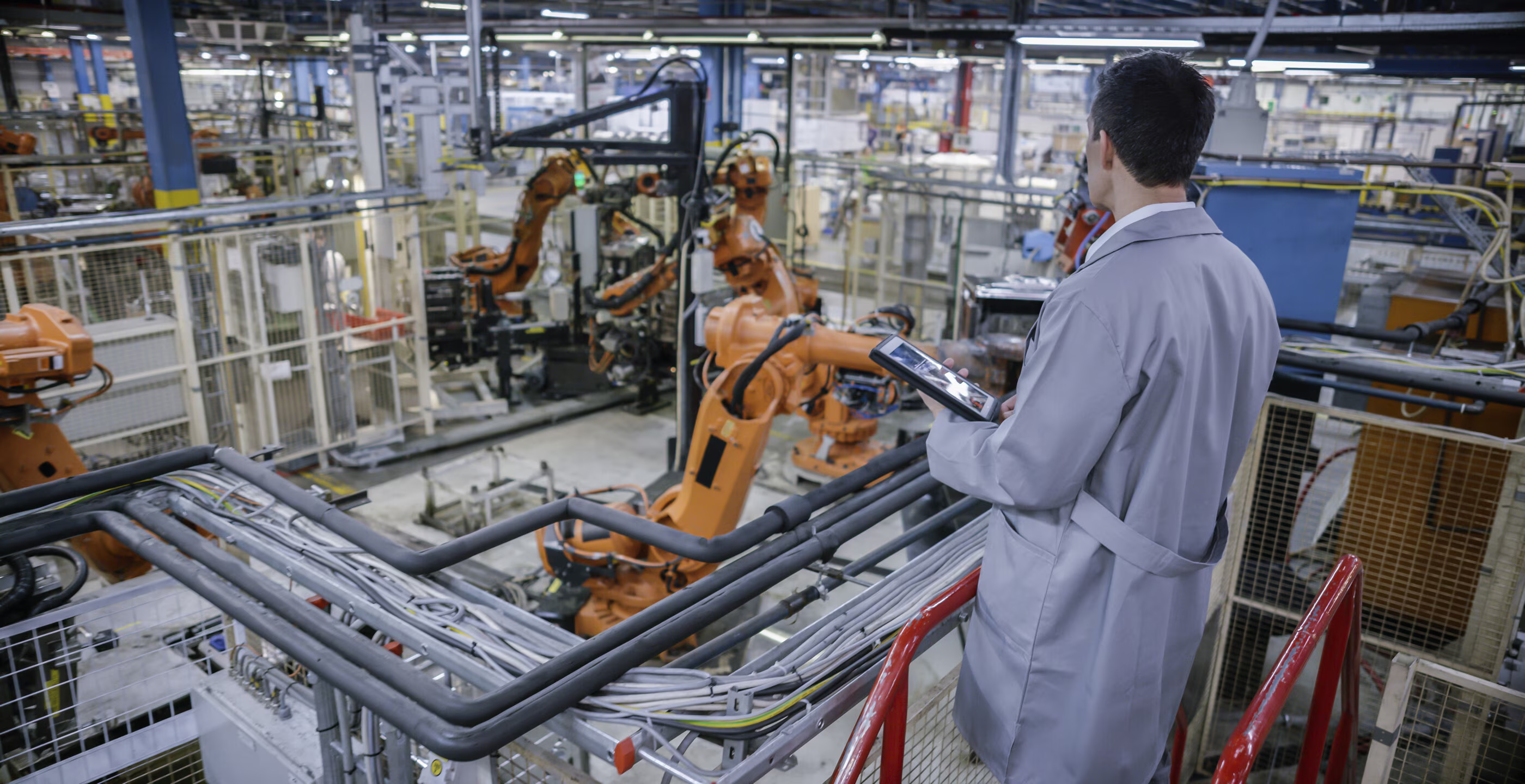
Established industries such as manufacturing and construction are integral to Europe’s ambition to compete on the global stage. Image: Getty Images
- The EU’s Industrial Accelerator Act marks a shift towards domestic manufacturing to boost Europe’s economic competitiveness.
- Secure and affordable energy supply is the critical variable for sustaining large-scale industrial expansion.
- Massive infrastructure investment is required to bridge the widening gap between energy supply and demand.
The European Commission unveiled its Industrial Accelerator Act in March, sending a clear and unambiguous message: the continent’s economic future hinges on the strength of its industrial base. The legislation is set to introduce streamlined permitting, “Made in EU” procurement preferences, and tighter conditions on foreign investment in strategic sectors. It represents Brussels’ most assertive industrial policy shift in decades. This is a direct response to mounting global competition and a frank acknowledgment that Europe must manufacture its way to prosperity, not merely regulate its way there.
The stakes are difficult to overstate. Established industries such as manufacturing, chemicals and construction are integral to Europe’s ambition to modernize and compete on the global stage. They provide more than 20% of added value to the European economy, employ over 20% of the continent’s workforce, and are expected to grow by more than 12.5% through 2027. The Industrial Accelerator Act puts forward an explicit target: raising manufacturing’s share of EU GDP to 20% by 2035. Delivering on that ambition will demand not only regulatory reform but the physical and financial infrastructure to support it. Moreover, mobilizing the materials and labour needed to sustain the initiative will hinge on flexible yet reliable models of collaboration amongst key regional leaders.
Europe’s industrial revitalization
But above all these considerations lies the most important factor in Europe’s industrial revitalization: its access to secure, stable and affordable energy. Across the continent, manufacturing accounts for nearly 25% of final energy use, while transport (rail, road, domestic aviation and inland shipping) consumes a further 31%. Coupled with rapidly rising consumption from the build-up of AI data centres and the wider digital economy, both of which are critical to the region’s plans for future growth, energy consumption is now expected to increase fourfold. Every percentage point of industrial and digital expansion translates into additional terawatt-hours of demand.
This arithmetic is unforgiving, especially when one considers how the ongoing conflict in the Middle East has roiled global energy markets and compounded supply chain vulnerabilities that were first exposed just a few years ago. Price volatility, infrastructure bottlenecks and geopolitical risk now form a persistent backdrop against which European manufacturers will likely have to plan capital expenditure, infrastructure development and even personnel hiring. In this context, supply security is no longer a background condition – it is the competitive variable that will drive immediate stability and long-term progress throughout Europe’s industrial base.
Modernizing energy infrastructure
Mastering this variable requires investment in a balanced energy mix, reliable infrastructure and efficient networks capable of delivering power at pace and scale. Europe’s industrial transformation and economic resilience depend on resource diversification and systems modernization – maximizing the value of gas, renewables, nuclear and hydrogen, intelligently integrated and digitally optimized to ensure affordable and abundant supply. The continent’s immediate stability and future growth cannot rest on a single resource or outdated grids, a reality underscored by the estimated €3.5 trillion needed to develop energy systems that can withstand external shocks and absorb projected demand surges.
The urgency of Europe’s situation is unmistakable, but the challenge of modernizing energy infrastructure is no longer a localized undertaking – it is a high-stakes race for economic competitiveness and resilience with other regions competing fiercely for the same pool of global capital.
The United States is accelerating its push towards domestic manufacturing and AI leadership, with the explicit aim of reducing external dependence. In Asia, China continues to dominate the supply chain for renewable hardware, leveraging massive-scale investment to drive down the cost of energy, while countries like Japan and South Korea are pioneering the integration of hydrogen into their long-term manufacturing blueprints as a cornerstone of energy security. It is no coincidence that the World Economic Forum’s Annual Meeting of the New Champions, convening in Dalian, China this June, has placed industrial resilience and energy transition at the heart of this agenda. The gathering reflects a broader regional conviction: that the economies best positioned to lead the next decade will be those that have already aligned capital, policy and infrastructure behind a coherent long-term energy strategy.
A simple truth
For both Europe and the rest of the world, industrial renaissance will not be powered by policy pronouncements alone. It will be driven by pragmatic investments in the resources and infrastructure that can support an increasingly complex and energy-intensive economic landscape. The Industrial Accelerator Act has articulated the destination; now the continent must secure the fuel required to get there.
Europe faces a simple truth: the continent’s industrial revival demands supply security and infrastructure development at an unprecedented scale.
”That need for fuel is already driving action. Just last week at the Hannover Messe event in Germany, regional stakeholders gathered for the launch of Europe Energy Week, a new platform purposefully designed to bring the entire energy value chain together with the European industries that depend on reliable and affordable energy most – from manufacturing and logistics to data centres and district heating. With just a condensed version on show this year, Europe Energy Week will debut fully in 2027, co-located with Hannover Messe to offer something increasingly rare amid rising global volatility: coordinated and consequential action to secure supply for key industries and sustain Europe’s long-term competitiveness.
Europe faces a simple truth: the continent’s industrial revival demands supply security and infrastructure development at an unprecedented scale. Manufacturing, logistics, data centres and district heating all consume more power than current grids can deliver, while widespread electrification and AI expansion are making these gaps wider every month. In the face of this unavoidable need for transformation, coupled with a global landscape increasingly defined by geopolitical instability, government and industry leaders must immediately mobilize the capital and collaboration needed to build resilient energy systems that can power enduring growth – or witness their competitors pull decisively ahead.
Don't miss any update on this topic
Create a free account and access your personalized content collection with our latest publications and analyses.
License and Republishing
World Economic Forum articles may be republished in accordance with the Creative Commons Attribution-NonCommercial-NoDerivatives 4.0 International Public License, and in accordance with our Terms of Use.
The views expressed in this article are those of the author alone and not the World Economic Forum.
Related topics:

Forum Stories newsletter
Bringing you weekly curated insights and analysis on the global issues that matter.
More on Trade and InvestmentSee all

Christophe Bernasconi
September 10, 2026


