As space and biotechnology research converge, here's how it affects life on Earth
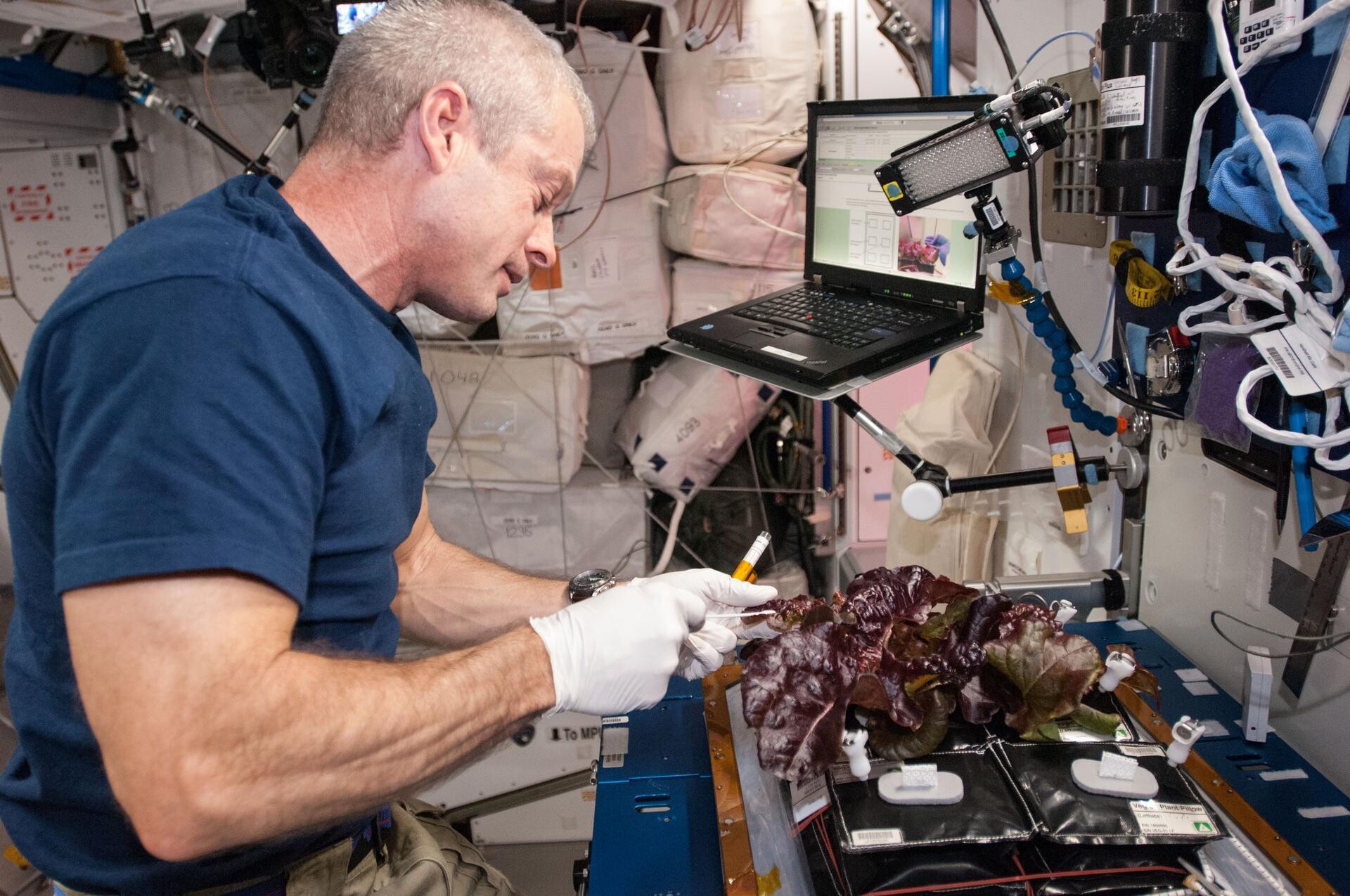
Space and biotechnology research advances are converging. NASA astronaut Steve Swanson, Expedition 40 commander, harvests a crop of red romaine lettuce plants grown on the International Space Station. Image: NASA Official
Paul Freemont
Co-Director, Innovation and Knowledge Centre for Synthetic Biology, Imperial College London- Space and biotechnology research are converging, with advances from decades of space flight being applied to health, agriculture and sustainability issues on Earth.
- This matters because the planet now faces constraints that were once unique to space, including water scarcity, supply chain disruptions and environmental stress.
- Translating insights from orbit into scalable solutions will require new models of partnership, investment and knowledge exchange.
The recent Artemis II mission returned astronauts to deep space for the first time in over 50 years, bringing human space flight to a new phase. It also signaled something broader – the growing convergence of space technologies and biotechnologies.
Advances from decades of human space flight are reshaping resilience in extreme environments like space, but they can also be applied to healthcare, agriculture and sustainability here on Earth.
After more than 25 years of continuous human presence aboard the International Space Station (ISS), it has matured into a fully operational testbed for sustaining life. It has driven the development of integrated life-support systems capable of recycling water, regenerating air, converting waste into usable resources and continuously monitoring human health.
These reliable, closed-loop systems are designed for autonomy. They now offer a working model for managing scarce resources on Earth, marking a shift from space-specific solutions to Earth-relevant applications.
This shift matters now because the planet is beginning to face constraints that were once unique to space. Water scarcity, supply chain disruptions and environmental stress are forcing a move towards circular systems. Technologies originally built for orbit, such as water recovery, biological waste conversion and decentralized diagnostics, are directly informing solutions for food systems, localized healthcare and urban sustainability.
Building on these advances, space is transforming how we study and engineer biology. Microgravity provides a fundamentally different environment – one that reveals biological dynamics that are difficult or impossible to observe on Earth.
This kind of closed-loop life support is becoming a blueprint for infrastructure that can operate under pressure. Space and biotechnology are not just intersecting, they are beginning to operate as a unified system of innovation.
Applying orbital insights to life on Earth
In orbit, the human body undergoes rapid and measurable changes. Bone density declines, muscle mass deteriorates and immune responses shift. These changes, which mirror accelerated ageing, provide a powerful model for studying disease progression, regenerative medicine and physiological adaptation.
Microgravity also enables higher-quality protein crystallization, improving the precision of drug design. Pharmaceutical and manufacturing companies already have active on-orbit research activities that are producing materials and biological structures that cannot be replicated under Earth’s gravity. And these capabilities are beginning to redefine how and where high-value pharmaceuticals are developed.
In parallel, stem cell research conducted in orbit is advancing our understanding of cellular development and differentiation. This has direct implications for regenerative therapies, tissue engineering and ageing-related diseases.
Speeding up the discovery to application cycle
What makes this moment different is the speed at which breakthroughs can now move from discovery to application. A major driver of this convergence is the rise in synthetic and generative biology.
Synthetic biology enables the programming of living systems to produce pharmaceuticals, nutrients and specialty materials on demand. Generative biology accelerates this process through the application of advanced artificial intelligence (AI) to design proteins, enzymes and entire metabolic pathways with unprecedented speed and precision.
This is being reinforced by developments in microfluidics and synthetic cells – simplified, engineered biological systems built from the bottom up – which are enabling more controlled and predictable approaches to drug production and delivery.
The implications are significant in both space and terrestrial contexts. These systems offer promising alternatives to traditional cell-based processes, particularly in constrained environments such as space. They also open new pathways for scalable and decentralized biomanufacturing on Earth.
In space, these capabilities could support the rapid design of organisms optimized for extreme environments and capable of recycling waste, producing nutrients, or synthesizing materials on demand. On Earth, they are accelerating drug discovery, industrial biomanufacturing and climate-focused solutions such as carbon capture and bio-based materials.
These advances, along with AI and automated lab systems, are dramatically compressing the cycle from discovery to application. Insights generated in space can now be translated into therapies, diagnostics and products on Earth far more quickly than before. This is accelerating a new model of biological innovation that is faster, more precise and inherently resource-efficient.
Valuing space and biotechnology convergence
Earth is beginning to exhibit characteristics once associated primarily with space: limited resources, fragile ecosystems and the need for continuous, intelligent management. Realizing the full societal value of space and biotechnology convergence will address these issues – but this has not yet happened.
Space agencies, biotechnology companies and infrastructure developers often operate within distinct ecosystems. Translating insights from orbit into scalable solutions on Earth will require new models of partnership, investment and knowledge exchange.
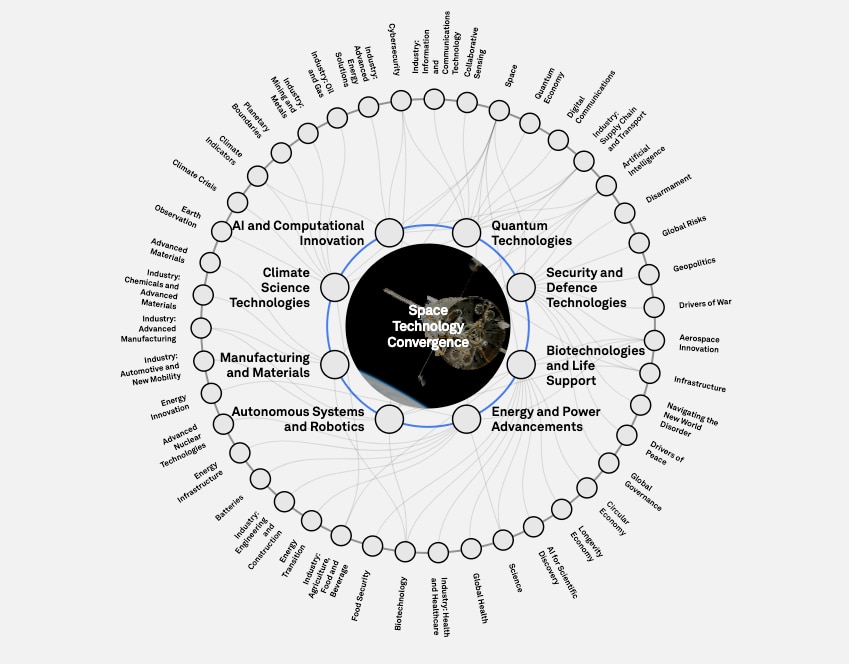
This convergence of space and biotechnology will create a new category of cross-sector innovation with implications across policy, investment and industry.
For policy-makers, this will require updated regulatory frameworks that can support cross-domain technologies spanning aerospace, healthcare and infrastructure. For investors, it will open up opportunities for companies building enabling platforms – from orbital manufacturing to AI-driven bioengineering. For industry, it will demand new forms of collaboration between space agencies, biotech firms and infrastructure developers.
Space has taught us how to survive with limited resources. Biotechnology is teaching us how to regenerate and optimize those resources. Together, they offer a framework for rethinking how we design systems for life on this planet and beyond.
Don't miss any update on this topic
Create a free account and access your personalized content collection with our latest publications and analyses.
License and Republishing
World Economic Forum articles may be republished in accordance with the Creative Commons Attribution-NonCommercial-NoDerivatives 4.0 International Public License, and in accordance with our Terms of Use.
The views expressed in this article are those of the author alone and not the World Economic Forum.
Stay up to date:
Space
Related topics:


Forum Stories newsletter
Bringing you weekly curated insights and analysis on the global issues that matter.