Podcast transcript
This transcript has been generated using speech recognition software and may contain errors. Please check its accuracy against the audio.
Erik Peterson, Partner and Managing Director, Global Business Policy Council, Kearney: We had 30 years of remarkable growth where we saw this political and economic liberalisation. Governments kind of retracted themselves from the picture.
Government is now back in the business of business.
Robin Pomeroy, host, Radio Davos: Welcome to Radio Davos, the podcast from the World Economic Forum that looks at the biggest challenges and how we might solve them. This week we’re looking at the rise of industrial policy - where governments are increasingly involved in the business of business.
Erik Peterson: Industrial policy is going to be a massively important issue in the years ahead. And bottom line here is that the level of government intervention has skyrocketed.
Robin Pomeroy: Governments have often imposed policies aimed at spurring or protecting industries in their own countries. After a period of economic liberalism and globalisation, industrial policy is now surging back - two experts tell us why, and what’s different now.
Lizhi Liu, Assistant Professor, McDonough School of Business, Georgetown University: The narrative about globalisation has changed over the years. In the past, it is really about absolute gains for each of the countries. Trade makes everyone better. But now it's about relative gains, whether you're better positioned than others
Robin Pomeroy: We hear how Industrial policy is being wielded as a tool of geostrategy.
Lizhi Liu: it's a very interesting strategic game that's played on the global stage right now. we're moving from a system that's optimised for efficiency to one that's optimised for security
Robin Pomeroy: I’m Robin Pomeroy at the World Economic Forum, and with this look at the new era of industrial policy
Lizhi Liu: Industry policy always have a mixed results and people like us try to figure out what works and what doesn't work.
Robin Pomeroy: This is Radio Davos
“Industrial policy is not merely resurging – it is accelerating at a historic pace. As economies face mounting pressures – from supply-chain disruptions to geopolitical uncertainty and the climate transition – traditional market mechanisms and policy tools alone are no longer sufficient.”
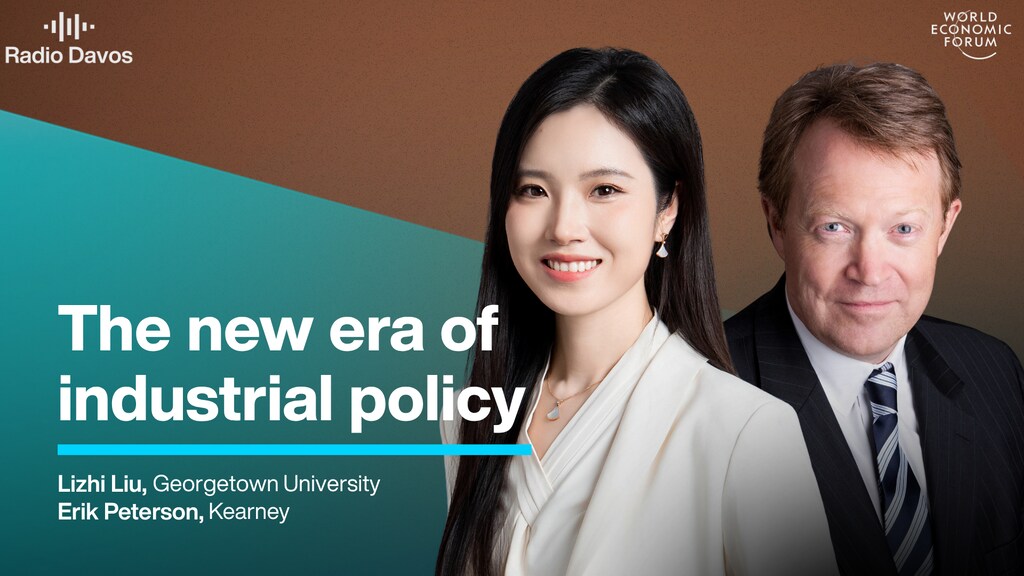
I’m reading from an article co-authored by Erik Peterson, a Managing Director at the consulting firm Kearney. He is one of two experts I spoke to for a conversation about industrial policy - to find out why governments are getting more - not less - involved in, as he calls it, the business of business.
It might sound like classic policy wonk stuff, but this resurgence of industrial policy has huge implications, for our economies and for the way the whole world works.
Our other expert is Lizhi Liu, Assistant Professor at the McDonough School of Business, Georgetown University, who has a particular interest in how China fits into all this.
They both cite research and books for further reading. So once you’ve listened to this, I hope it will have whetted your appetite to learn more - and you can find links to all that interesting stuff in the show notes.
Here’s my conversation with Liz and Erik.
Lizhi Liu: Hi, my name is Lizhi Liu, I'm Assistant Professor of International Business at the McDonald School of Business at Georgetown University. I do research on the intersection of politics, technology, and also business, with some focus on China as well.
Erik Peterson: Erik Peterson, 16-year partner at Kearney, where I have the privilege of heading the Global Business Policy Council, a 35-year-old think tank.
Robin Pomeroy: Welcome both of you to Radio Davos.
We're going to talk about industrial policy. And it's one of those phrases that gets bandied about. I think we've heard more of that phrase in the last few years. So first I'm going to get you to define what we mean by it. What it's doing today, what industrial policy is today, maybe how it was different from before, and where we see things going from now.
So I'm going to start with either the easiest or the hardest question. What is industrial policy? Which one of you wants to start?
Lizhi Liu: I can start.
So industrial policy isn't just any government intervention. I think there's sometimes there's some misunderstanding around that.
There are actually two defining features of industrial policy. Firstly it has to be targeted or involve some selection. These are the selective government interventions that really support specific firms, sectors or regions over others. So the selection is very important. Of some of the broad economy-wide policies like general education spending wouldn't count.
And second, industrial policy usually has a long-term view and it's structural. It aims to transform the structure of the national economy to pursue some broader public goals. In other words, it doesn't focus on fixing some of short-term market failures.
So these are the two features of industrial policy.
Erik Peterson: I'm in total agreement with that and I also believe that in answering your question, Robin, it's the most difficult question.
Because although it's not a new phenomenon by any means, industrial policy after all it's been around for centuries. It's manifested itself in very different ways and I think that we're going through a period now where we're a significant reformulation and intensification of industrial policies.
Robin Pomeroy: Of course it's been around forever. Governments have policies about their economies and they can choose how much and how and where to get involved in industry in terms of supporting their industries. And there are various policy levers for doing that. And it strikes me there was a period of kind of globalisation where industrial policy was out of fashion and this idea of free trade, globalised trade, with as little as possible government intervention, the world seemed to have agreed, in some economists' eyes anyway, that that was the way forward. It's almost the end of history, end of economic history. Am I reading things right? Did we go through that period at some point?
Lizhi Liu: Yes, indeed I think recently we've seen some resurgence of industrial policy and it's actually helpful to look at some of the data. I highly recommend one of the dataset called New Industrial Policy Observatory that was put together by my GFC colleagues, Professor Simon Evenett and his co-authors.
So basically the data set has a very detailed tracks of industrial policies globally after global financial crisis, since 2009. And that actually shows how industrial policy has been shifting, has been resurging, and also the motivations underlying that has been changing.
Just to give you some examples. So basically, we see that between 2009 and before 2020, the whole period already we see that industrial policy has been on the rise. But the major motivation for industrial policy during that period was, one, promoting sectoral competitiveness. In other words, pick on and promote certain industrial strategic sectors to boost national competitiveness. And the second is to achieve climate goals. So a lot of expenditure on environmental sectors et cetera.
But around 2020, we see actually a clear structural break. In fact, industrial policies, especially in the advanced economies that Robin just mentioned, like, used to refuse industrial policy for a while, now doubling down industrial policy, and also tie that to, I would say, geopolitics and national security concerns and also supply chain resilience.
So we do see that there is more sort of a motivation around industrial policy and the whole phenomenon has been rising.
Robin Pomeroy: Could you help me out by defining some of the types of policies that we consider as industrial policy?Would you include trade tariffs in there? What else is in there?
Lizhi Liu: Yeah, so industrial policies, I think the most commonly used industrial policy is actually subsidies. So right now, across both advanced and developing economies, people really use subsidies, try to foster a certain sector to grow.
However, there's actually some difference between advanced economies and developing countries.
In advanced economies, because they're more resource-rich, so they actually use more of this kind of subsidies. But for developing countries, usually they rely more on trade barriers of something like, you said, tariffs and others.
But beyond subsidies, there are other measures, for example, trade measures. You have just mentioned export controls, tariffs, or government procurement can be another type of industrial policy. For example, I just buy from domestic companies.
And also there are entry barriers. For example, if you're a foreign investor investing in my country, you cannot invest in some areas I try to protect, for example, sensitive areas like telecommunication and others. And also, you have to go through certain screening, and also, there will be usually some sort of a localization requirement. That's very important, which is, if you invest in my area as a foreign investor, you have make sure a certain part of the components that you use in the production come from domestically.
So, these are the normal types of industrial policy tools.
Erik Peterson: If we zoom back, I think, you know, starting with that period that you mentioned, the end of history, which clearly is an allusion to the seminal work that was written by Frank Fukuyama and the important books that he's written after that. What we saw after collapse of Soviet Union, and this of course is ancient history, was a remarkable renunciation of the kind of economic statism that existed before then.
And the logic was that industrial, at that time, industrial policy didn't work. It was a slippery slope to economic autarky. And it, in effect, was a renunciation of the whole theory of comparative advantage in trade. The massive movement, the cross-border movement of goods and services and everything else at the time.
So what happened was that we had 30 years of remarkable growth where we saw this political and economic liberalisation such that governments kind of retracted themselves from the picture. Well, I think that Liz is absolutely right. Especially at the end of the century and then the last 20 years, government is now back in the business of business. And they're putting both the developed and developing country governments are putting their fingers on the scales.
I think an easy way to kind of look at things is to ask two, three-word questions, policy for what and policy for how long. And right now what we're seeing is a movement of kind of traditional areas where governments were very protective of their systems, national security, energy, other areas like that.
And we're seeing that the kind of migration that Liz has mentioned into competitiveness And now we're even seeing it kind of move into protectionism in some areas. And so the key question is, how long will this go on and how wide will the scope of government intervention be?
And bottom line here is that the level of government intervention has skyrocketed. If you look at the numbers, I won't throw too many numbers at you, but this year alone, we now stand at where we were total last year, which was about 1,400 government interventions.
And this is really off the charts compared to those earlier years that you were talking about so this is a sea change and before we started Liz and I were agreeing that probably industrial policy is going to be a massively important issue in the years ahead.
Robin Pomeroy: Before we look at kind of the present and the future, let's have a tiny bit more history. Erik, you mentioned the collapse of the Soviet Union. So what happened then, you know, what's happened more recently that's brought industrial policy back?
I think maybe you've already touched on a couple of things. The financial crisis of 2008 has been mentioned. And also you've mentioned China and China joining the World Trade Organisation. China is a centralised economy, I don't suppose China ever turned its back on industrial policy in the way Western governments at least say they did.
Could one of you, maybe Erik again, could you walk us through what were those historical turning points that brought us to where we are today?
Erik Peterson: Well, I think there are a lot of these historical turning points, Robin. You mentioned a few of them.
What I see is kind of two parallel movements. The first is that as we see the gradual erosion of the rules-based system, and that we saw the kind of development of new trade and other tensions, we saw the attitude of kind of every economy for itself a bit. We presented a report way back when, in 2015, entitled, awkwardly, From Globalisation to Islandization.And this report that we did in our think tank highlighted concerns that we had that we were seeing this kind of moving toward a period of parochialization of economic policies, and that...
Robin Pomeroy: When did that happen? When did it happen and why? Because it's tempting to look from today and say Trump 2.0, kind of ripping up the rule book, pulling out of international treaties on various things, very sceptical about anything that smells in some way of globalism or global rule books. But from what you're saying, no, it actually predates that by quite some time.
Erik Peterson: Yeah, it does. And here in the U.S., I think it's an equal opportunity phenomenon when it comes to political. I mean, we've seen exercising with our policy on both sides of the political aisle. So while we're getting a lot of significant volatility, to be sure, from the current administration, we can't point fingers merely at what's happening now. This started a long time ago. Wouldn't you agree, Liz?
Lizhi Liu: Yeah, I fully agree with what Eric just said. I want to add a little bit about that.
I think at the beginning, especially 80s and 90s, a lot of Western economies, they have this neoliberal market-oriented philosophy and ideology. Basically feel that governments are really bad at picking winners. So industry policy usually generate more government failure, even though it is supposed to fix market failure. So government failure was a problem at the time.
But I think a lot of things have changed. I think the one fundamental change, as Erik and I spoke before the podcast, is the narrative about globalisation has changed over the years. In the past, it is really about absolute gains for each of the countries. Trade makes everyone better. But now it's about relative gains, whether you're better positioned than others, right?
And also we're moving from a system that's optimised for efficiency to one that's optimised for security and control over choke points.
So I think that is a very important change that also justifies certain wastes or inefficiencies under industry policy. And industry policy has become increasingly more politically popular. But however, I think the risk is that it will also generate a fragmented global system that probably will carry a lot of costs down the road.
Erik Peterson: I totally agree, and Robin, I think a lot of this too is the broader social attitudes.
I think that with globalisation, we saw a lot of populations that were very concerned that they were losing their jobs and opportunities and livelihoods as a result of what was happening in countries far beyond what they see day to day, and they were feeling very intimidated. And I think that that there's evidence of this in a number of the advanced economies now starting with the US.
In the end it is kind of a tragic thing because these last thirty years have brought prosperity to a lot of people across the world and if we allow the kind of fragmentation that this was just talking about to occur. I think everybody's going to pay a price in one way or another, and that's a disappointment in my view.
Robin Pomeroy: You both wrote great articles for the World Economic Forum's website published around the Annual Meeting time. I'm going to quote one from each of you. I think this was you, Erik, from yours, "The key to geopolitical power hinges in part on control over economic choke points or critical nodes in the global system."
So, you've both mentioned the importance of geopolitics and national security as being kind of motivations for countries deploying forms of industrial policy. And here you've said that the use of a choke points and critical nodes. Now this was published in January, Erik, that as we speak now, I'm not sure when this episode will go out, but the Strait of Hormuz is blocked. That might be a geography that many you know, normal people had not heard of until fairly recently, and now they realise if that's blocked, so much of the energy and other critical things are blocked there, it has a knock-on effect all over the world.
I mean, I don't know if the blockade in a wartime environment, a blockade of a waterway like that would count as classic industrial policy. I think it's probably something a little bit different. But it certainly does count as an economic choke point.
So Erik, when you're writing that, what kind of choke points or critical nodes were you thinking of? And what do you think we should be looking out for?
Erik Peterson: Yeah, it's a great point, and I think that we have a very, very significant example happening right now, as you suggest, in the Strait of Hormuz, but it's happening elsewhere.
And in the end, if we look at shadow movement of oil on the oceans now, there are a number of kind of choke points that suggest geographical, but there are other kinds of chokepoints as well.
I'm sure that Liz is going to address herself to this, but in technology, there are choke points with respect to availability of resources and critical materials and minerals. And these nodes or choke points are really vital.
I would recommend to your listeners that if they really want to learn a lot about this. There's a seminal book that came out of a colleague of Liz at Georgetown by the name of Ed Fishman entitled Choke Points. It's a great book. And then she has other colleagues who are doing some extraordinary work in this area of Georgetown as well. But I think that generally speaking, we have to be looking at a widening scope in the future. Choke points won't just be geographical. They'll be in a number of other dimensions as well.
Robin Pomeroy: Do you give us some examples of that? I mean, the ones that come to my mind are critical, physical things that we need to make things like certain minerals or certain high technology products, chips. Those are the kinds of things you're talking about?
Erik Peterson: Absolutely. Or movement of fertiliser through the Gulf. Or what about water movement or availability or access to water now? We're all watching the whole desalination dimension of the conflict in the Gulf right now. But a lot of it involves resources, a lot it involves ideas and technologies and intellectual innovations. I think that these choke points are going to take many forms.
Lizhi Liu: Yeah, I actually want to like add a little bit on that because I think Erik's points are great and very insightful. One thing that countries really care about choke points is that theoretically this kind of reliance of other countries relying on your choke points can be used for you as economic statecraft. You can use that choke points to pressure other countries.
However, the issue is that when you overuse it, the other countries will have incentives to build alternatives, right?
As we see that, for example, China is building its domestic chip industry, with mixed results, and also other countries are building rare earth mining capacity and manufacturing and refining capacities outside of China, because both US and China kind of pressed other countries on these choke points.
So I think it's a very interesting strategic game that's played on the global stage right now.
Robin Pomeroy: Let's turn our attention a bit to China then, because I wonder how much of this resurgence in industrial policy, and I'm sure this is only part of it, but how much is to do with the West and maybe other parts of the world seeing China, this massive success story of China over the last 20 years or so, and feeling threatened by it?
Erik, you mentioned there's a public opinion. We've lost manufacturing jobs to Asia, to China, and elsewhere, and that from a political standpoint that has maybe brought back on both sides of the political aisle this kind of appetite for industrial policy, for reshoring some of those jobs.
So let's look at China, and I'm looking at the blog you wrote, or you co-wrote, Liz, also published in January, and you said that Made in China 2025, which was an initiative of the Chinese government from May 2015, it marked a "defining comprehensive shift and the beginning of a new era of Chinese industrial policy".
In what way was it new? Because like I said before, viewed from outside, China is a very centralised economy. So what was new about this?
Lizhi Liu: First of all, I would like to clarify on this point of China being a centralised economy.
China is politically very centralised, but economically quite decentralised. So the central government usually says very broad priorities and guidelines, but local governments always fill in the details. So that means that China actually has a lot of variation about how policies are implemented very different across regions.
And in fact, according to a paper, 80% of China's industrial policy come from the local level. Even though after, I would say 2013 and 2014, why I'm saying there's a more systematic change is that there's more like a Chinese central influence on the local policy priorities.
But I think in general, a lot of people will be equating government intervention as industrial policy. But as I said, you need to have some sort of a targeting. You need to some very concrete government backing on that.
So if we take those two measures, in fact, before the mid-2000s, China didn't really have very active and systematic industrial policies, even though state intervention is always there. But between roughly 2006 and 2014, there's some ad hoc supporting strategic emerging industries. So the government started to have a list of the industries they want to support.
But what is really going on, why I'm calling this as a qualitative change, is around 2014, there is more of a government become a investor. In the sense that the government not only started to have more systematic measures like Made in China 2025, trying to upgrade the manufacturing industry and also having more like robotics, semiconductors, all these advanced manufacturing industry competing with other countries. But also, there is more of the rise of a government guidance, a guided funds, meaning that the government would allocate part of the public funds and behave like a VC, even though it's not a private entity. So they started to invest in startups and also trying to cultivate these strategic sectors.
In fact, I would say industrial policy does have this phenomenon of policy loop, like a feedback. So essentially, countries are sometimes imitating each other, including, I guess, some of the practises.
Oh, one thing I forgot to mention is that after 2020, there's actually another turn of China's industrial policy, which is because of more of a credible threat from the U.S. export control and restricting China's access to these core technologies, therefore they started to shift their industrial policy towards more of self-reliance and national security. So they feel that we definitely need to build an indigenous industry rather than just importing American or Western technology. So that's another very meaningful turn.
Robin Pomeroy: On that, I'm going to quote from your article again, Liz, at the risk of slightly repeating what you just said, but I'm going to quote verbatim, "External pressure is unlikely to curb China's industrial policy. If anything, export controls, technology restrictions and geopolitical tensions have strengthened Beijing's resolve to support strategic industries and accelerate self-reliance."
What are we concretely talking about here? It's chips and the AI race? Is that the main thing when we talk about export restrictions?
Lizhi Liu: Yeah, something I found to be interesting for the, because industry policy always have a mixed results and people like us try to figure out what works and what doesn't work.
But sometimes it's not the industry policy per se would work, it's whether you have access to foreign technology would actually influence the effectiveness of a domestic industry policy. I think one example is chip industry that you're talking about and also that's what I wrote. Which is, in fact, the Chinese government always want to build a very strong chip industry and poured a lot of money into this. But it also created a lot a fraud in the past.
For example, in mid-2000s, there's a Chinese scientist claim that they had a domestically developed chip called Hanxing. But it also got a lot of government support. But it turned out to be they just bought some Motorola chip and used sandpaper, scratched the logo from it, and then they just claimed to be themselves. And when this is discovered, it was a huge blow to China's initial policy, just as asking how wasteful it can be.
However, export control actually helped somehow. I mean Definitely it created a lot of disruptions to Chinese tech development, which I all agree. But in the long run, especially in hindsight, I think you can see that because the Chinese government and Chinese firms see now it is a credible threat that they are no longer getting access to foreign chips. So they have stronger incentives to buy domestic alternatives.
And the Chinese government even mandated some of the tech companies to purchase domestic chips.
So that in itself create a market for the domestic chips because before that there was not such a market, even though there has been some government support, but it wasn't very successful.
So I would say like it's a combination of government support but at the same time, sometimes external pressure can have unintended consequences to incentivize countries to really have domestic substitution for foreign technology.
Robin Pomeroy: Export restrictions the other way around then, there are fears that China has too dominant a position over certain critical minerals that are critical for manufacturing. Is China exerting its influence there restricting those exports or are we just worried that it could do that from one moment to the next?
Erik Peterson: That question was framed, Robin, or X or Y. I think it's both.
I think Beijing is now trying to use its leverage whenever and however it can. And the reason for this is something that that you mentioned earlier, and Liz affirmed in her reaction. And it's all about self-sufficiency and sovereignty now.
And I think that countries, if we look at the most significant economies in the world, there's a push now in virtually every one of them to be thinking about ways to find sovereignty and self-sufficiency. Whether it's digital sovereignty in Europe, whether it so the elements that Liz has just highlighted in China, we are all watching developments here in the U.S. these days.
And the key question is, how rapidly will the scope of government intervention move in order to try to support this self-sufficiency?
And let me repeat, that goal is non-economic in the end, and it's inefficient and it carries with it significant costs. And not only that, but if we look at major economies mobilising public resources in order to support their interventions, Liz mentioned that I think probably the most aggressive area these days is in subsidy support of industrial policy.
The bottom line is that they're piling on the debt that they've already put together. We see a significant debt overhang in a number of economies worldwide.
So the question is how much longer can this game be played and how effective will it be?
Lizhi Liu: Yes, I fully agree with Erik. One thing I want to add is that China's rare-earth industry is another example about, similarly to the chip industry that I mentioned, how export control and China's exercise of export control will lead to other countries trying to build their domestic capacity to circumvent China's export control. So we do see that there are some other countries trying to do this.
But one thing I also want to mention is that manufacturing sometimes or mining, they move not just because of labour quality or labour cost, they also move with pollution. So the reason why China is good at rare earth industry is not just that China has a huge stock of it, a huge reserve of it. Some other countries also have some reserves. I think part of this is because rare earth refinement and also extraction is a highly polluting industry.
So I actually had a conversation with someone who specialised on this, and I was asking her the question about whether U.S. Would build some of the capacity in this area. And she was saying that, at least right now, because of the highly polluting nature of this industry, probably U. S. Is going to rely on some of its allies to actually do this.
So I think this kind of alliance-based trade blocks, especially around these critical minerals, probably are on the rise as well.
Robin Pomeroy: Forging better alliances with countries, if the product you're relying on is restricted from somewhere, you can either try and make it yourself or you can go to somewhere else and that may well happen for things like minerals and mining. We've seen how important China has become in terms of investment in Africa, for example.
Is this resurgence of industrial policy creating also a new era of international relations?
Erik Peterson: Yes, it is. And it could go one of two ways. We could see it moderated in the end. We could see wise government interventions in support of broader social policy goals. Or we could see the kind of phenomenon of neo-mercantilism that the Financial Times writer, Martin Wolf has highlighted.
Post Davos, he presented a number of uh articles that I thought were really compelling, suggesting that unless we get it right this this whole government intervention competition could get out of control. So i've suggested i think it carries cost but it had as you know Robin it has geopolitical consequences that we need to take very seriously
Robin Pomeroy: This still is the World Trade Organisation, which is meant to set rules, which are, as you've said, are under pressure, but on things like tariffs and on things like subsidies and non-tariff barriers, to try and to provide somewhere where countries can diplomatically, supposedly, work out their differences. Are we going to see a kind of a change to the WTO? Does it have to be reinvented?
Where do countries go now to resolve their differences if it's not literally... You know, on a battlefield like I suppose it is in the Strait of Hormuz. Where's the future for that kind of multinational cooperation, which, in theory, should be a good thing for everyone?
Erik Peterson: It's impossible to know.
We are watching with concern the attempts now to revivify developments in the WTO. But if you look at the UN specialised agencies or even the UN itself, or the Bretton Woods group, you know, there's a constant pressure in terms of evidence of dysfunctionality that needs to be addressed.
So the operative question, as far as I'm concerned, is how do you modernise? How do you create structures that reflect the current circumstances? And do you just kind of pile on, or do you find wholesale new institutions?
And we've seen this, Robin, not only in the UN system, but in the G20 and the G7 and all kinds of other intergovernmental mechanisms that have had their ups and downs, let's face it, with respect to their effectiveness.
There's a crying need right now for us to find ways to put together an international structure that reflects the world that not only exists in front of us now but where it's going to be, where the puck is, we have to skate to where the puck is going to be in the future
Lizhi Liu: I fully agree with Erik, especially I think what he was saying that is that international relations has fundamentally been changed from one that's more like a rule-based, now, unfortunately, to something that's more power-based.
And I think with regard to WTO, there has been some of the structural issues, especially the dispute resolution system, the appellant body, right now having some issues with filling in the judges, I think partly because U.S. Is unhappy with WTO and required some changes. I think indeed some of the reforms is yet to be seen in the WTO structure, and the future is uncertain.
But on the other hand, I'm kind of – I'm still an optimistic person, even though I know, like, being an optimistic person in this period means that I'm always wrong.
But I think things tend to go in cycles, right? If you look at the history, right, in terms of political polarisation, in terms of tariffs, right we used to have very high tariffs and then tit-for-tat ones then there is a multilateral negotiation that really negotiate down the tariffs.
So I just feel like perhaps in the future, especially when the cost you know, are high enough, even though I hope the cost wouldn't be that high, maybe there will be some incentives for countries to sit down and really figure out a multilateral solution to solve the current issues.
Robin Pomeroy: So does that mean that regional groupings of countries will take on more importance because if it's a question now of the stronger will get away with what they can so the big economies will push the others around, the only way for smaller economies. Is to band together in some ways. I think we're already seeing that. Is that something that's going to happen in the future?
Lizhi Liu: I would say right now geodistance does matter much more than before.
Geodistance basically means the two countries' diplomatic relations, their friendship, for example, whether they are in the same alliance. So I think this kind of a… because we used to say like distance matters for trade, but now geodistance matters.
So indeed, a lot of this kind of a rule setting can be set within a block of countries that's friendlier to each other.
However, to be honest, the one thing to be optimistic, again going to this question about being optimistic, is that according to the transportation data, for example, from the DHL, they track this shipments and the mobility of persons and commodities across border. You still don't see a very clear sign of regionalization of trade.
So in other words, I think in terms of the rules, perhaps negotiations will be based in the regions, but still like different regions are still connected with trade. So I think that's something that brings some hope.
Erik Peterson: Robin, I think we need to revise our thinking now about the traditional way that we've addressed trade blocks and trade organisations and regional groups, regional groupings.
I think in the future, it's all going to be a lot more virtual and we're not going to have the same kind of, we memorialise our trade agreement in 20 clauses, detailed clauses. It will all be fluid, my sense is, to reflect the current circumstances.
We've been talking about a lot of kind of macro factors but I can tell you because i work day-by-day with the business community that business is quite concerned about the uncertainties and the volatilities implicit with many of these issues that we've been talking about, including in some cases, industrial policy. Some benefit, others don't, et cetera. But the upshot is that business knows that things change immediately, and you put together kind of quick alliances and you need to. To be remarkably agile and remarkably resilient in terms of planning.
Robin Pomeroy: Yeah, well that was going to be my next question. I mean, what advice do you have for businesses in this way? Because they can't sit back and wait for the smoke to clear. You know, these are companies that are doing business around the world right now. What advice do give them?
Erik Peterson: Yeah, I think the companies that are sitting and waiting right now are probably asking for trouble, long range.
And as I say, we work with a lot of great companies that are proactive and basing their thinking on strategic foresight. And from my point of view, they need to be thinking about a world in which they can no longer rely on stable geopolitics. That's a thing of the past. They can no longer bank on the continuation of globalisation.
I think, Liz, that DHL work is so important, but nevertheless, we know that there's turbulence now and there are disruptions in the trade space.
They can't rely on the rules-based order, Robin. We talked about that. And then government policies that in the old days used to promote free markets and reduction of cross-border barriers have really changed with this whole industrial policy reality now.
And then the last point, and this is one that I know that resonates in Europe, is that the conditions defining business and stability are really quite ambiguous now you know with hybrid warfare for example in Europe, it's tough to navigate effectively between peace and war. And i think that that's you know from the standpoint of our, the CEOs engaged in our work. We need to be thinking about that in the future.
I'm proud to say that uh that Kearney is, this is not an advertisement, forgive me, but Kearney is doing good work now on an industrial policy effort with the World Economic Forum. And I know that there's great interest in this and from the standpoint of business precisely because we know that things are really changing so rapidly that we have to respond.
So there's wait and see. It's take a position, aggressively use strategic foresight to think through competitive futures, and get your organisation aligned for a turbulent outcome.
Lizhi Liu: So I would give like two tips for companies probably in this area of industrial policy.
One is look closely and the other is look upstream.
So what do I mean by look closely? So I think if your sector is targeted by the industrial policy, you should really pay attention to the policy details.
I'm saying this because right now people know that governments are really passionate about industrial policy. However, sometimes a lot of industry policy are also performative rather than being substantive.
So I did some research actually about China's local government industrial policy variations with great co-authors like Junting Chen, Jerry Xing, and Xiaomeng Liu. And we actually look at Chinese industrial policy about EV chargers in different local areas. You definitely can see that the level of details are quite different, right? Like some of the industrial policies, they do this probably to please the central leaders.
And in democracies, we can see that the politicians would announce huge amount of government spending just to win popular votes, right.
So there are different motivations for really promote certain sectors, but that's not always real commitment to funding.
So I would say companies should really look at that, whether there's enforcement detail, whether there is a follow through, et cetera.
The second advice is that if you're outside of these sectors that's targeted by the industrial policy, but you're interested in moving in, or if you are investor, you need to be cautious. I think the reason why some of the industries are targeted is because commercially they probably are not making money. Or it's very difficult to figure out the technology, such as chips or advanced manufacturing. So in other words, there is a high failure rate, if not very high failure rates. And the history basically tells us that industry policy does not always work.
So I think a safer strategy for people who's outside of those sectors. Is probably, instead of competing directly in the crowded policy-driven sectors, focus on supplying the inputs and infrastructures that these sectors will rely on.
For example, chip industry, you focus on the minings, right, like the raw materials that would be used by the chip industry or data centres. So I think it's a classic idea, right? Like during a gold rush, the most reliable profits often go to those shovels. So that's my take.
Robin Pomeroy: Tips, proper tips for investing and for running businesses there. You heard it on Radio Davos. Thanks for that.
We don't have much time left. I'm just wondering, it really strikes me the way you're both talking here, that we're in, it's kind of a new era for a lot of things. It's a new area of industrial policy and it's a new era of geopolitics. We can mark, you know, 1990 for the fall of the Berlin Wall, and you can mark certain economic crises, 2008. I wonder if we'll look back and find out that this year or somewhere around this time, the world has entered a new era. Have you had time to think about that kind of historically? I was wondering, are we in a post-COVID world? We mentioned COVID earlier on. And that made so many changes in our lives. Are we in a post-cold war world? Because we were post-post-Cold War for a couple of decades.
Have you coined a phrase or have you seen anyone else kind of define, ah, that's the era we're in now?
Erik Peterson: In a nutshell, no, is how I would respond to that, Robin. I haven't seen anybody kind of capture where we are right now.
If we pull back the stick from industrial policy, I think we stand at a moment of remarkable geopolitical reformulation right now, We've talked about the broader global economy and the changes that are happening. Technology is reshaping us by the day. And then on top of that I believe that nusiness is coming up with remarkable and interesting new approaches to a lot of these issues.
And drawing inspiration from Liz's optimism, I would like to make a point about, you know, I'm really hopeful that some of the incredible innovation that we're seeing now in technology and elsewhere will spill over to the ways that we deal with these big global international issues.
And here's a case in point that zooms in on our topic, industrial policy. I was really interested to see a report come out of OpenAI on industrial policy, a recent report. And, uh, you know, that they would lay a marker with this report, you know, and we're all watching AI every single day these days, that they would lay a market in such a critical area as industrial policy as a dimension of the AI process and the AI phenomenon to me is meaningful.
And there was also an amazing report that came out of the World Bank in terms of industrial policy and its effect on development. And so I think both these are great examples of the kind of fresh thinking that we need here and the opportunity that we have to kind of reshape our future.
Lizhi Liu: Yeah, I agree with Erik, because I think right now the world is very different from the previous Cold War, even though some people would say this is Cold War number two, due to there's some sort of a great power dynamics right now between U.S. And China.
But I think the structure of global trade is entirely different, right? Because in the previous Cold War the U.S. and Soviet Union were basically economically separate largely. Whereas right now, between U.S. And China, there's still lots of business that was running and also strengthening the ties. Even with the talk of decoupling, the two economies are still pretty much connected.
So I think that means there has been a lot of opportunities.
But I do think one thing I would like to say is that shocks sometimes bring good opportunities, just, you know, gollowing Erik's point.
Because I think we right now do not have a very good understanding about COVID. We have some understanding, but not full understanding. I think in relation with industrial policy, one thing is that, of course, COVID exposed the real vulnerabilities in global supply chains. That's why governments really doubled down on industrial policy. But on the other hand, it really created opportunities for domestic substitution and for late commerce in certain areas.
Just to give you an example, I'm actually working on a project with Jiang Cui and also Mike Chen on China's industrial robot sector. So this is a sector that is now exporting to the rising manufacturing hubs in Southeast Asia, also to Mexico. And China actually had a very interesting transition from a net importer of industrial robots to a net exporter. So I think this is a very important industry.
This is also an industry that supposedly is helped by the Made in China 2025, which attracts foreign players to really localise in China and facilitate technology diffusion. However, before COVID, domestic Chinese robot makers still struggled to gain market shares, because even Chinese companies would not to buy from them. They want to buy from leading producers from Switzerland, the US, Japan, and Germany. So COVID really changed this because of the supply chain disruptions. A lot of these foreign companies couldn't deliver on time.
So downstream manufacturers, for example, like BYD, the EV maker, started to turn into domestic robotics producers. And they surprisingly found out that these firms were at the technology, they're not at the technology frontier, but they're good enough in automation. So they're reliable and more importantly much cheaper. So that's why domestic companies started to buy from these domestic makers.
So I do think that this example tells us that sometimes shocks or even fragmentations can create opportunities that business can really take on.
Robin Pomeroy: It's been a fascinating discussion. We're definitely in a new era, whatever we're going to call it.
My thanks very much to Liz Liu. Thanks very much, from Georgetown University. Thanks to Erik Peterson from Kearney.
Radio Davos is available wherever you get podcasts at wef.ch/podcasts. We'll be back next week, but for now, thanks to you for listening and goodbye.
Industrial policy - government intervention in the economy - is on the rise around the world. Is this a new era for global trade, and what will be the impact on economies and international relations?

Bringing you weekly curated insights and analysis on the global issues that matter.
Bing Chomprasob
April 23, 2026