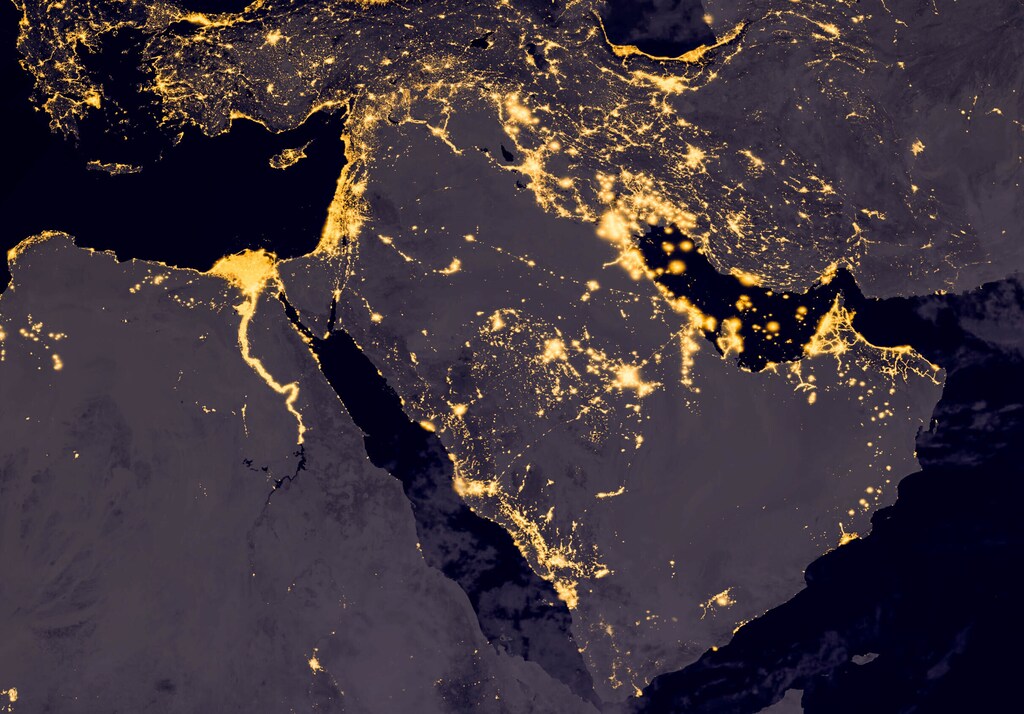
The conflict currently affecting the Strait of Hormuz is not just feeding through to global energy supplies, it could rewrite the future of artificial intelligence (AI), says serial entrepreneur, Tony Pan.
The next phase of the AI race will not be won by code alone, he says, but by the countries that can summon electrons, copper and molecules – even amid geopolitical shifts and tension.
Given that one quarter of the world’s seaborne oil trade used to pass through the Strait of Hormuz, the obvious economic story of the Iran war is higher oil prices. However, beyond creating an oil shock, this crisis will also serve as a stress test for the physical economy of artificial intelligence (AI).
The current conflict is disrupting not only oil, but natural gas, shipping, insurance, industrial gases and the security of data centres. The future of AI will depend on the countries that can still deliver reliable electrons, materials inputs and secure infrastructure when world trade is under geopolitical strain.
Even with the current ceasefire, the aftershocks of this crisis could last for years through higher insurance costs, tighter materials markets and a lasting repricing of geopolitical risk.
AI may run on chips, but its future still depends on ships, substations and molecules.
Electricity’s chokehold on AI
The first effect of the current conflict on AI relates to electricity. It is now the number one chokehold on the expansion of AI use – so much so that AI data centre capacity is described in terms of electricity units, known as gigawatts. This means the Iran crisis is not just raising power prices, it is re-ranking where AI compute can be fuelled and financed.
Natural gas matters more than oil in this context because it is used to produce much of the world’s electricity. Before the current crisis, around 20% of the world's supply of natural gas transited the Strait of Hormuz in the form of liquified natural gas (LNG), according to the International Energy Agency.
So, the US currently has an advantage because its abundant domestic gas and other resources insulate it from these challenges to some extent. While US LNG exports are replacing lost Qatari cargoes, the global squeeze on supply will also tighten the domestic US gas market, raising power and AI costs there as well.
China is perhaps in an even stronger position. Its power advantage over the US is systemic and almost overwhelming: Over the last decade, it has added around five times more solar, five times more wind, over 15 times more nuclear and about 50 times more kilometres of transmission lines than the US.
On the other hand, countries exposed to the energy-compute nexus are in a more vulnerable position, particularly the East Asian semiconductor manufacturing hubs of South Korea and Taiwan, China.
Four decades ago, much of the electricity consumed by Taiwan, China was supplied by nuclear power. After shutting down its last reactor in May 2025, the island is now effectively nuclear-free, although it has recently applied to restart two plants. In the meantime, LNG accounts for around 50% of its power generation supply, and it has less than 2 weeks of strategic reserves. As AI demand rises, Taiwan Semiconductor Manufacturing Company (TSMC), the world’s most advanced and critical semiconductor manufacturer, currently consumes around 10% of the economy's electricity demand. The LNG shock caused by the Iran war will add a risk premium to every advanced AI chip.
And if Taiwan, China is the compute bottleneck, South Korea is the memory bottleneck. The country’s Samsung Electronics and SK Hynix together control nearly 80% of the high-bandwidth memory market that feeds modern AI clusters. South Korea imported around 20% of its LNG and around 70% of its oil from the Middle East in 2025. When the Iran war broke out, the Korea Composite Stock Price Index (KOSPI) fell almost 20%, underlining the global awareness of South Korea’s centrality to producing semiconductors for AI use and its reliance on energy and materials supplies from the Gulf region.
From electrons to molecules
After energy, the next layer of fragility caused by the current conflict is molecular. Let’s look at just three examples: helium, bromine and sulfur.
Qatar is responsible for approximately one-third of the world's helium supply, which is extracted as a byproduct of LNG processing. Helium's extreme thermal conductivity, its inertness and its low boiling point versus other elements makes it a uniquely ideal coolant for industrial uses such as semiconductor manufacturing. The majority of helium imported by both South Korea and Taiwan, China comes from the Gulf. Following Iranian drone strikes on the Ras Laffan complex in March 2026, helium prices have spiked.
Bromine is also essential to semiconductor production and South Korea sources more than 90% of its bromine from Israel. Conflict in the region has put massive stress on this critical pipeline.
Lastly, sulfur is the sleeper issue. Although not rare, the world relies on massive quantities of sulfur for activities like copper production, and the Strait of Hormuz facilitates roughly 50% of global seaborne sulfur trade. Copper is the backbone of all things electricity, so the metal is foundational to AI’s power expansion in the form of cables, transformers and grid upgrades.
Securing AI infrastructure
Perhaps the most precarious shift of all as a result of the current conflict relates to security. In early March, Reuters reported that drone strikes had damaged three of Amazon’s data centre facilities in the UAE and Bahrain. This is the first time in history that data centres were targeted in war. Iran's Islamic Revolutionary Guard Corps later claimed to have hit an Oracle data centre in Dubai.
This creates a sovereign data and AI localization trap. Governments would like sensitive data and AI workloads to be hosted domestically, but in regions exposed to the conflict, these assets could be vulnerable. Even if the Iran war cools quickly, lenders and companies are unlikely to forget recent lessons. Investment that previously flowed into the Middle East for ambitious AI campuses may shift to jurisdictions that can offer better physical security.
This is unlikely to terminate the Gulf’s AI ambitions, but it could create a lasting slowdown and a repricing of risk. Rather than simply going where AI compute and energy infrastructure is cheap, investment may start going where it is more secure, harder to interrupt and easier to insure.
This is the enduring legacy of this war for AI – not just a spike in energy prices due to the effective closure of the Strait of Hormuz, but a rewriting of the future of AI. The next phase of the AI race will not be won by code alone, but by the countries that can summon electrons, copper and molecules – even amid geopolitical shifts and tension.