How the World Health Organization’s ‘One Health’ framework can benefit from mission-oriented policy

One Health is an integrative framework that recognizes the interdependence of human, animal and environmental health. Image: CDC
- The WHO’s One Health framework links human, animal and environmental health but suffers from slow, fragmented policy delivery.
- Economist and academic Mariana Mazzucato’s mission-oriented policymaking can unify these domains under a shared Grand Challenge.
- This will enable coordinated missions and projects such as integrated zoonotic early-warning systems or regenerative agriculture transitions.
In an era defined by cascading crises, our policy tools and institutions are struggling to keep up. Nowhere is this clearer than in the World Health Organisation’s One Health: an integrative framework that recognizes the interdependence of human, animal and environmental health.
How the Forum helps leaders strengthen health systems through collaboration
It is estimated that zoonoses (diseases derived from animals) cause 2.5 billion cases of sickness and 2.7 million deaths every year. Likewise, 75% of emerging infectious diseases are of animal origin, demonstrating the urgent need for the One Health approach.
One Health is inherently a systems-level concern. It recognizes that human, animal and environmental health are inextricably linked and that preventing pandemics requires a shift in how we manage land, biodiversity and animals. However, all these domains require specialist thinking and targeted policies. In this reality, transdisciplinary action is difficult to achieve.
Consequently, One Health policy delivery remains slow and fragmented. Key policy actors are still largely operating in incoherent silos.
Reframing One Health through mission-oriented policymaking
While knowledge and technology exist, an institutional mechanism to mobilise collective ambition and align actions remains missing.
Economist and academic Mariana Mazzucato’s concept of mission-oriented policymaking offers precisely such a mechanism (see Figure 1). More than a theoretical framework, it is a call to structure public policy around ‘grand challenges’. These unify multiple policy areas and solidify these as ‘missions’. It allows for cross-cutting and coordinated objectives under the auspices of a Grand Challenge.
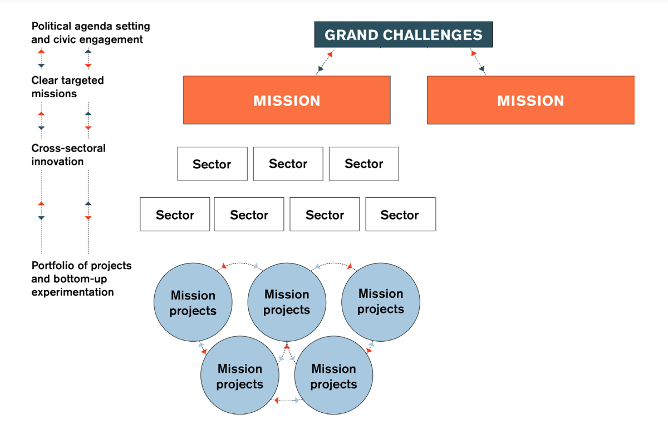
For One Health, this serves as a mental heuristic to overcome sectoral silos and foster innovation at the intersection of health, agriculture and ecology. It offers a blueprint for integrated and coherent governance.
A mission-oriented approach could unify these disparate domains under a shared ‘Grand Challenge’ such as “preventing and mitigating zoonotic pandemics and ecosystem-driven health crises in an age of climate, biodiversity and food system breakdown.”
This Grand Challenge reframes One Health under a coherent governance imperative. It acts as a ‘centre of gravity’ for coordinated policy development and delivery.
Have you read?
The role of missions and projects
While the Grand Challenge offers an important ‘centre of gravity’, it must be underpinned by ‘missions.’ These ‘missions’ provide a visible, actionable set of activities around which diverse policy actors can coordinate.
Missions must be specific and time-bound. They could include “developing and deploying integrated early-warning systems for zoonotic spillover across all high-risk eco-regions by 2030.” These translate into mission projects, such as the USAID PREDICT Project. This project has built transdisciplinary open data-sharing systems across virus hotspots, enabling early detection of viral threats at their source.
Another mission might include “transition 30% of high-risk agricultural systems toward ecologically regenerative, biodiversity-safe models by 2035.” Mission projects might include Agroecology Accelerator Zones that pilot land stewardship schemes, biodiversity corridors and incentives for regenerative practices. Examples of this include the AGROMIX Pilot Projects – 12 in-depth pilot projects across Europe to develop and test mixed farming and agroforestry systems.
Each of these missions and projects aren’t designed to only achieve technical aims, but also to stimulate capability-building in governance, industry and science. It embeds systems of accountability, experimentation and public legitimacy.
Cross-sectoral opportunities
An important consideration is to bring missions and their associated projects together in a ‘horizontal’ cross-sectoral manner and ensure they vertically align with the Grand Challenge.
This creates opportunities for cross-sectoral collaboration, recognizing that ecological and health risks do not stop at sectoral boundaries. This could align what would otherwise be dispersed projects – instead operating under a shared Grand Challenge and mission framework. This approach enables pooling resources, harmonizing data standards and sharing best practices between agriculture, ecology and health. This cross-sectoral approach not only amplifies impact but also builds resilience into the political and institutional systems that must sustain One Health interventions in future.
Looking forward for One Health
We are living in an age of entangled crises that go beyond single-sector fixes. The One Health approach identifies the biological entanglement of human, animal and ecological systems. To make it real, we need an equally integrated governance approach. Mariana Mazzucato’s mission-oriented policy design offers precisely that. This is imperative to address the complex system One Health exists within.
It’s time to stop managing crises in isolation and start designing futures in concert. A mission-oriented One Health is not only possible, but necessary – for our species, our ecosystems and our shared resilience.
Achieving this vision will require more than institutional mandates. It demands political will, cross-sector trust and a readiness to invest in shared infrastructure. This includes interoperable data systems and co-funded prevention programs.
By setting bold, measurable goals that unite health, agriculture, environment and technology sectors, we can create the conditions for transformative change. The prize is a future where we anticipate risks before they cascade, where human and planetary health reinforce one another and where collective action replaces fragmented response.
Don't miss any update on this topic
Create a free account and access your personalized content collection with our latest publications and analyses.
License and Republishing
World Economic Forum articles may be republished in accordance with the Creative Commons Attribution-NonCommercial-NoDerivatives 4.0 International Public License, and in accordance with our Terms of Use.
The views expressed in this article are those of the author alone and not the World Economic Forum.
Stay up to date:
Global Health
Related topics:


Forum Stories newsletter
Bringing you weekly curated insights and analysis on the global issues that matter.
More on Health and Healthcare SystemsSee all

Annika Green and Gail Whiteman
March 30, 2026


