These 10 nature finance models could help deliver returns and impact – here’s how
Continued investment in nature-negative activities presents a severe risk to global GDP, but emerging nature finance models could help. Image: Unsplash/Coralie Meurice
- Nature finance is an emerging area of sustainable investing, but significant complexity is slowing progress in this area.
- A new World Economic Forum and McKinsey & Company report aims to consolidate existing guidance, identifying 10 priority models for nature finance.
- From sustainability-linked loans to internal nature pricing, these models could help mobilize capital for global biodiversity goals and a transition to a nature-positive economy.
Nature finance has moved from the margins of sustainable investing into a core area of focus in recent years, according to a new World Economic Forum report.
Finance Solutions for Nature, produced in collaboration with McKinsey & Company, examines how to effectively mobilize capital for nature. As interest in nature finance grows, it’s essential to acknowledge the complexity that remains, with fragmented biodiversity data and nascent links between climate and nature finance being just two challenges for investors to overcome.
There is also a persistent gap in how nature is valued in economic and financial decisions. It’s estimated that half of global GDP is at risk of disruption as a result of nature loss. Reinforcing this, the Forum’s Global Risks Report 2025 identifies biodiversity loss and ecosystem collapse as the second greatest global threat of the next decade.
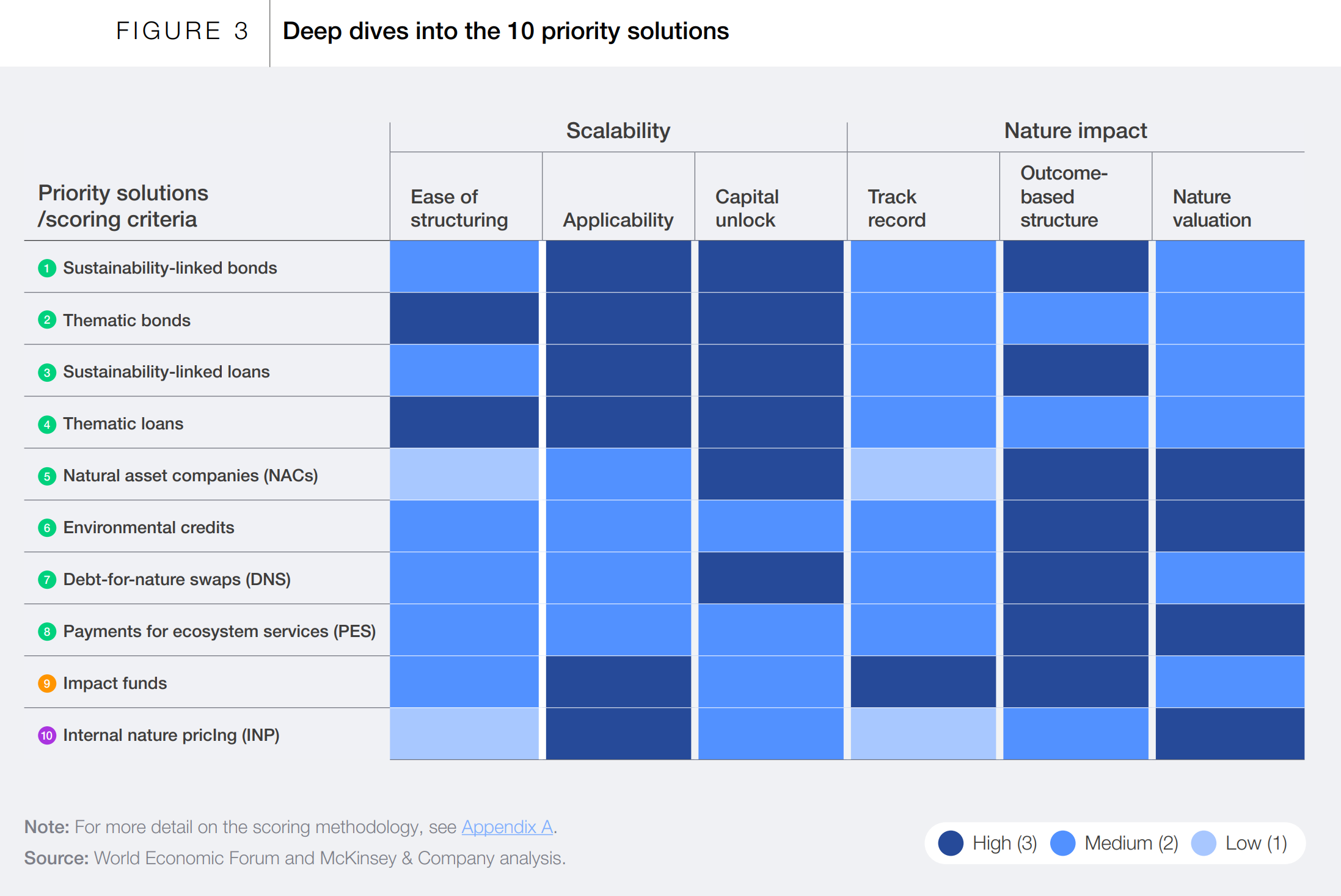
Finance Solutions for Nature aims to help boost investor confidence in nature finance by consolidating existing guidance. It explores 37 financial solution structures, but focuses on 10 priority solutions with high potential to mobilize capital for nature and deliver investible returns. They range from the familiar, such as sustainability-linked bonds and impact funds, to frontier solutions like natural asset companies and internal nature pricing.
Each solution has different strengths depending on context, but they all stand out for their potential to deliver nature outcomes, at scale, with investable returns.
The 10 priority solutions
So what are these solutions, the key actions required to achieve them at scale and their real-world applications?
1. Sustainability-linked bonds (SLBs)
These are commercial bonds that tie coupon rates to nature-related targets, for either corporates or governments. To scale, they will require stronger triggers, clearer metrics and closer alignment between issuers and investors.
Uruguay issued a sovereign SLB in 2022 that is linked to targets of lowering greenhouse gas emissions and maintaining or increasing native forest area by 4%, relative to a 2012 baseline. It saw significant demand from investors and was four times oversubscribed.
2. Thematic or ‘use of proceeds’ bonds
These differ from SLBs as their performance is not linked to nature-related targets, but rather their proceeds are reserved for nature projects. Clearer guidance and aggregation platforms would improve outcomes for investors.
In 2023, Ørsted became the world’s first energy company to issue a blue bond. The €100 million bond will see proceeds allocated to investments, including restoring reef habitats and seafloor vegetation.
3. Sustainability-linked loans (SLLs)
This flexible debt links interest rates to nature targets. Standardized metrics, simpler verification and stronger triggers would benefit SLLs and help them to scale.
Renewable energy company Iberdrola secured the world’s first credit facility explicitly linked to a water footprint goal in 2022. The interest margin is linked to the company’s target to reduce water withdrawals for its power needs by 50% by 2030, as well as to its CDP water score. BBVA was the sole sustainability coordinator and agent bank for this SLL.
4. Thematic or ‘use of proceeds’ loans
These loans are directed towards specific nature-related projects. Capital flows to this kind of solution would be enhanced through improved clarity on taxonomies and aggregation mechanisms.
In 2020, Tornator Oyj, a Finnish forest company, secured a €350 million green bank loan from a syndicate of Nordic banks. The proceeds have been allocated to sustainably managed forest assets.

5. Impact funds
These capital pools invest in nature-positive outcomes, often taking higher risk or longer pathways to generate returns. A stronger pipeline of investable projects, improved governance and standardized metrics are needed to scale this kind of solution.
Silvania, a $500 million global natural capital fund, invests directly in large-scale restoration, sustainable forestry, coastal and marine ecosystems.
6. Natural asset companies (NACs)
As a new class of public or privately listed company, NACs take the full economic value of nature and convert it to financial flows through equity models. They hold significant potential, but need more transactions to create proof-of-concept, price discovery and replicable investment structures.
The world’s first NAC was established by an indigenous-led corporation to safeguard heritage and foster sustainable growth. This boreal NAC (transaction details are not public) is located on more than a million acres of native-owned land. Ecosystem services managed by the NAC include climate regulation, fresh water and flood mitigation.
How the Forum helps leaders align climate action with nature-positive growth
7. Environmental credits
These tradeable certificates for verified environmental benefits are used in compliance or voluntary markets. For this solution to scale, integrity principles, unified standards and stronger local community engagement are needed.
The UK’s Biodiversity Net Gain scheme is a regulatory requirement for developers that aims to ensure habitats are left in a measurably better state than before development. By law, developers must deliver a net biodiversity gain of 10% – either by creating biodiversity on site, investing in off-site gains, or buying statutory biodiversity credits from the UK government.
8. Debt-for-nature swaps (DNS)
In exchange for conservation or restoration commitments, these mechanisms restructure sovereign debt, often with improved financial terms. Increased standardization, better governance, collaborative platforms, plus an extended pipeline of eligible debt are all required to scale DNS.
Barbados’s DNS, secured in 2024, was designed to finance water and sewage resilience projects. Structured as a sovereign SLL, it was tied to volume and quality targets from reclaimed water in treatment plants. Failure to meet the targets, critical in a highly water-scarce country, would trigger financial penalties.

9. Payments for ecosystem services (PES)
These contracts reward conservation efforts for specific ecosystem services and are largely driven by the public sector. To engage the private sector, longer-term contracts, aggregation, standardized blueprints and integration with supply chains are all required.
VEJA’s PES scheme in the Amazon rewards sustainable rubber sourcing. Since 2018, the footwear brand has paid rubber tappers an 80% premium above market rates for deforestation-free wild rubber. By 2021, over 1,000 tonnes had been purchased from 435 suppliers, enabling VEJA to both meet its sustainability goals and build stronger, more resilient supply chains.
10. Internal nature pricing (INP)
This is a novel, voluntary shadow pricing or fee-based tool that’s similar to internal carbon pricing. The aim is to incentivise nature-positive performance in companies or across investment portfolios, but pilots are required to establish their effectiveness as a governance and investment tool.
There are no direct examples of this model – it’s so new. There are comparable examples from carbon pricing schemes, however. Take Microsoft’s internal carbon fee, which charges its own business groups a certain amount based on tracked emissions.
No ‘perfect’ single solution
As the examples above show, success in financing nature isn’t just theory – it’s already happening. But while momentum is building and the market is growing, it is still fragmented.
Private finance for nature reached over $102 billion in 2024, yet nearly $7 trillion still flows annually into nature-negative activities. Global biodiversity finance needs to hit at least $700 billion per year, but public and private flows remain far short of this, while markets are nascent and unstandardized.
The report also includes some priority actions that stakeholders should focus on to bring these 10 financial tools mainstream, summarized in the chart below.
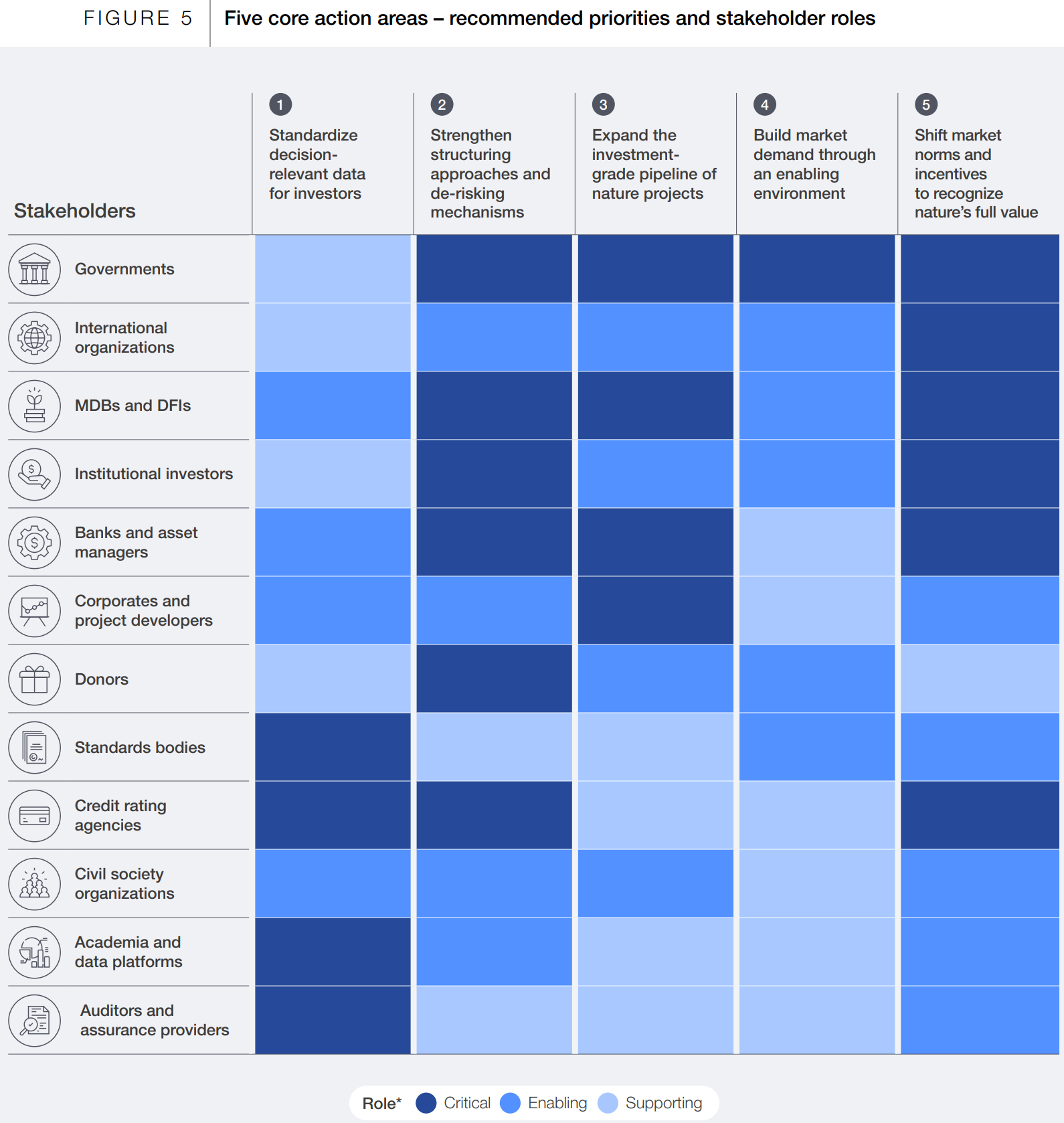
Multistakeholder action is critical to bridging the investment gap and delivering real impact through nature finance. These five enabling actions, outlined in the report, will be essential to driving this transition with the support of the public, private and multilateral sectors:
1. Make data, metrics and valuation decision-relevant for investors
2. Strengthen structuring, approaching and de-risking mechanisms
3. Expand the investment-grade pipeline of nature projects
4. Build policy and regulatory signals to stimulate market demand
5. Shift market norms and incentives to recognize nature’s full value
With convergence and coordination, we can sidestep a world where there is more duplication than deployment. We can drive impact and replicability, protecting biodiversity-rich regions and building credibility with stakeholders of all stripes, making the most of the narrow window we have to finance better outcomes for nature before irreversible loss sets in.
Don't miss any update on this topic
Create a free account and access your personalized content collection with our latest publications and analyses.
License and Republishing
World Economic Forum articles may be republished in accordance with the Creative Commons Attribution-NonCommercial-NoDerivatives 4.0 International Public License, and in accordance with our Terms of Use.
The views expressed in this article are those of the author alone and not the World Economic Forum.
Stay up to date:
The Net Zero Transition
Related topics:


Forum Stories newsletter
Bringing you weekly curated insights and analysis on the global issues that matter.