The state of Carbon Capture and Utilization, and other climate and nature news
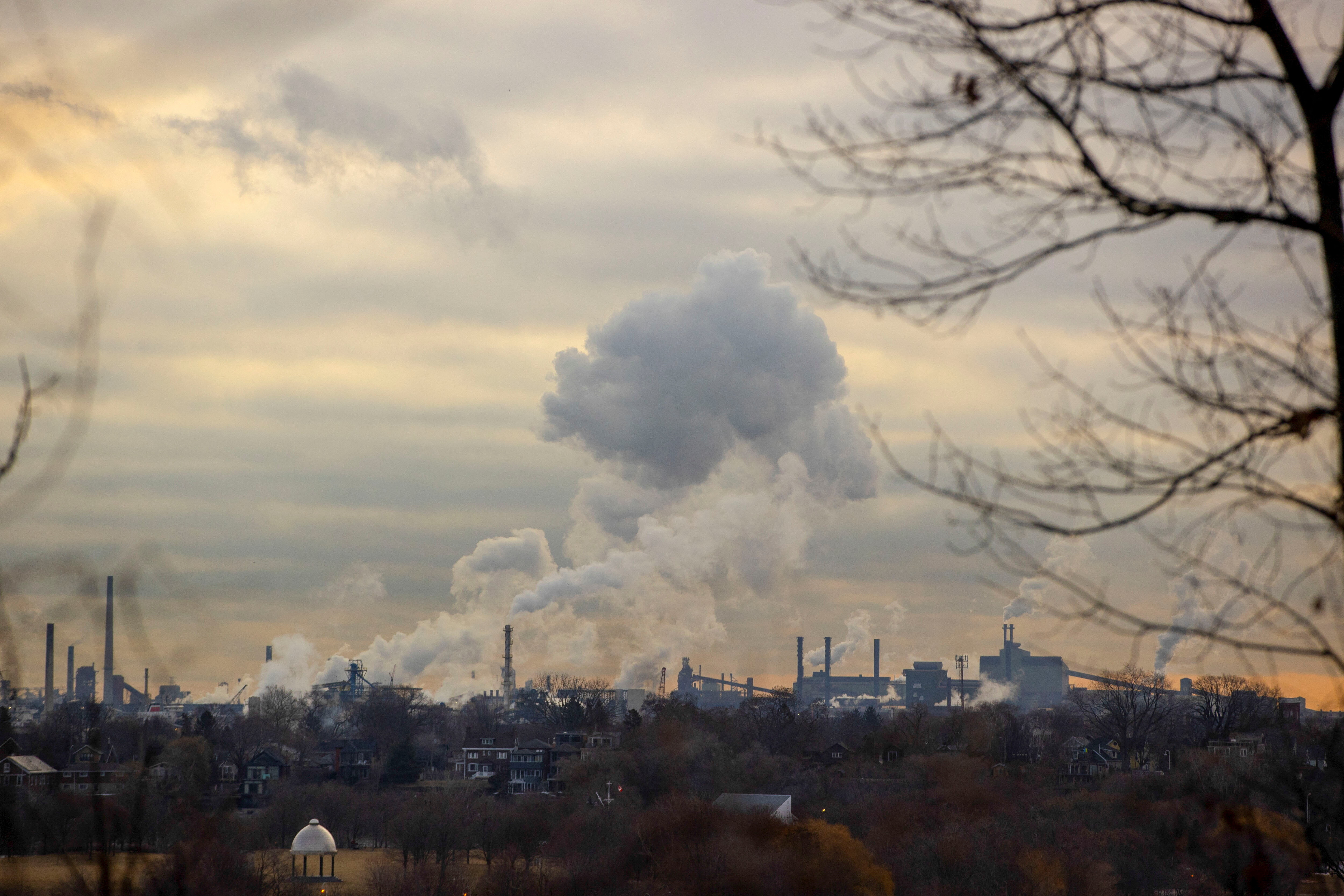
Carbon Capture and Utilization (CCU) can help decarbonization efforts. Image: REUTERS/Carlos Osorio
- This round-up contains the key nature and climate news from the past week.
- The World Economic Forum's Sustainable Development Impact Meetings (SDIM) took place in New York from 22-26 September.
- Leaders around the world convened in person for a series of carefully curated, impact-driven dialogues.
- Top nature and climate news from our meetings in New York: How CCU could accelerate decarbonization efforts; Climate health costs projected to reach trillions by 2050; Innovative investment models scaling nature-positive solutions.
1. The state of Carbon Capture and Utilization
Carbon Capture and Utilization (CCU) could open up new markets, enhance industrial resilience and provide climate benefits – if given strong public sector support, clear demand signals and innovative finance models, says a new report from the World Economic Forum and Wood Mackenzie.
CCU involves a variety of methods for capturing carbon dioxide and using it either directly, without chemical alteration, or indirectly, through transformation into different products such as sustainable fuels or construction materials.
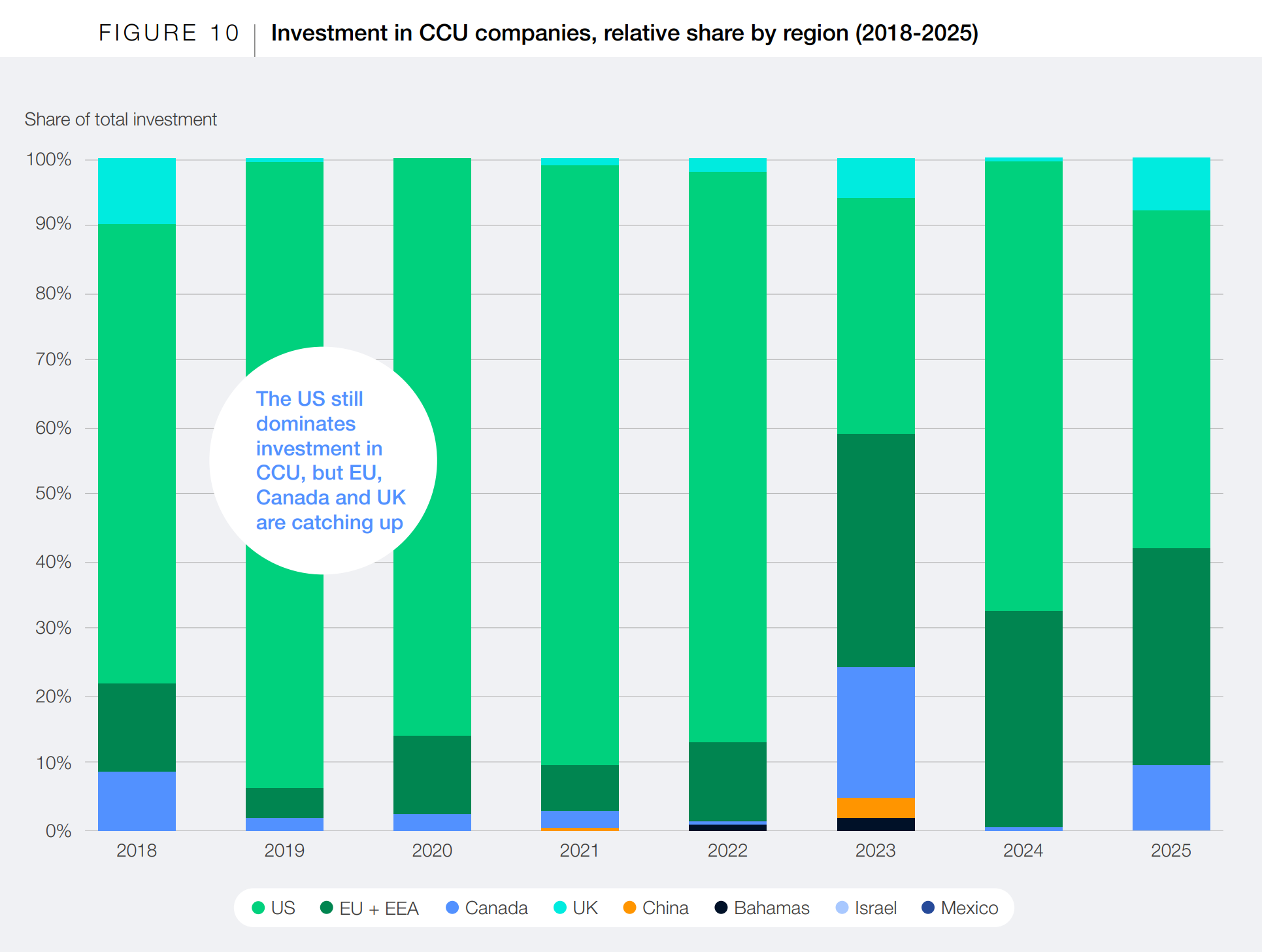
The pipeline of investments in CCU is very low, due to systemic market barriers currently facing the sector. The US dominates overall investment, but other nations are closing the gap, as shown in the graph below.
The report identifies three main barriers to innovation faced by nascent CCU technologies:
- Fragmented, inconsistent policy frameworks: This makes it challenging for first movers to see a reliable and significant market to support future scaling-up, deterring investment. Existing policies heavily favour carbon sequestration over utilization.
- CCU companies face “valleys of death”: These are characterized by long development timelines, high capital requirements and immature business models lacking well-defined routes to revenue.
- Lack of cross-sectoral collaboration between CCU companies and incumbent industries: Partnerships can offer access to infrastructure, expertise and market channels to support the scaling-up of nascent CCU technologies. But the inherent complexity of testing small-scale, first-of-a-kind technical solutions within large, mature, industrial complexes can limit collaboration.
Read the full report below to explore some of the solutions to these barriers, from de-risking innovation and R&D to creating predictable market environments. Additionally, here's an explainer article on CCU.



2. Climate health could cost the global economy $1.5 trillion in lost productivity by 2050
As climate change reshapes our world, it creates an urgent opportunity to build healthier, more resilient societies.
Strengthening resilience can protect the global economy from projected losses of over $1.5 trillion between 2025 and 2050 due to reduced worker availability, a new report, Building Economic Resilience to the Health Impacts of Climate Change, from the World Economic Forum and Boston Consulting Group (BCG) has found.
It makes the business case for proactive adaptation rather than reactive response to escalating disruptions caused by the warming climate.
The report proposes steps that companies can take to shore up the health of their staff, including:
- Climate-responsive health plans: Employee benefits should cover plans for relevant climate conditions, such as heat risk.
- Use risk monitoring and early-warning systems: Analyzing data from disease outbreaks to workforce health can help businesses to avoid crises escalating.
- Educate workers and communities: Organizations can build climate-health literacy through training, workshops and clear guidance.
Explore the other steps by watching our video or reading our handy summary below.

3. News in brief: Other top nature and climate stories this week
With extreme weather events and ecosystem degradation impacting the well-being of 3.2 billion people, the following session from our meeting in New York explored how innovative investment models and cross-sector strategies can scale nature-positive solutions to unlock new opportunities for growth, resilience and innovation. Watch it on demand here:

For more coverage of our New York meetings, you can access all the highlights by clicking on the article in the adjacent link.
So what else has happened around the world?
Global river basins under stress: Only a third of the world’s river basins experienced normal conditions last year, according to the World Meteorological Organization's (WMO) latest report, State of Global Water Resources 2024. The report highlights the critical need for improved monitoring and data sharing: “Continued investment and enhanced collaboration in data sharing are vital to close monitoring gaps. Without data, we risk flying blind,” said WMO Secretary-General, Celeste Saulo.
Brazil announces $1 billion investment in global forest fund: At the United Nations' (UN) 80th General Assembly, President Luiz Inacio Lula da Silva announced the country will invest $1 billion into the Tropical Forests Forever Facility, a multilateral funding mechanism it has proposed to support conservation of endangered forests. This makes Brazil the first nation to commit investment into the fund. It expects more public and private investment to follow.
UN climate official urges action to match promises: At Climate Week NYC, Simon Stiell, Executive Secretary of the United Nations Framework Convention on Climate Change (UNFCCC) urged the world to turn promises into practical action on climate. “This new era of climate action must be about bringing our process closer to the real economy,” he said.
Typhoon Ragasa has made landfall in China: The world's most powerful tropical cyclone this year has made landfall in southern China. Watch the video below to see how communities are responding and the measures being taken to stay safe:
4. More on the nature and climate crisis from Forum Stories
Nature-positive transition for tech: The demand for data centres, semiconductors and hardware to power the new tech revolution has never been greater. This transformation is highly dependent on nature, requiring vast quantities of water, energy and other resources. If tech companies are to thrive in the years ahead, they must address the sector’s relationship with the planet and invest in a nature-positive future. Michael Donatti, Principal, Oliver Wyman and Benoit Bégot, Lead, Nature Positive Technology Sector, World Economic Forum, outline seven priority actions that can drive this transition, from improving water use and tackling pollution to powering operations sustainably.
Early-stage innovation is transforming water systems: With critical freshwater making up just 3% of the world's water supply, how can we ensure we're being as efficient as possible with its use? Early-stage innovation is transforming water systems, watch the video below to find out how.
Tackling extreme working conditions: Millions of informal workers in Delhi are forced to down tools when the city’s heat or fumes swell to unbearable levels. With no sick pay or formalized contracts, these workers are then forced to go without wages. Watch the video below to see how a new insurance pilot by Go Digit General Insurance and K M Dastur Reinsurance Brokers is paying out whenever temperatures or pollution reach unsafe levels – and how insured workers are already seeing the benefits.
License and Republishing
World Economic Forum articles may be republished in accordance with the Creative Commons Attribution-NonCommercial-NoDerivatives 4.0 International Public License, and in accordance with our Terms of Use.
The views expressed in this article are those of the author alone and not the World Economic Forum.
Related topics:

Forum Stories newsletter
Bringing you weekly curated insights and analysis on the global issues that matter.
More on Climate Action and Waste Reduction See all

Laetitia Gardé and Marc Delobelle
February 26, 2026


