Debt, AI and geopolitical division: takeaways from the 2025 IMF-World Bank fall meetings
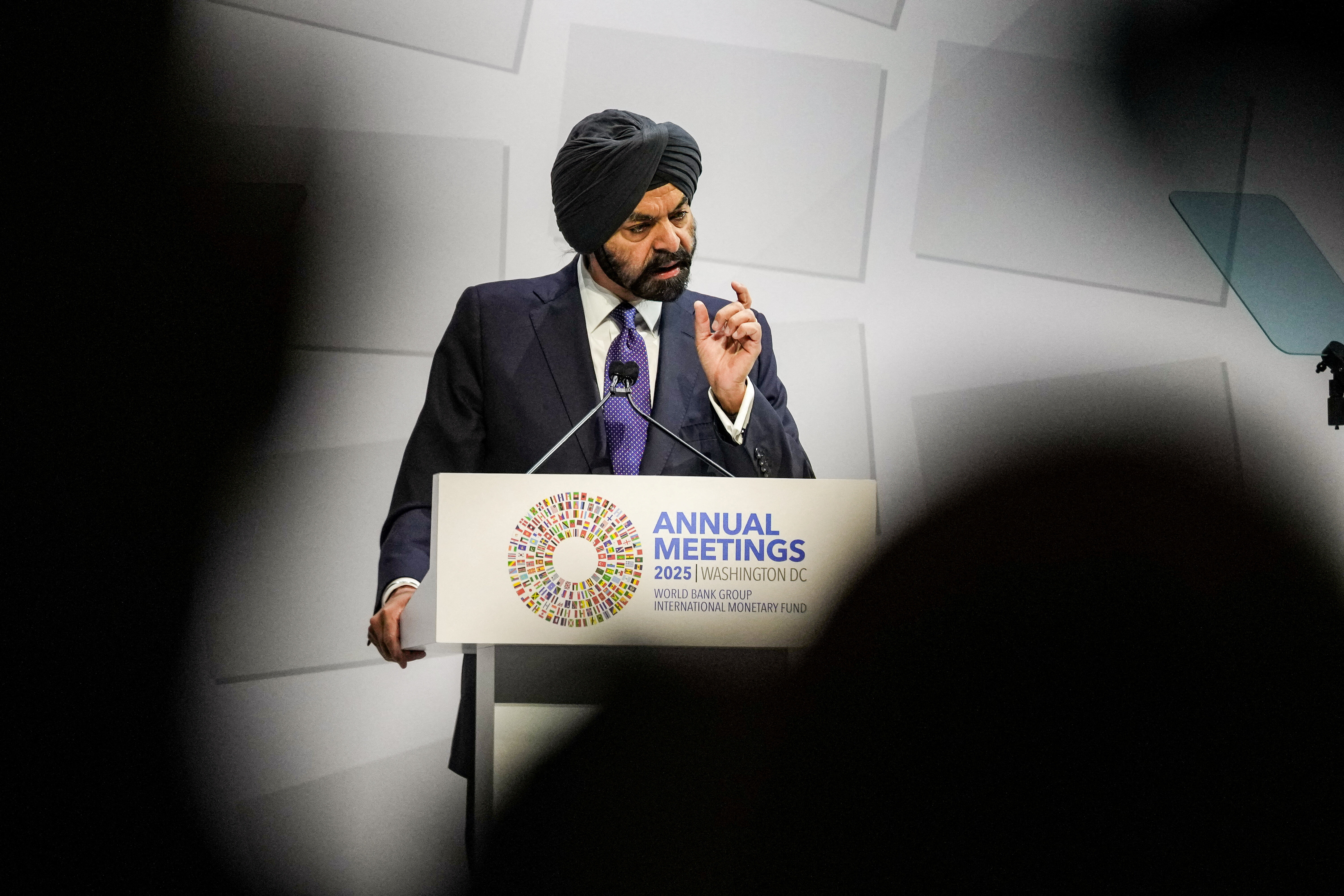
World Bank President Ajay Banga speaks during the IMF/World Bank annual meetings in Washington, DC. Image: Reuters/Ken Cedeno
Alem Tedeneke
Media Lead, Canada, Latin America and Sustainable Development Goals, World Economic Forum- Debt transparency and reform dominated the 2025 IMF-World Bank fall meetings.
- Trade tensions and technological risk, from US-China frictions to unregulated AI, highlighted how economic security now shapes global growth.
- Credibility emerged as a defining theme, as global institutions face growing pressure to demonstrate results and sustain trust in a fragmented world.
This year’s IMF-World Bank discussions in Washington, DC reflected a world still adjusting after years of shocks: economic, technological and geopolitical.
Leaders gathered to take stock of how governments, markets and international institutions can navigate an era of slower growth and greater uncertainty. This fragmentation stems from competing economic models, uneven recovery paths and the growing politicization of trade and technology, factors that continue to test the limits of cooperation.
Global growth steady, but fragile
The IMF projected global growth at 3.2% for 2025, slightly above last year but still below the long-term average. Managing Director Kristalina Georgieva described “uncertainty as the new normal”, pointing to renewed trade tensions, fiscal constraints and higher borrowing costs.
Much of the attention centred on the latest flare-up between the United States and China over rare earth exports, which are vital for clean energy and technology industries. Georgieva urged both sides to avoid escalation, warning that supply chain disruptions could have a “material impact” on the global economy.
Debt and development: transparency takes centre stage
Debt sustainability was one of the most urgent topics. The IMF warned that global public debt could surpass 100% of GDP by 2029, with many developing economies facing renewed repayment pressures.
World Bank President Ajay Banga called for a “new culture of transparency” in debt restructuring and for faster, more efficient disbursement of development finance. Civil society groups echoed that message, noting the cost to public services when governments are forced to prioritize debt repayment over health and education.
Several African and Latin American finance ministers also called for stronger representation in global financial governance, arguing that reform must move beyond symbolic access to give low- and middle-income countries real influence over global lending, debt restructuring and investment decisions.
Reform, climate and private finance
While the US Treasury urged the institutions to stay “anchored to core mandates”, both the IMF and World Bank agreed that climate finance and economic stability are now inseparable.
This year’s discussions also highlighted blended finance and guarantee mechanisms as tools to attract private investment in emerging markets, especially as public budgets tighten. Bank leaders emphasized the importance of reforms that balance ambition with agility, a shift toward results-based multilateralism focused on measurable outcomes.
The conversations in Washington also align with work across the World Economic Forum’s platforms to strengthen cooperation in a fragmented world. Through initiatives such as the Resilience Consortium and the Humanitarian and Resilience Investing (HRI) Initiative, the Forum is helping bridge public and private finance to deliver lasting development impact. These efforts reflect a growing consensus that meaningful progress will depend on practical partnerships rather than parallel systems.
Technology and the new financial frontier
Artificial intelligence and digital innovation featured prominently, not just as future considerations but as immediate risks. Georgieva warned that most countries still lack the regulatory and ethical foundations needed to govern AI effectively.
At the same time, development banks showcased early projects using AI to enhance credit-risk assessments and promote financial inclusion. These pilots suggest that, with responsible oversight, technology can expand opportunity rather than deepen inequality.
Beyond risk management, leaders also discussed how responsible AI and digital tools could unlock productivity gains and extend access to finance, areas where collaboration between the public and private sectors will be essential.
A test of credibility
As the meetings concluded, one message resonated across panels and press briefings: Credibility matters more than ever. From debt transparency to digital regulation, global institutions face mounting expectations to turn promises into progress.
For many leaders, credibility will hinge on proof of delivery, from faster climate finance to debt relief and fairer growth. The path to renewed trust lies in showing progress that people can see and feel.
The 2025 fall meetings revealed both the limits and possibilities of multilateral cooperation. As attention now shifts toward COP30 and other global convenings, these discussions will help shape the agenda as leaders head to the Forum's Annual Meeting in Davos, where they will continue exploring how to strengthen cooperation and deliver progress that restores confidence in the global economy. The themes discussed in Washington also echo the priorities shaping the Forum’s upcoming engagement cycle, centred on rebuilding confidence through cooperation, innovation and inclusive growth.
Don't miss any update on this topic
Create a free account and access your personalized content collection with our latest publications and analyses.
License and Republishing
World Economic Forum articles may be republished in accordance with the Creative Commons Attribution-NonCommercial-NoDerivatives 4.0 International Public License, and in accordance with our Terms of Use.
The views expressed in this article are those of the author alone and not the World Economic Forum.
Stay up to date:
Geopolitics


Forum Stories newsletter
Bringing you weekly curated insights and analysis on the global issues that matter.
More on Global CooperationSee all

Ariel Kastner, Miriam Schive, Sannan Pervaiz and Jessica Margolis
October 2, 2026