4 lessons we learnt from Jane Goodall, the renowned primatologist

Jane Goodall shared stories from her life and work at the World Economic Forum’s Annual Meeting in 2024. Image: World Economic Forum / Mattias N
This article has been updated.
- Jane Goodall, the renowned British primatologist and foremost expert on chimpanzees, has died at the age of 91.
- At the 2024 World Economic Forum Annual Meeting in Davos, Goodall discussed her early life, climate action and why young people still gave her hope for the future.
- Here, we share some of her words of wisdom on the resilience of nature, and how technology and tradition can both support conservation efforts.
“I was born loving animals and loving nature, and I learned by being out in nature.”
So said Jane Goodall, the British primatologist, anthropologist and arguably the world's foremost expert on chimpanzees, when speaking to young environmentalists at the World Economic Forum’s Annual Meeting in Davos in 2024. Goodall spoke about her early life, climate action and resilience, and why young people give her hope for the future.
On 1 October, 2025, at the age of 91, Goodall sadly died. To mark the passing of this titan of conservationism, here are some of the key lessons she learned throughout her life.
1. Dreams can come true
In a world without television, Goodall immersed herself in nature, but also in books. It was Tarzan of the Apes by Edgar Rice Burroughs that first inspired her to pursue her career.
“I dreamed that I would go to Africa, live with wild animals, and write books about them,” she explained. “And everybody laughed at me. ‘How will you do that? You don't have money. Africa's a dangerous place, full of wild, fierce animals. And you're just a girl.’
“Not my mother. She said if you want to do something like this, you're going to have to work really hard and take advantage of every opportunity. And then, if you don't give up, hopefully you’ll find a way.”
2. Technology and tradition can both support climate action
While Goodall did not underestimate the power of technology as a tool in climate action, she was also an advocate for tapping into more traditional methods.
“There's a much cheaper and a very age-old way of solving at least a major part of the climate crisis,” she explained. “Protect and restore our forests. Plant trees, as trees are going to take a long time to get the full carbon capture capacity of an old forest.
“That's why protecting the Amazon is so important now, and the Congo Basin and [forests] in Indonesia and Malaysia.”
3. Passion powers change
Goodall also spoke about the challenge of getting people to face up to a problem as large as the climate crisis. She said the sheer scale of the problem can make it difficult for people to accept and understand.
In 1991, Goodall launched her education and environment charity, Roots and Shoots, to bring together young people to work on environmental, conservation and humanitarian issues.
“I began our programme for young people … to try and help people get over this feeling of hopelessness,” she explained. Students were able to choose their own projects and Goodall said this opportunity to pick their own paths – ones they were passionate about – meant many participants were still advocating for their causes years later.
“The main message [of the programme] is every single one of us matters, makes a difference, has a role to play,” Goodall said.
She believed that young people today are invested in solving all climate crisis issues – something she took great comfort in.
“That's my biggest hope for the future. All the young people around the world, once you know [and] understand the problem, once you are empowered to take action, there's no stopping you.”
4. Nature’s resilience provides hope
Goodall started her work in Gombe, Tanzania in 1960. She said when she arrived it was a small part of a huge forest, stretching across the continent. However, by 1980, it had been hugely reduced in size and was surrounded by bare hillsides.
Seeing this sort of destruction can be extremely disconcerting, but Goodall gave reason to be hopeful for other areas that have suffered from deforestation.
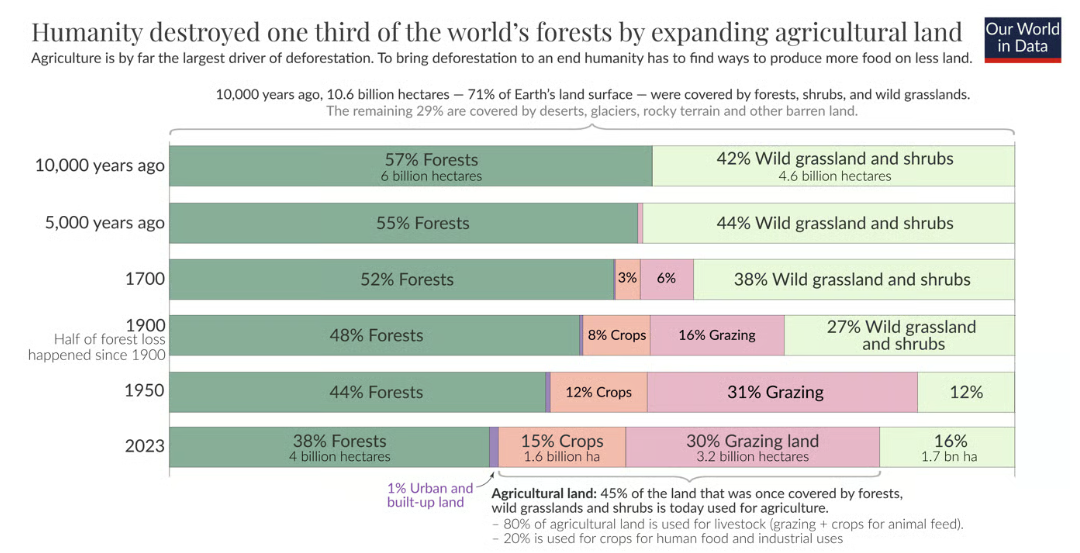
“They're not bare anymore because the people have understood that protecting nature isn't just for wildlife, it's for their own future,” she explained.
“Nature is so resilient that seeds left from the trees that were there, and sometimes even the roots, even after 10, 15 years, there's a magic life in those seeds. New trees will spring up, helped with a little planting of the right trees in the right place at the right time.”
Don't miss any update on this topic
Create a free account and access your personalized content collection with our latest publications and analyses.
License and Republishing
World Economic Forum articles may be republished in accordance with the Creative Commons Attribution-NonCommercial-NoDerivatives 4.0 International Public License, and in accordance with our Terms of Use.
The views expressed in this article are those of the author alone and not the World Economic Forum.
Stay up to date:
Forests


Forum Stories newsletter
Bringing you weekly curated insights and analysis on the global issues that matter.
More on Climate Action and Waste Reduction See all

Laetitia Gardé and Marc Delobelle
February 26, 2026


