AI paradoxes: 5 contradictions to watch in 2026 and why AI's future isn't straightforward
Human insight and expertise is set to become more crucial in order to effectively use AI tools. Image: REUTERS/Carlos Barria
- Artificial intelligence promises transformation, yet its future is not easy to predict and may take multiple paths.
- From job displacement to productivity and energy demand to youth adoption, the impact of AI is full of contradictions and paradoxes.
- As expectations race ahead of reality, the technology’s future may depend as much on human idiosyncrasies and human agency as on technical, geoeconomic or market factors.
If 2025 has been the year of AI hype, 2026 might be the year of AI reckoning.
Its powerful capabilities are already driving advances in healthcare, manufacturing and more, yet, in some areas, the returns on investment are mixed and potential future profits not certain.
In the meantime, AI’s promise is radical, but it's deployment is shaped by potential real-world trade-offs. These range from significant – such as widening social inequality, soaring energy demand and shifting job markets – to existential.
There is much talk of an AI bubble as the world anxiously watches the global economy, with unprecedented spending on AI infrastructure, but the enthusiasm to adopt AI and get ahead in the AI race remains an almost universally shared priority for 2026.
As the technology evolves at a pace, disrupting established sectors and creating new business models, many experts are calling for a focus on systems that bring long-term benefits, although an adversarial geopolitical context makes this hard to achieve at the global level.
Here are five contradictions or paradoxes emerging as AI is adopted, which may reveal less about the technology per se than the idiosyncrasies of the human beings using it and developing it.
1. Will AI take our jobs or give us new ones?
The World Economic Forum's 2025 Future of Jobs Report highlights demand for new roles, many of which call for skills unique to humans. And, for now at least, economic growth still seems to need big, human ideas.
Analytical thinking is the most sought-after core skill among employers, with seven out of 10 companies considering it as essential. This is followed by resilience, flexibility and agility, along with leadership and social influence.
The report drew on a survey of more than 1,000 leading global employers, and found 170 million new roles set to be created and 92 million displaced, resulting in a net increase of 78 million jobs between 2025 and 2030.
But half of employers plan to reorient their business in response to AI, two-thirds plan to hire talent with specific AI skills, while 40% anticipate reducing their workforce where AI can automate tasks.
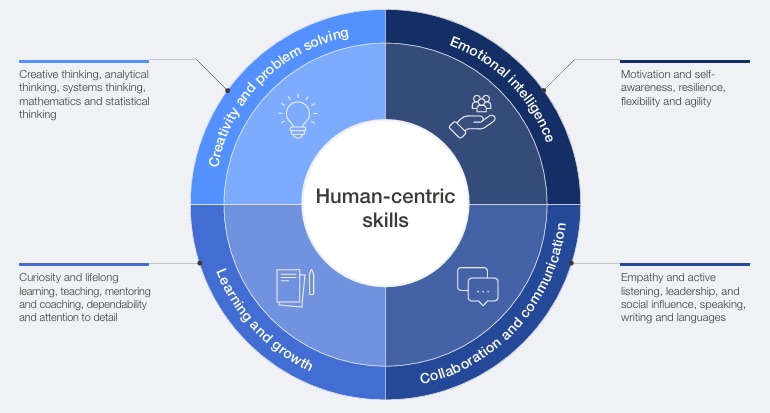
Nearly two-fifths of existing skills required on the job are predicted to change over the next five years. Unsurprisingly, tech-related roles are some of the fastest growing and the skills needed to direct, oversee and evaluate AI operations are set to increase.
But so too are frontline roles such as farmworkers, delivery drivers, construction workers, nursing, teaching and social work seeing significant growth.
Another recent paper, Jobs of Tomorrow: Technology and the Future of the World’s Largest Workforces, emphasizes sector-specific variations. Some jobs are being automated while others are enhanced, especially those requiring complex problem-solving, interpersonal skills, and creativity.
Counterintuitively, therefore, the demand for human-centric skills may be increasing as AI adoption grows. Closing skills gaps and transitioning from declining to growing roles will be essential to growth and employment prospects.
2. Is AI productivity creating extra work?
Thanks to the speed at which AI is developing, it might seem reasonable to expect to feel its benefits at a similar pace. Yet, according to MIT Sloan, manufacturing companies that adopt AI often experience initial productivity losses.
This is known as the productivity paradox. Research into AI adoption at US manufacturing firms found that AI introduction frequently leads to a measurable but temporary decline in performance. But this is then followed by stronger business outcomes over the longer term.

This ‘AI adoption J-curve’ is caused by a misalignment between digital tools and legacy processes regarding investments in data infrastructure, training or redesigning workflows.
Part of this paradox may lie in how AI is being deployed. AI agents can plan and coordinate work across systems, producing outputs that appear complete. But as the Forum report AI Agents in Action highlights, their deployment requires ongoing evaluation, monitoring and human oversight.
As a result, agents can accelerate activity but also potentially increase the effort required to ensure AI-generated outputs are reliable in practice.
Over time, however, the MIT Sloan study found that organizations adopting AI tended to outperform similar firms not using AI in both productivity and market share.
For the knowledge sector, the outlook is nuanced. While workers are being encouraged to embrace AI, a recent report from the MIT Media Lab found that 95% of organizations see no measurable returns. Even worse, some workers are saying that AI is creating 'workslop'. This low quality, AI-generated work requires unnecessary extra work.
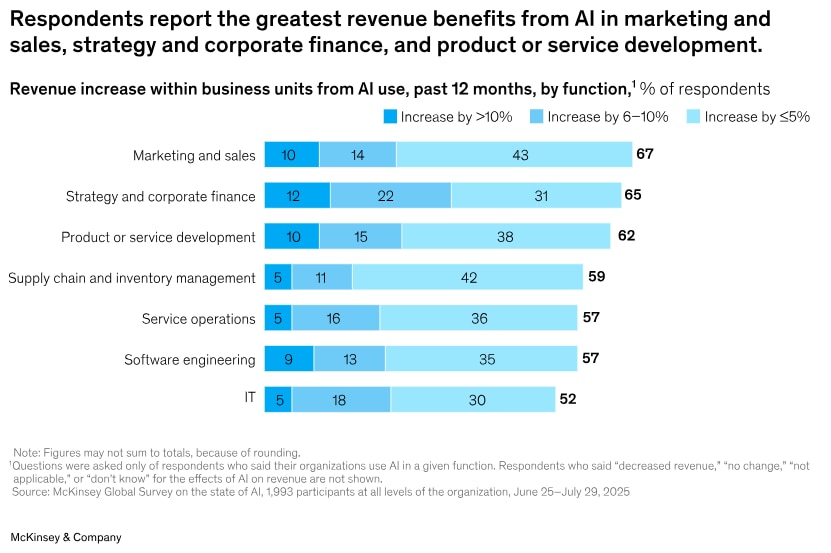
However a recent McKinsey study reveals that for most organizations, AI use remains in pilot phases and many companies have yet to scale the technology in ways that might offer tangible results. Those that are ahead of the AI curve are reporting benefits. So the jury's out.
3. Will 'AI slop' put a premium on human-crafted content?
Large language models have rapidly become adept at creating text that is almost indistinguishable from that made by people. Generative AI tools can now create incredibly realistic audio, images and video from a simple prompt.
At the same time, the amount of AI content online is exploding. Some estimates now suggest that the quantity of AI-generated articles has surpassed those written by humans.
At best this will mean a proliferation of bland, mediocre content, or 'AI slop'. At worst, the result is a surge of false or misleading content. The number of deepfakes shared on content platforms, for example, is projected to reach 8 million in 2025, a 1,500% increase from 500,000 in 2023.
Misinformation and disinformation – which were among the top global risks for 2025, according to the World Economic Forum’s 2025 Global Risks Report – are becoming increasingly difficult to distinguish from true information. One study says that in searches on TikTok for prominent news topics, almost 20% of the videos contained misinformation. Humans can now only detect high-quality deepfake videos about one in every four times.
As this blurring of what’s true and what’s not continues, some commentators suggest that people might start treating everything as fake. Could that, in turn, put a premium on authentic, transparent and accurate media? And as the information space becomes crowded with AI slop, could there be a scenario where human-crafted content from trusted individuals or platforms has a higher value?
The Forum's recent paper, The Intervention Journey: A Roadmap to Effective Digital Safety Measures makes clear that trust online doesn’t emerge automatically – it has to be earned and reinforced. That means clear signals of authenticity, accountability and human oversight may become what helps reliable information stand out.
4. Will the AI generation be the lost generation?
They may be digital natives, but younger peoples' relationship with AI is complex.
Many in Gen Z are using the technology, with 47% telling one US survey they use generative AI weekly. Yet, 41% say they feel anxious about the technology, and almost half are concerned it will harm their ability to think critically.
They may be right. A recent MIT study highlights "reduced brain activity, diminished memory retention, and less original thinking" as potential downsides of over-reliance on AI.
Other young people recognize how the technology could benefit them, but are worried about the effect using it will have on the planet through its water and energy use and the impact of mining for critical minerals for AI infrastructure.
A recent paper, New Economy Skills: Building AI, Data and Digital Capabilities for Growth, reveals some labour-market implications for Gen-Z. Many of the roles that once served as entry points for young workers are being reshaped or hollowed out by automation and AI-enabled tools, while the jobs that are growing often demand experience, digital fluency or specialized skills from the outset.
This leaves young people caught in a familiar bind: expected to arrive “AI-ready”, yet with fewer opportunities to learn on the job. For those without access to high-quality education, training or employer support, the risk is not just anxiety about AI, but a narrowing of pathways into stable, meaningful work.
A parallel shift is the rise of AI agents that don’t just assist with tasks but plan, coordinate and act across workflows. As the Forum’s AI Agents in Action report notes, these systems increasingly resemble human decision-makers rather than static tools.
And as more agents take on tasks once handled by entry-level workers, the question is how younger people can find ways to build the judgement, context and confidence traditionally gained on the job.
Even beyond cognitive risks and job prospects, in their personal lives, some Gen Z-ers seems to be turning to AI to help navigate feelings, make decisions and filter relationships - not always to their benefit.
5. Will AI solutions meet AI's energy needs?
AI's energy footprint is a significant challenge. By 2035, data centres in the US alone could account for 8.6% of total electricity use – more than double their current share. Globally, data centres consumed around 415 TWh in 2024 and this is expected to more than double by 2030, according to the International Energy Agency (IEA).
But its role in the energy sector extends beyond its growing electricity demand.
AI could act as a layer of system intelligence, improving renewable energy forecasting, grid balancing and predictive maintenance, while optimizing building efficiency and enabling flexible demand that responds to variable solar and wind output.
The paradox is that AI could help create a more adaptive, resilient and equitable energy system, rather than simply adding to power consumption. It's growth is also an incentive for tech firms to invest in clean, reliable power.
COP30 discussions of the “twin transition” (bringing together digital transformation and the energy transition), recognized that AI’s growth must not just meet its own power needs but also help accelerate clean energy deployment at scale.
Investments in AI and data-centre infrastructure could also strengthen broader energy systems, supporting renewables, grid resilience and equitable access rather than creating parallel, siloed energy demand.
The Forum report From Paradox to Progress: A Net-Positive AI Energy Framework says that managing AI's energy impact is no longer a future concern but a "present tense innovation imperative".
It offers a framework to help policymakers and tech executives align AI's growth with energy, economic and climate goals.
By doing so, organizations can accelerate progress towards net-positive AI energy and make responsible design a competitive advantage, it says.
License and Republishing
World Economic Forum articles may be republished in accordance with the Creative Commons Attribution-NonCommercial-NoDerivatives 4.0 International Public License, and in accordance with our Terms of Use.
The views expressed in this article are those of the author alone and not the World Economic Forum.
Related topics:

Forum Stories newsletter
Bringing you weekly curated insights and analysis on the global issues that matter.
More on Artificial IntelligenceSee all

Asoz Rashid
April 1, 2026


