Opinion
Why it’s time to put scientific guidance at the heart of climate policy
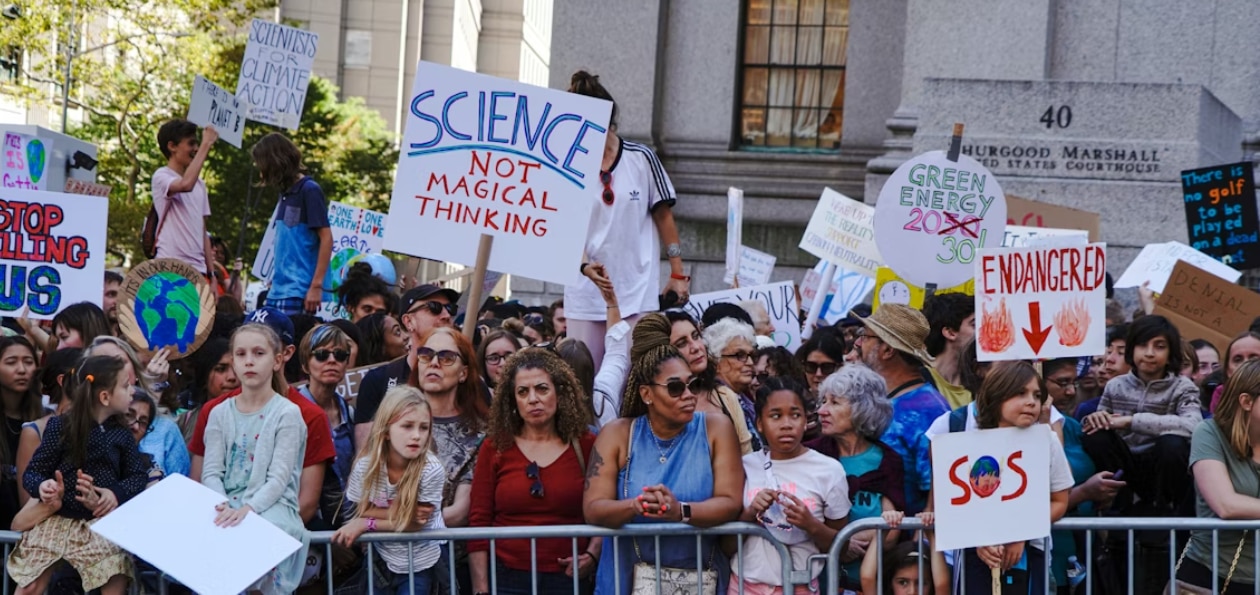
This is not the time for resignation; it’s a time of heightened urgency for climate policy. Image: Unplash/Katie Rodriguez
- Scientific consensus indicates that global warming has reached the 1.5°C threshold, necessitating an immediate shift from commitments to implementing a rapid, science-aligned phase-out of fossil fuels.
- A Science Panel on the Global Energy Transition could provide a dedicated, rapid-response resource to equip decision-makers with the pragmatic, evidence-based policy frameworks required.
- Leaders are gathering at the World Economic Forum Annual Meeting 2026 to advance climate action and ensure that protecting the environment and driving economic growth go hand in hand.
Last year became one of three warmest years on record: on par with 2023 and just short of the El-Niño driven 2024. The three-year average exceeded 1.5°C for the first time ever, pushing the world to the brink of the 1.5°C limit set in the 2015 Paris Agreement. Crossing 1.5°C in the 10-20 year average intended by the Paris Agreement is now a matter of when, not if. And yet the 1.5°C limit is just as key as it was 10 years ago – only now we’re facing at the very least several decades of global warming above 1.5°C.
This is not the time for resignation; it’s a time of heightened urgency. Since the Paris Agreement took effect, the science has become even clearer about increasingly unmanageable risks from extreme weather events beyond 1.5°C. Warming is driving increases in extreme heat, fires, droughts, water scarcity, flooding, wind gusts and soil degradation, impacting the lives and livelihoods of billions of people. Each tenth of a degree will render these climate and natural extremes even more deadly, costly and unmanageable. For many systems and communities, the capacity to adapt is already at its limit. Beyond 1.5°C, the risk of crossing many critical tipping points rises sharply, threatening the stability of key life-supporting processes on Earth.
Four deciding factors for climate policy
How high we go, and if we can return to below 1.5°C, depends in essence on the following four factors:
1. The speed of reaching net-zero emissions, which requires a near-complete phase-out of fossil fuel use before mid-century and immediate annual emission reductions of at least 5%.
2. The transformation of agriculture and land use from a net source to a net sink of greenhouse gases.
3. The scale and pace of carbon dioxide removal, which is essential for bringing temperatures back down after net zero but cannot substitute for rapid emission reductions.
4. The protection and enhancement of natural carbon sinks in terrestrial and ocean ecosystems.
These milestones, although getting tougher to meet with each year of delay, are nothing new. But after 10 years of countries submitting ‘Nationally Determined Contributions’ (NDCs) to meet these milestones, we must admit that it simply doesn’t add up. Currently, if all pledges contained in the NDCs were to be implemented, the world would be heading for more than 2.5°C global warming.
From commitments to action
The ambition of COP30 in Belém was to be the “COP of truth and implementation”, where the leaders of the world, in a Mutirão spirit, shift gear from negotiating commitments to focusing on ways to accelerate the global transition away from dangerous human-caused climate change. Two roadmaps were proposed by the COP Presidency, one on the global energy transition and the orderly and science-aligned phase-out of fossil fuels, and the second one on the urgent need to halt deforestation by 2030.
While no consensus could be found amongst the 195 member countries of the COP to pursue the two roadmaps, the COP President showed remarkable courage and leadership in his commitment to convene a coalition of the willing to pursue the roadmap on the global energy transition. Together with the Netherlands, Colombia offered to host a ministerial meeting at the end of April 2026, inviting all countries in the world who are committed to accelerating the global energy transition towards a safe, just and 1.5°C-aligned future.
For us scientists, this initiative couldn’t have come soon enough. The alarm bells of the scientific consensus are becoming deafening, and we have no time to waste. The good news is, we are ready to support this transition with science-backed guidance considering necessity, feasibility and equity. We have the very latest calculations on the path an ambitious, science-aligned, global phase out of fossil fuels could take; a wealth of scientific knowledge is also available on novel policy mechanisms and concrete strategies for catalysing and managing the phase out. Here are just two examples: implementing a financial mechanism to compensate, kilowatt hour for kilowatt hour, emission-free energy production in lieu of fossil fuel-based production; or linking a global price on carbon to the real cost of burning fossil fuels to our societies (i.e. the Social Cost of Carbon).
Supporting a concrete roadmap for climate policy
We therefore propose to set-up a Science Panel on the Global Energy Transition (SPGET) to support the development of a concrete roadmap that has a chance of providing safety and justice. The origins of this idea is a challenge put to us by COP30 CEO Ana Toni, during the COP30 deliberations in Belém. The key tasks of this group would be to:
- Provide state-of-the-art milestones for mitigation pathways (starting globally and working towards country scale) to be achieved in order to “keep 1.5°C within reach”. The focus should be on what needs to be achieved, year-by-year, over the coming 5-10 years.
- Map and develop the most promising policies and policy mixes, regulations, financial arrangements, and justice dimensions that can support an accelerated energy transition away from climate danger.
The climate landscape is well populated with initiatives to guide and inform decision-makers, be it the UNEP Gap Report, the Climate Action Tracker, the GHG Protocol, the IPCC reports or the UNFCCC Global Stocktake process itself. These will all be invaluable resources for the SPGET. What the SPGET will add is a rapid-response and policy-focused scientific resource to those charged with designing and implementing the road map. Embedded in the road map process, but maintaining its scientific independence, the SPGET will be part of the conversations that matter, building relationships and bridges for the long term.
When the worlds of science and decision-making meet, there’s no denying that disciplinary clarity can become fuzzy and cultural and geographic perspectives matter. That’s why the SPGET must be representative of all these dimensions, drawing on the scientific, engineering and social-science communities, and spanning continents and economic realities.
It’s time to break the deadlock of vested interests and avoid strengthening historical power imbalances by pursuing pragmatic, science-backed, just and effective solutions. There’s no time to waste.
Don't miss any update on this topic
Create a free account and access your personalized content collection with our latest publications and analyses.
License and Republishing
World Economic Forum articles may be republished in accordance with the Creative Commons Attribution-NonCommercial-NoDerivatives 4.0 International Public License, and in accordance with our Terms of Use.
The views expressed in this article are those of the author alone and not the World Economic Forum.
Stay up to date:
Climate Crisis
Related topics:


Forum Stories newsletter
Bringing you weekly curated insights and analysis on the global issues that matter.
More on Climate Action and Waste Reduction See all

Laetitia Gardé and Marc Delobelle
February 26, 2026


