Europe’s economies are too slow, right? Not when it comes to energy
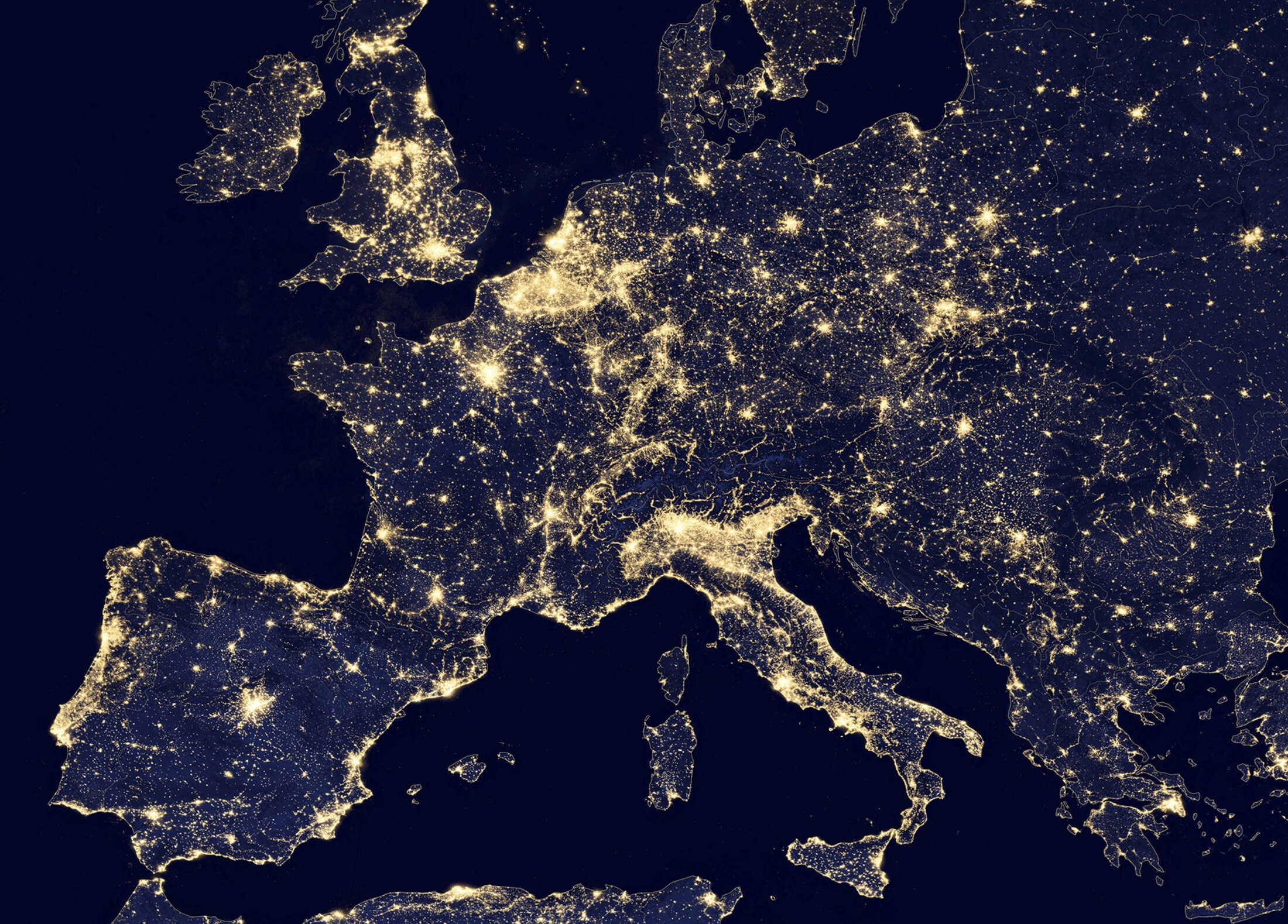
It's about more than just keeping the lights on; Europe's energy situation is complicated. Image: REUTERS/NASA
- Uncertainty pervaded discussions about Europe’s economy at the World Economic Forum's Annual Meeting in Davos last year.
- With the 2026 Annual Meeting upon us, there’s a sense the region’s troubles could be eased by curbing ambitious green-transition efforts.
- But the situation may call for a broader perspective. Europe has made admirable progress – should it scale back?
“High-performance punishment” is usually something meted out in an office. Do your job too well, and risk facing terminally heightened expectations and a stinging lack of recognition.
In a way, this form of backhanded discipline is now being delivered to citizens of liberal democracies at the frontier of the energy transition. Europe has had issues with its economy, which isn’t unique; the relative speed of its progress in adapting to a warming climate is. That can make a virtue feel more like a vice.
Concerns about the cost impacts of Europe’s green energy push on its economic health are genuine and deserve scrutiny. That’s particularly true at a time when livelihoods are being pressured by artificial intelligence, amplifying a sense of middle-class precarity.
A bit of perspective may be helpful, though. And a steady focus on maintaining progress in a world where success in re-fitting for the future doesn’t necessarily earn accolades, but what-ifs. Europe’s biggest what-if in recent years might be the invasion of Ukraine – which abruptly undid its energy supply.
“The only way Europe can be clean, competitive and secure is by accelerating its energy transition,” said Andrew Caruana Galizia, the World Economic Forum’s Head of Europe and Eurasia. “But how this is done matters a great deal for European industry and workers. It will be more effective and less painful with predictable demand signals and deeper energy market integration.”
Europe has developed vast amounts of renewable-energy infrastructure. In terms of capacity, it ranks behind only China and well ahead of the US.
But that buildup comes as energy costs, always a potential hindrance for companies looking to expand or people who want to buy things, have spiked in many European countries. That’s magnified the image of an overburdened, underperforming collective economy. One recent verdict, delivered by a former European Central Bank president: it’s “failing to match the speed” of rivals.
Like any relatively wealthy part of the world, Europe contributes a significant portion of global emissions. Unlike some other parts, it’s assumed a commensurate degree of accountability. The G20, a group that includes some of the richest countries, accounts for nearly 80% of emissions, according to the UN; among the half-dozen biggest individual emitters, the European Union was the only one to reduce its emissions in 2024.
But the achievement occurred in the midst of dramatic upheaval. Europe had been relying on Russia for nearly half of its gas supplies when the unprovoked attack on Ukraine in 2022 put an end to that arrangement. Energy prices proceeded to hit record highs, and remain volatile.
That geopolitical context matters, even if reliance on fledgling energy systems is also part of the story. This past June marked the first time the EU has been able to rely on solar as its main source of electricity. But even proponents acknowledge that new sustainable energy networks will require consistent, long-term support.
That makes for two ambitious European efforts at once: the green transition, and a further tightening of a single market that’s been a work in progress for decades.
All the energy we can get (and more)
Europe’s energy situation can be easily conflated with the notion of an economy out of touch with the hard realities of market-based competition. The term “Euromalaise” has been used for decades, even when some European economies are relatively booming.
There are differing opinions on how to best measure the region’s vital signs. In terms of overall productivity, it seems to have fallen far behind the US – its usual foil.
But according to some experts (and data sources), the two economies actually look pretty similar in terms of economic output per hour worked. There are obvious cultural differences when it comes to things like work-life balance; Europe tends to be healthier, with generally less dramatic wealth inequality.
Whether or not eliminating those differences would really better serve the bulk of Europe's population is a question for Europeans to ponder.
Another way the American and European economies resemble one another: some parts progress when others don’t. In the US, GDP per capita in the richest state is more than twice what it is in the poorest. Differences among EU members can also be considerable.
There's similar variation in terms of renewable energy performance. Not every state can be Texas, where vast plains have proven ideal for wind energy. And not every European country is Norway, with its high-elevation lakes and abundant hydropower, or Spain, where abundant sunshine means extensive solar power generation.
Tapping the brakes on renewable efforts might make more sense if the global economy didn’t need all the energy it can get, at a time when we're trying to square a desire for a more AI-enabled future with a related requirement to power up vast numbers of data centers.
The International Energy Agency estimates that renewable energy will play a big role in that imagined future, due to its cost and availability.
The availability of sun and wind, or more precisely a lack of both, is something that’s hindered renewable efforts in some European markets more than others. For Germany, geothermal might be a more viable alternative. The UK has big plans for nuclear power.
If parts of Europe have brought the average performance of energy systems down, the European project is about elevating the average. That goes for many things.
The lasting imprint of a cataclysmic 20th century means it’s a place familiar with the cost of turning a blind eye to ugly realities. Which might help explain much of its current approach to energy and climate change more generally.
That may be hard for some people to fathom unless they can know what it’s like to start at a historical nadir – which is about where the earliest efforts to form the EU began.
Don't miss any update on this topic
Create a free account and access your personalized content collection with our latest publications and analyses.
License and Republishing
World Economic Forum articles may be republished in accordance with the Creative Commons Attribution-NonCommercial-NoDerivatives 4.0 International Public License, and in accordance with our Terms of Use.
The views expressed in this article are those of the author alone and not the World Economic Forum.
Related topics:

Forum Stories newsletter
Bringing you weekly curated insights and analysis on the global issues that matter.
More on Economic GrowthSee all

Vivin Rajasekharan Nair and Anna Pramod
July 20, 2026


