Geopolitics took centre stage at Davos 2026. Here are 5 key takeaways
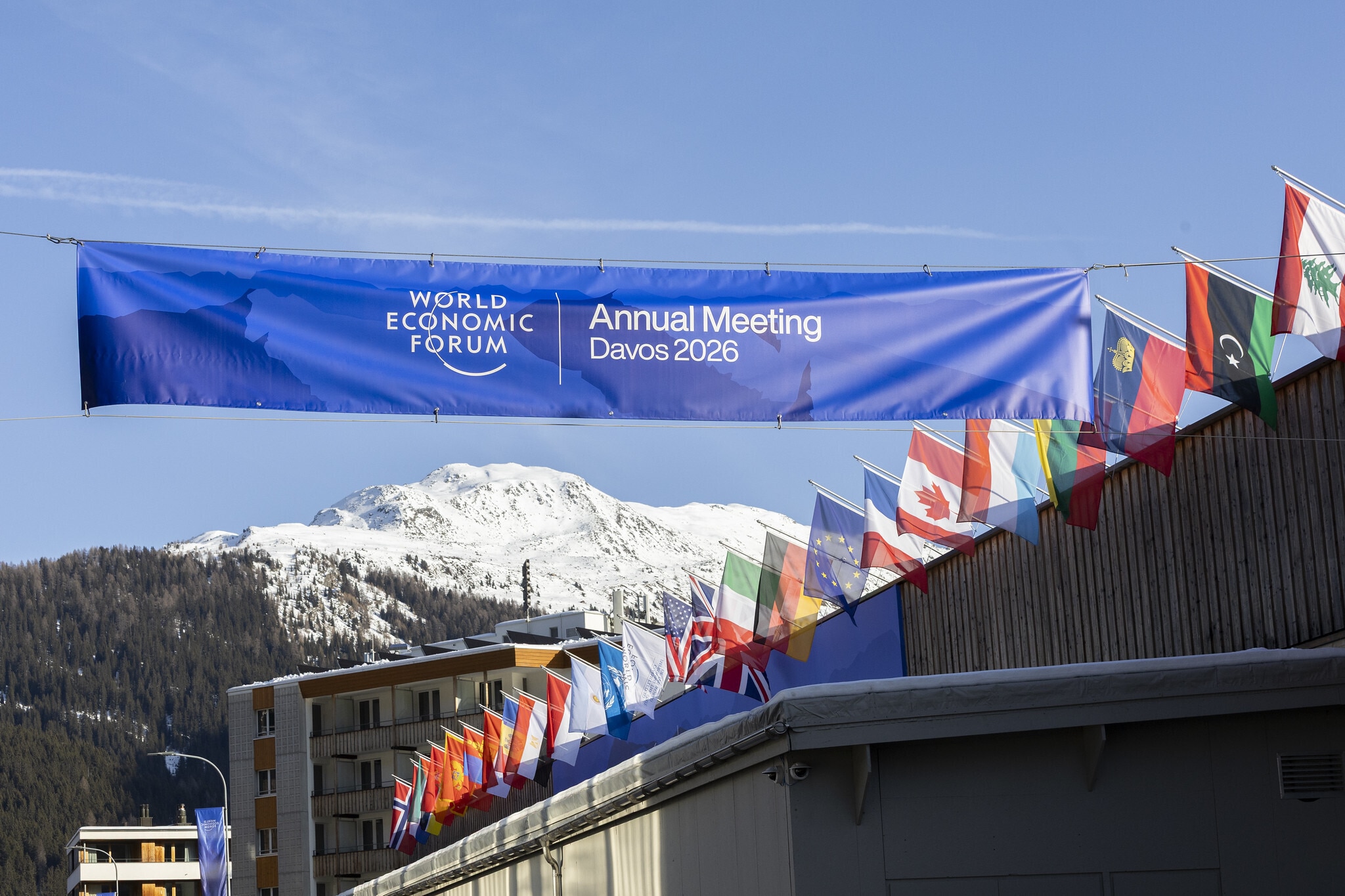
Throughout the Annual Meeting, discussions repeatedly returned to how cooperation is adapting in a more fragmented and competitive world. Image: World Economic Forum
- The World Economic Forum Annual Meeting 2026 convened at a time of heightened geopolitical tensions.
- Nearly 65 heads of state and government attended the gathering, which was held under the theme of 'A Spirit of Dialogue.'
- Here are the key geopolitical takeaways from Davos 2026.
At this year’s World Economic Forum Annual Meeting in Davos, Switzerland, geopolitics took centre stage.
The gathering – which welcomed nearly 400 top government officials, including close to 65 heads of state, as well as hundreds of business leaders, academics, heads of international organizations and civil society representatives – convened at “one of the most complex global moments in generations,” said World Economic Forum President and CEO Børge Brende.
Yet the Annual Meeting, Brende added, served as a “testament to the fact that leaders are committed to a spirit of dialogue.”
Here are five key geopolitical takeaways from Davos 2026.
1. Geopolitical complexity is the new normal
Geopolitical complexity and uncertainty emerged as the defining feature of this year’s Annual Meeting, shaping discussions across regions and sectors.
“This is the 1918, 1945 or 1989 moment of our generation,” said President of Finland Alexander Stubb. “It is a moment when the world order, balance and dynamics are changing.”
One of the catalysts for the change, Stubb added, was Russia’s 2022 full-scale invasion of Ukraine, which fuelled power competition between the US, China and the Global South.
That sense of structural change was echoed by French Foreign Minister Jean-Noël Barrot, who noted that “the growing competition between the US and China threatens to drag Europe into a confrontation or force it to pick sides.” The comment reflected a wider consensus that geopolitics is no longer confined to specific crises but is reshaping global decision-making across domains.
2. Dialogue isn’t dead
The Annual Meeting came at a moment of heightened global conflict—there were 61 active armed conflicts worldwide in 2024, the highest number recorded since the Second World War—and amidst elevated global uncertainty.
Yet the meeting underscored how dialogue can actively shape the geopolitical context. High-level interventions throughout the week did not simply describe geopolitical change but framed new strategic pathways forward. This was most clearly articulated by Canadian Prime Minister Mark Carney, who stated that the world is “in the midst of a rupture, not a transition,” underscoring a fundamental shift in how global power is organised and exercised.
European Commission President Ursula von der Leyen reinforced this message by highlighting efforts to expand Europe’s economic partnerships. “Europe wants to do business with the growth centres of today and the economic powerhouses of this century, from Latin America to the Indo-Pacific and far beyond,” von der Leyen stated. “Europe will always choose the world, and the world is ready to choose Europe.”
Just days after Davos 2026, the European Union and India announced they had concluded negotiations on a historic trade deal, creating a free trade zone of 2 billion people.


3. Cooperation is taking place in new forms
Throughout the Annual Meeting, discussions repeatedly returned to how cooperation is adapting in a more fragmented and competitive world.
Rather than disappearing, cooperation was described as evolving through more flexible, minilateral and bilateral arrangements that allow countries to align where interests overlap. This shift was detailed in the World Economic Forum’s Global Cooperation Barometer, developed in partnership with McKinsey & Company, which notes that “in the face of strong headwinds, cooperation is still taking place, albeit in different forms than in the past.”
As McKinsey’s Global Managing Partner Bob Sternfels remarked during the Barometer’s presentation in Davos, “cooperation works like water.” It twists, bends and shapeshifts, but “it always finds a way to flow through."
This framing resonated across sessions on trade, national security and development, where leaders highlighted the growing relevance of targeted partnerships and issue-specific alignments.
4. The ‘G2 relationship’ may be reaching an equilibrium
Discussions on US-China relations, at times referred to as the so-called G2 relationship, took place at the Annual Meeting just months ahead of US President Donald Trump’s expected visit to China in April.
The timing framed debates around whether the world’s two largest powers can manage an increasingly competitive relationship. As Australian Ambassador to the US Kevin Rudd stated, “the core challenge is whether a bilateral management mechanism is possible.”
Discussions highlighted how the global power balance has shifted, giving rise to a new relationship characterised by a carefully managed atmosphere of competition, in which cooperation on commercial and economic issues can still advance.
“There is actually bipartisan support for a clear-eyed engagement with China,” US Senator Chris Coons said in Davos.

5. Geopolitics and technology are intertwined
Geopolitics and technology converged repeatedly in Davos, with artificial intelligence emerging as a central strategic frontier.
AI featured prominently in US President Donald Trump’s speech, particularly in the context of competition with China, and surfaced throughout discussions on US-China relations and tensions around Taiwan.
Beyond great-power competition, conversations focused on the immediate impact of AI, as leaders grappled less with whether AI will transform societies and more with how to manage that transformation responsibly, with several participants echoing warnings from leading AI developers that the most serious risks may be closer than anticipated.
License and Republishing
World Economic Forum articles may be republished in accordance with the Creative Commons Attribution-NonCommercial-NoDerivatives 4.0 International Public License, and in accordance with our Terms of Use.
The views expressed in this article are those of the author alone and not the World Economic Forum.

Forum Stories newsletter
Bringing you weekly curated insights and analysis on the global issues that matter.
More on Geo-Economics and PoliticsSee all

Francisco Betti, Hernan J.F. Saenz, III and Karen Harris
March 14, 2026


