'Choose now!': Ocean explorer Sylvia Earle's message of hope ahead of 'Blue Davos'
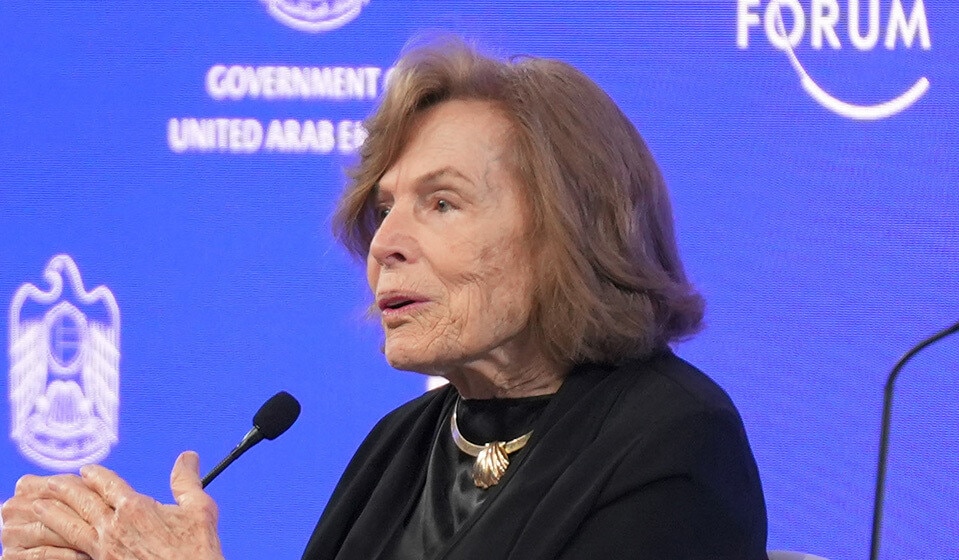
Sylvia Earle addresses the World Economic Forum's Annual Meeting of the Global Future Councils 2025. Image: World Economic Forum
- People alive today have a unique opportunity to safeguard the environment and humanity's future, says Sylvia Earle.
- The nonagenarian scientist has pioneered deep ocean research.
- 'Blue Davos': The Forum's Annual Meeting in Davos will focus on a blue thread highlighting the vital role of water ecosystems—from ocean to freshwater—in global stability, trade, livelihoods, food systems, and climate resilience.
"I think if you could be born anywhere in time - especially if you have an inclination to want to make a difference in the world - choose now."
Sylvia Earle has no delusions about the state of the environment. The nonagenarian oceanographer has seen massive destruction to nature on land and sea in her lifetime. But she still has this message of hope to younger generations:
"Never before could we know what is now known. And never again will we have a chance as good as we now have," she says. The chance Earle is referring to is the opportunity to reverse the decline in nature - something she sees as essential for human flourishing and even survival.
The ocean explorer and "aquanaut" spoke to the Radio Davos podcast, ahead of the World Economic Forum's Annual Meeting 2026, where the ocean will be a major focus of attention.
Born in New Jersey in 1935, Sylvia Earle has devoted her career to exploring and studying life in the ocean. She pioneered the use of technologies that have enabled humans to spend time beneath the waves - something that was science fiction when she was a girl.
"There's submarines like spacecraft," she tells Radio Davos. "Nobody had done that when I was a child, to go to the deepest parts of the ocean."
"It's been a privilege to be on the planet during this era where we have developed technology that gives us the power to go to the Moon," she says, equating space travel with deep-sea ocean exploration.
In 1970, a year after the first Moon landing, Earle was among the first all-female group of "aquanauts" to live underwater, in a submersed laboratory called Tektite II. In the 1980s, she was pioneering submersibles that could explore the deep sea.
But Earle's wonder and gratitude is mingled with a deep sense of regret and concern about humans' impact on nature. "The world I knew as a child, literally it doesn't exist anymore. I was there at the very last piece of time when birds darkened the sky. I can remember it," she says.
"And now those great flocks really don't exist as they once did. We treasure birds, we've made laws to protect birds, but we haven't been able to restore the magnitude, that richness of other forms of life that make Earth habitable."
"[In] the ocean, I watched the collapse of half the coral reefs, kelp forests, seagrass meadows, just that fabric of living systems that make our existence possible," she says "We're still consuming ocean wildlife by the tonne without even knowing their names and turning them into products. We're doing the same thing with forests."
Earle is calling for a more sustainable use of the ocean's resources, not only when it comes to fishing, but also in mining: "Let's stop killing ocean wildlife by the tonne. Let's not even think about tearing up the seafloor with deep-sea mining when we don't even know who is down there."
So why does Earle still have hope for humanity and the nature on which we all depend?
"Technology cuts both ways. It gives us this immense new power, not only to explore, but to communicate on a scale that is unprecedented, and not when I was a child or during all preceding human history or the history of life on Earth, no species has been able to come to the point where we are a global force of change, changing the nature of nature.
"So we've learned more in my lifetime about who we are, where we come from, what is the future, how can we live on this little blue miracle that we call Earth in a long and enduring way," Earle says.
"We need to take all that skill, all that energy, and turn it around. How can we take this knowledge, this wonderful capacity to think through problems, think how we can continue to thrive, not just barely exist, on this miracle planet."
At 90, Earle is still working, advocating for the ocean at her Mission Blue foundation and as a member of the World Economic Forum's Friends of Ocean Action.
"We're just at the beginning of the greatest era of exploration, of opportunity that there's ever been, as long as we can maintain the habitability of the Earth first," she says.
"This is our time. Never before could we know what we now know. It's the best time. Get busy."
The Forum aims for its Annual Meeting 2026 to drive progress on a blue thread that connects every part of the water cycle. At this "Blue Davos," the Forum will focus on improving freshwater access and management, strengthening “blue food” security, and advancing the blue economy to support ocean conservation.
Stay tuned for updates through panel discussions, reports, and other announcements as this key year for water action unfolds. Follow all the action from Davos at wef.ch/wef26 or across social media using the hashtag #WEF26.
Don't miss any update on this topic
Create a free account and access your personalized content collection with our latest publications and analyses.
License and Republishing
World Economic Forum articles may be republished in accordance with the Creative Commons Attribution-NonCommercial-NoDerivatives 4.0 International Public License, and in accordance with our Terms of Use.
The views expressed in this article are those of the author alone and not the World Economic Forum.
Stay up to date:
Ocean


Forum Stories newsletter
Bringing you weekly curated insights and analysis on the global issues that matter.
More on Nature and BiodiversitySee all

Adriana Mata and Judith Ketelslegers
April 9, 2026


