Why climate justice must start with living wages
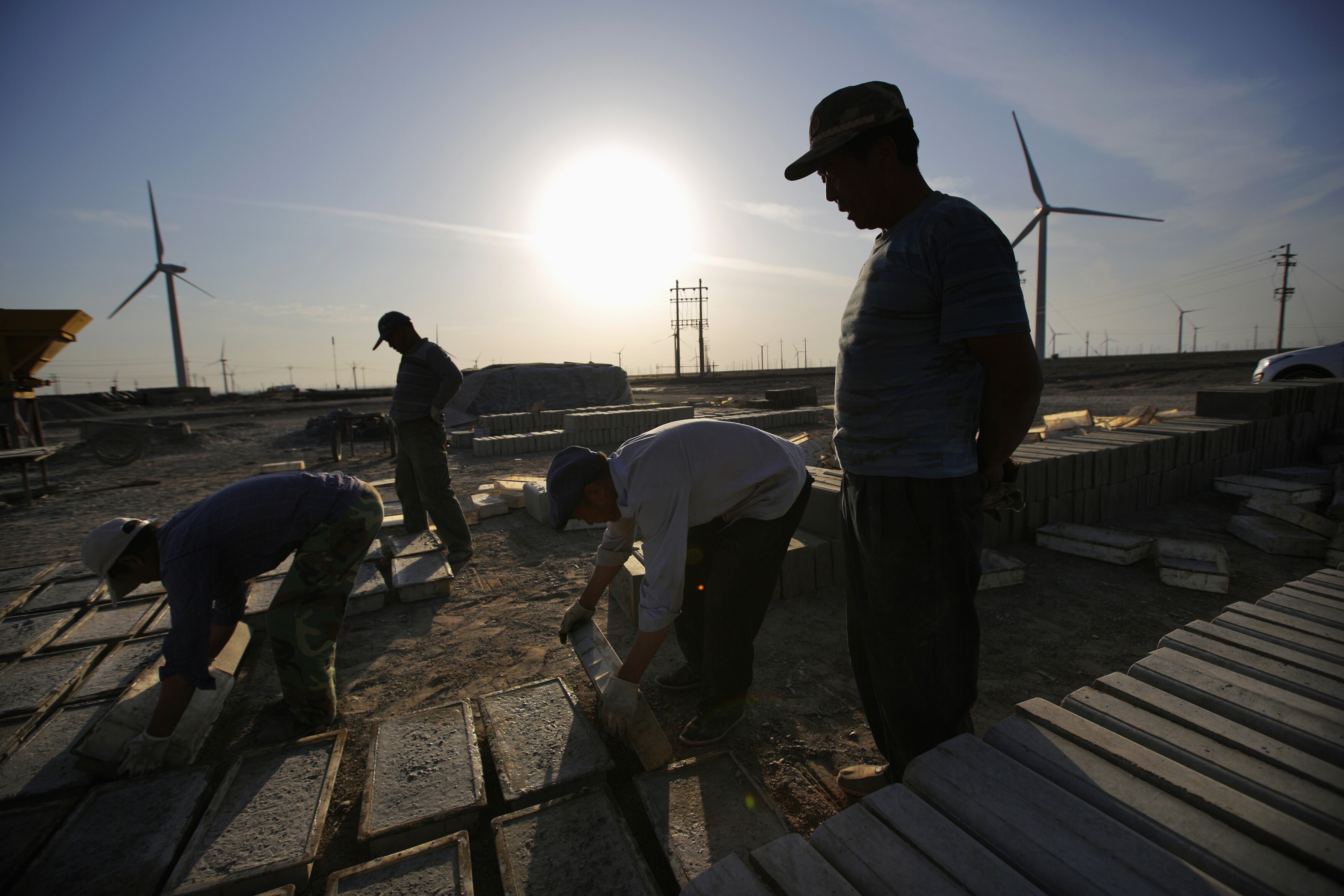
Low wages reveal a structural tension at the heart of the green transition Image: REUTERS/Carlos Barria
- While companies are embracing climate ambition, many still fail to account for the impact of transitions on workers through fair wages, thereby exacerbating systemic social inequality.
- Rectifying inequalities embedded within value chains like wage inequality and the rising cost of living must fall to the companies pursuing transitions.
- Failing to protect wages during a transition eventually harms companies, as it fosters instability and deepens regional divides.
Last year’s UN Climate Conference (COP30) in Brazil and World Social Summit in Doha concluded with strong language calling for aligning climate ambition with social justice.
In the respective political declarations, leaders reaffirmed that decarbonization must be inclusive and that sustainable development requires restoring trust in institutions and markets.
Yet, recent assessments suggest a widening gap between climate ambition and socio-economic reality.
The World Benchmarking Alliance’s (WBA) assessment of climate disclosures from more than 1,000 of the world’s most influential companies, spanning 28 industries and 76 jurisdictions, shows that a majority now report valid near-term operational emissions targets, accounting for roughly one-fifth of global energy-related emissions.
This underscores how climate ambition now stretches across the breadth of the real economy.
However, in another WBA assessment of 2,000 of the most influential companies, far fewer – less than 3% – can demonstrate that workers in their operations and supply chains earn a living wage.
This imbalance reveals a structural tension at the heart of the green transition, just as cost-of-living increases have affected developed and emerging economies alike.
Climate strategy tends to be layered onto business models that continue to depend on suppressing labour costs, externalizing social risk and shifting adjustment burdens onto workers and small producers.
”Why there is a mismatch between climate and social justice
Governments and businesses may cite “just transitions” and “inclusive growth” within strategies, but wage structures and purchasing practices often remain anchored in cost minimization.
Climate strategy tends to be layered onto business models that continue to depend on suppressing labour costs, externalizing social risk and shifting adjustment burdens onto workers and small producers.
The result is a fragile political economy of decarbonization.
Energy systems are being redesigned, industries modernized and supply chains reshaped. When these shifts coincide with stagnant wages, insecure contracts or rising household costs, climate policy begins to feel extractive rather than enabling.
For example, when a coal plant closes without clear plans for new jobs, income support or retraining, or when the shift to electric vehicles reduces roles in traditional auto manufacturing, workers can face immediate income loss. Combined with rising living costs, this can turn the transition into an unintended economic shock for affected communities.
Much of the backlash against carbon pricing, energy reform or industrial policy is often framed as cultural or ideological. But often it is material – when economic security erodes, climate ambition loses its social licence.
Why companies must ensure social equity within their green transition strategy
The principle of common but differentiated responsibility has long guided international climate negotiations. It recognizes that countries with greater historical emissions and financial capacity must lead.
As climate action becomes embedded within value chains, this principle must be applied to wages and the cost of living.
Responsibility for implementing this now extends to companies whose revenues exceed the gross domestic product of many states and whose procurement practices shape wages and working conditions worldwide.
If states bear differentiated responsibility for emissions, then companies must bear differentiated responsibility for the economic consequences of a green transition.
The United Nations Pact for the Future, particularly Action 55(c), calls for strengthening corporate accountability and aligning private sector conduct with sustainable development objectives.
In practice, this requires clearer global expectations for corporate transition planning, supply-chain responsibility and human rights due diligence. Under the leadership of the UN Global Compact, the UN is developing a roadmap to clarify the role of business in delivering on global frameworks such as the Paris Agreement and the Global Biodiversity Framework.
A green transition built on precarious labour is not only unjust; it is economically brittle.
”This reflects a growing recognition that climate ambition cannot rest solely on state commitments if the underlying market incentives driving inequality remain untouched.
How must companies rectify green transition strategies
Yet, most corporate green transition plans remain carbon-centric, modelling emissions trajectories in detail but rarely wage trajectories. They project capital expenditure on renewables but not the income security needed to sustain workers through industrial change.
“Just transition” appears in sustainability reports, while living wages, collective bargaining coverage and income stability are treated as adjacent or voluntary concerns.
For example, WBA has found that fewer than one in 10 of the world’s most influential companies systematically assess human rights risks in their supply chains, and many do not trace basic product origins or take steps to manage those risks, even as they acknowledge climate and nature impacts.
Decarbonization at scale requires workforce mobilization, reskilling and sectoral reallocation – such as the coal phase-out tripartite agreements in Spain that combine income protection with retraining, and Denmark’s Offshore Academy supporting the shift of oil and gas workers into offshore wind. There are also green steel initiatives that pair hydrogen-based production with employment guarantees and skills academies.
It will demand public consent for industrial policy, infrastructure build-out and behavioural change, secured through formal social dialogue, community consultation and clear government mandates.
That consent depends on whether the gains and costs of a green transition are shared fairly. Without economic security, transition risk becomes systemic risk.
Why poor wages eventually hit companies
Emerging research underscores this link. Companies sourcing in high-climate-risk regions often benefit from low wages but as climate risk rises, they shift their demand elsewhere.
This further depresses local wages and amplifies inequality. Evidence from the United States shows that heat shocks reduce wage growth and employment in affected areas, prompting companies to relocate jobs to safer regions.
Globally, climate stress lowers productivity and increases income volatility, especially in exposed sectors.
When companies move capital and production without protecting wages and livelihoods, workers in climate-exposed regions pay the price first. Companies later inherit the consequences in the form of greater instability, higher turnover and deeper regional divides.
A green transition built on precarious labour is not only unjust; it is economically brittle.
Participants at last year's summits in Brazil and Doha called for a renewed social contract in a warming world. But delivering on that ambition requires aligning climate metrics with inequality metrics, and transition planning with labour standards. Living wages, responsible purchasing and worker voice are not social add-ons – they are core transition infrastructure.
The next phase of climate leadership must consider whether decarbonization affects economic security for the people whose lives it reshapes.
Don't miss any update on this topic
Create a free account and access your personalized content collection with our latest publications and analyses.
License and Republishing
World Economic Forum articles may be republished in accordance with the Creative Commons Attribution-NonCommercial-NoDerivatives 4.0 International Public License, and in accordance with our Terms of Use.
The views expressed in this article are those of the author alone and not the World Economic Forum.
Related topics:

Forum Stories newsletter
Bringing you weekly curated insights and analysis on the global issues that matter.
More on Climate Action and Waste Reduction See all

Temidayo Akenroye and Hushneara Begum
April 10, 2026


