Workplace well-being is a competitive advantage. 5 steps effective leaders take

Leaders can make strategic choices to turn well-being into a competitive advantage Image: Unsplash/boliviaintelligent
Jacqueline Brassey
Director of Healthy Workforces and Director of Research Science, McKinsey Health Institute- Staying competitive depends on both strategy and sustained human performance.
- Workplace health is emerging as a defining economic variable amid the acceleration of artificial intelligence, demographic shifts and rising burnout, yet it is often not valued as a competitive advantage.
- Thriving workplaces emerge through deliberate action – leaders can make five strategic choices to turn well-being into a competitive advantage.
Improving employee well-being represents a major untapped economic opportunity, with up to $11.7 trillion in annual economic value at stake. Yet, many organizations struggle to translate well-being into measurable business outcomes.
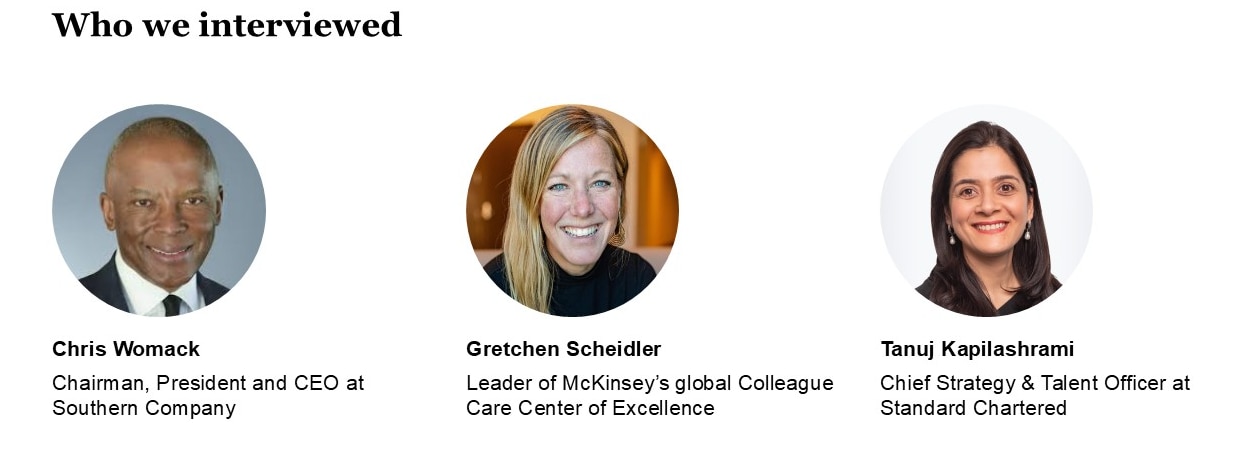
To understand what distinguishes those who succeed, the World Economic Forum and McKinsey Health Institute interviewed several leaders of high-performing organizations about how they create sustainable, thriving workplaces.
A persistent misconception is that organizations must choose between high performance and employee health. Evidence suggests otherwise. Research from the University of Oxford shows a direct correlation between employee well-being and financial performance.
Leaders can achieve strong performance and healthy people or end up with neither. As Tanuj Kapilashrami, chief strategy and talent officer of Standard Chartered, puts it, “High performance can be unsustainable for your well-being; low performance can come with great well-being. Neither tells the full story.”
The solution is to perform through people. Organizations that consistently outperform recognize that results are delivered through how work is designed, how people are supported and how performance is measured.
When employees thrive, performance improves. When performance improves, investment in well-being strengthens. This virtuous cycle turns well-being into a competitive advantage.
Gretchen Scheidler, leader of McKinsey & Company’s global Colleague Care team notes, “Our teams with the highest levels of satisfaction, purpose, connectivity and well-being are rated most highly by clients.”
5 choices to turn well-being into a competitive advantage
Interviews with selected leaders revealed five choices that help turn well-being into a competitive advantage.
1. Manage well-being like performance
Organizations that deliver results through their people apply the same rigour to well-being metrics as they do to financial and operational performance. “If we’re serious about well-being, we have to measure it, track it and embed it in the expectations we have for organizational leaders,” says Kapilashrami.
Metrics should extend beyond healthcare costs to include business outcomes like attrition, sickness absence, engagement and productivity, enabling focused investment. “I don’t want to sprinkle gold dust everywhere,” Kapilashrami explains. “I want to ensure we take targeted actions on the areas where we can have the greatest impact.”
This doesn’t require new systems. Many organizations already collect relevant data, including contributions to team health and work environment in performance reviews.
“All colleagues can provide feedback on the behaviours of peers and leaders, including whether they create a healthy environment,” Scheidler explains.
2. Make “how we work” healthy
Well-being should not be delivered through standalone programmes. Organizations that succeed incorporate well-being into how work gets done, addressing job design, workflows, and team norms. This requires having a portfolio of interventions grounded in operational reality.
“What we want to build is the discipline of well-being,” says Kapilashrami. Discipline means consistency, prioritization and alignment with constraints, such as work schedules, caregiving, federated teams and workload.
For example, Standard Chartered’s flexible working approach enables colleagues and their managers to agree where, when, and how they work. By embedding flexibility into operating norms, well-being becomes part of performance.
3. Make safety a system for performance
Sustainable performance depends on employees feeling safe, physically and psychologically. On the front line, physical safety begins with minimizing hazards and smart workflow design.
At Southern Company, digital twins are used to assess physical spaces remotely, enabling teams to identify maintenance and safety risks more accurately and efficiently.
Psychological safety – the ability to speak up, raise concerns, and seek help without fear – is equally critical.
“Leaders don’t create psychological safety by talking about it, they do it by asking genuine questions and listening carefully to responses,” says Harvard researcher Amy Edmondson. “When leaders invite others’ perspectives, they make it harder for them to remain silent than to speak up.”
Organizations that fail to encourage dissent reinforce the status quo. When employees feel unsafe, energy shifts toward self-protection; when they feel safe, performance, learning and speaking up improve.
“We all have private individual struggles,” says Chris Womack, chairman and CEO of Southern Company. “Creating an environment where people feel supported is essential.”
Psychological safety does not mean avoiding challenge. Leaders at all levels need adaptability and empathetic leadership skills. “We train people leaders to notice signs of ill health, create space for conversations and connect colleagues to the right support,” says Scheidler.
Safety is not a “soft” issue; it is performance infrastructure. “We put in support structures – training, learning and platforms – so people feel able to get help when and how they need it,” says Kapilashrami.
Safety must be designed into the system, not left to chance.
4. Lead by example and reinforce by design
What leaders do matters as much as what they say. “We set clear expectations of the behaviours we expect our leaders to role-model,” says Kapilashrami.
When leaders model healthy behaviours, balancing intensity with recovery, demonstrating vulnerability and using available support, they shape norms across an organization.
Bob Sternfels, global managing partner at McKinsey & Company, points out that leaders are like elite athletes who are at the “pinnacle of their professions.”
“Peak mental performance is often required – adaptability and resilience are imperative,” he adds.
Role modelling alone is insufficient. Leaders must reinforce it through intentional design, shaping spaces, workflows and incentives so healthy choices are practical, supported and rewarded, rather than dependent on individual willpower.
5. Position AI as a partner in well-being
As AI reshapes work, leaders must decide whether technology intensifies or alleviates pressure. When deployed thoughtfully, AI can reduce administrative burden, streamline decision-making and free time for more meaningful work, directly supporting well-being.
Leaders must implement AI and communicate its impact, even as its full effects are still emerging. Positioning AI as a partner in improving performance and well-being fosters adoption by making employees feel enabled, not replaced, by technology. As Womack puts it, “AI is not a boogeyman, it’s here to help us be better.”
Aligning AI deployment with drivers of employee health, such as autonomy, workload, and self-efficacy, allows organizations to improve productivity while strengthening well-being. This requires investing in brain capital – the combination of brain health and brain skills – that drive long-term performance.
Well-being comes from a leadership system, not a slogan
Leaders may have differing motives for addressing employee well-being but that should not delay acting. What matters is linking well-being to results and rewards. “Whether leaders are motivated by purpose, results or incentives, linking well-being to performance and rewards is what drives action and accountability,” says Kapilashrami.
“If employees are our number one asset, we have to show it not just in pay and benefits but in the culture we build,” explains Womack.
Thriving workplaces are built by actively making choices around measurement, disciplined work design, safety, role modelling and responsible technology. When well-being is embedded into how performance is defined, delivered and sustained, people and performance thrive together.
The authors wish to thank Alex Vaught, Amy Edmondson, Andy Moose, Barbara Jeffery, Danielle DiStefano, Darshini Mahadevia, Elizabeth Newman, Erica Coe, Lucy Perez and Sophie Merckelbach for their contributions to this article.
The authors also wish to thank Chris Womack, Gretchen Scheidler, and Tanuj Kapilashrami for their contributions to this article.
Don't miss any update on this topic
Create a free account and access your personalized content collection with our latest publications and analyses.
License and Republishing
World Economic Forum articles may be republished in accordance with the Creative Commons Attribution-NonCommercial-NoDerivatives 4.0 International Public License, and in accordance with our Terms of Use.
The views expressed in this article are those of the author alone and not the World Economic Forum.
Stay up to date:
Well-being Economy
Related topics:


Forum Stories newsletter
Bringing you weekly curated insights and analysis on the global issues that matter.
More on Wellbeing and Mental HealthSee all

Clementina Colombo and Rafaela Valencia-Dongo Q.
April 1, 2026


