The 5 faces of human readiness for AI adoption – and how to work with them

There are two clashing narratives regarding how AI will transform the workplace. Image: Getty Images/iStockphoto
Shaista Khilji
Professor of Human and Organizational Learning & International Affairs, The George Washington University- The tension between boardroom enthusiasm about AI and worker scepticism is limiting the technology's impact on the ground.
- Recent research reveals five distinct postures among employees regarding AI's potential and their openness to adopting it.
- Organizations can follow three key strategies to minimize backstage resistance to AI and reinstate the human factor at its centre.
The rise of AI is no longer a futuristic concept; it is impacting daily life through automated tasks, algorithmic decision-making and ubiquitous chatbots. In the United States alone, 62% of adults now interact with AI several times a week.
This rapid expansion is fuelled by "AI hype", the promise that technology will boost human agency, efficiency and productivity. This excitement is reflected in a massive surge in global private investment, estimated at $660 billion in 2026.
However, there is a paradox at the heart of this digital transformation. While executives push for rapid AI scaling, most employees feel threatened by it. This tension has created a "capability overhang"; a significant gap between what AI systems can technically do and how they are actually used in practice.
The collision of two narratives
Our research into human readiness for AI adoption reveals two competing narratives currently clashing within organizations:
- The top-down messaging: Driven by tech leaders, investors and consultants, this narrative focuses on breakthroughs, innovation and thinking big. It presents AI as a plug-and-play solution for value creation.
- The bottom-up narrative: This narrative is mainly shaped by public anxiety and employee dread. It centres on fears of job losses, the loss of critical thinking skills and a profound distrust of technology executives.
While executives move full speed ahead with their AI adoption plans, they often ignore these bottom-up fears. This lack of engagement has put top-down messaging on a collision course with employee reality across a range of organizations, resulting in inconsistent, superficial or even outright resistance to AI use.
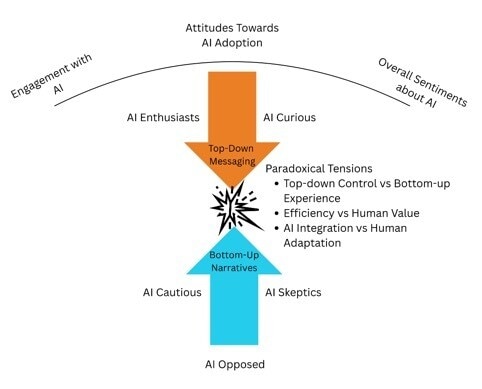
The five faces of AI readiness
To effectively manage this transition, leaders must recognize that employees do not respond to technological change in a binary fashion. As detailed in our recent paper, a two-phase study combining sentiment analysis of public social media spaces with in-depth interviews across multiple industries identified five distinct archetypes of AI readiness:
- AI enthusiasts: Driven by innovation, competitive advantage and efficiency, these individuals are eager to champion new tools. An organization channels this energy by appointing enthusiasts as "AI champions" or internal super-users. For instance, an enthusiastic financial analyst could pilot an advanced generative AI forecasting model, documenting its practical workflows to help demonstrate tangible value to the rest of the department.
- AI curious: Intrigued by the technology's potential but fundamentally pragmatic, they withhold full buy-in until their technical and operational questions are answered. To bridge this gap, a law firm can host interactive, low-stakes "sandbox" hackathons. Here, curious paralegals can experiment with AI-driven document review software without the pressure of client deadlines, allowing them to test the tool’s accuracy and boundaries first hand.
- AI cautious: Acutely aware of data security, ethical guardrails and the unintended consequences AI might have on human collaboration. A healthcare administrative team can address these concerns by introducing AI-driven scheduling while deliberately mandating a strict "human-in-the-loop" protocol. This ensures cautious medical coordinators retain final approval over all automated decisions.
- AI sceptics: Intellectual pragmatists who doubt corporate hype and demand empirical proof of utility before altering their workflows. When an engineering firm faces pushback from senior engineers regarding automated design optimization, management can dismantle this skepticism through controlled, transparent A/B testing. This allows the engineers to validate the AI’s data inputs and outputs against traditional manual formulas.
- AI opposed: Driven by deep psychological or socio-economic fears, such as immediate job displacement or corporate surveillance, these individuals represent the deepest layer of resistance. Because these individuals strongly resist or completely refuse to use AI tools, an organization must address their underlying anxieties directly. For example, in a media company seeing severe pushback from content creators fearing replacement, leadership can introduce a formal "Pro-Human AI Charter".
Frontstage compliance, backstage resistance
Our study highlights that resistance to AI is deeply rooted and operates in two arenas. In frontstage settings – public, visible areas – employees may appear to comply with AI mandates to manage impressions. However, in backstage settings, they often engage in informal critique, "clowning" AI tools, or finding ways to circumvent and delay their use.
Even "AI enthusiasts" tasked with implementing strategies related to this emerging technology often privately doubt their effectiveness. This ambivalence indicates that the success of AI adoption depends less on the technology itself and more on human behaviour and psychological readiness.
Putting the human back in AI development
If business leaders implement AI initiatives without considering employee input, they will continue to see lacklustre results and wasted investment. To move from experimental expense to a sustained enterprise strategy, organizations should follow three key recommendations:
1. Prioritize cultural change over technical solutions. Because successful AI deployment fundamentally necessitates behavioural adaptation, leaders must focus on fostering workplace trust through radical organizational transparency. Consider a scenario where a financial institution decides to restructure its underwriting division using machine learning algorithms. Instead of issuing vague corporate memos, executive leadership would bypass standard PR filters to hold open-door town halls. In these sessions, they would explicitly detail which manual data-entry processes are slated for automation, outline a clear transition roadmap for affected staff, and directly address the realities of role evolution. By meeting employee uncertainty with honest communication, such an organization can minimize "backstage" anxiety and cultivate an authentic culture of adaptability.
2. Focus on "pro-worker" AI and human-machine symbiosis: Instead of evaluating new software through the purely technical lens of "How can we use AI?", forward-thinking executives must ask a fundamentally problem-oriented question: "What systemic problem are we trying to solve?" Shifting the strategic focus toward human-machine symbiosis, where technology explicitly augments and empowers human labour rather than simply substituting it, significantly lowers employee apprehension while boosting project ROI. Imagine a manufacturing logistics firm that intentionally rejects the idea of using AI for automated, top-down workforce scheduling. Instead, they deploy a pro-worker AI tool specifically designed to analyze warehouse safety risks and physical strain. By delegating complex, hazardous risk-assessment variables to the machine while keeping final scheduling choices under human control, the firm effectively preserves worker oversight, maximizes operational efficiency, and achieves high internal adoption rates.
3. Address the roots of employee unease: Until organizations actively acknowledge the multifaceted nature of worker concerns – which stretch beyond technical hurdles to include energy costs, human connection and the erosion of core cognitive skills – AI adoption will remain an uphill battle. Picture a professional services firm establishing a multi-disciplinary governance council tasked with auditing its internal generative AI deployment. If employees express deep unease regarding automated report drafting and the potential atrophy of their analytical skills, the firm would respond not by implementing a strict guardrail: the AI may only be used to generate rough initial structural skeletons. The heavy cognitive lift of synthesis, editing and contextual application would remain strictly a human responsibility – thereby restoring social trust in the workplace.
Human beings are not computing machines; they are emotional, sentient beings. When organizations genuinely balance empathy with strategic technological deployment, it opens the door to a highly productive and positive AI future for all.
How the Forum helps leaders make sense of AI and collaborate on responsible innovation
In this desired future, we will see the emergence of a truly collaborative workplace. Free from repetitive, low-cognitive administrative burdens, workers will find their agency boosted, allowing them to redirect their energy toward strategic thinking, deeper human connections, and creative work. AI will not stand as a threat to job security, but as an empowering tool that amplifies human capability.
Don't miss any update on this topic
Create a free account and access your personalized content collection with our latest publications and analyses.
License and Republishing
World Economic Forum articles may be republished in accordance with the Creative Commons Attribution-NonCommercial-NoDerivatives 4.0 International Public License, and in accordance with our Terms of Use.
The views expressed in this article are those of the author alone and not the World Economic Forum.
Stay up to date:
Artificial Intelligence


Forum Stories newsletter
Bringing you weekly curated insights and analysis on the global issues that matter.
More on Artificial IntelligenceSee all

Etay Maor
October 15, 2026


