How China’s AI-driven collaborations are reshaping global pharma
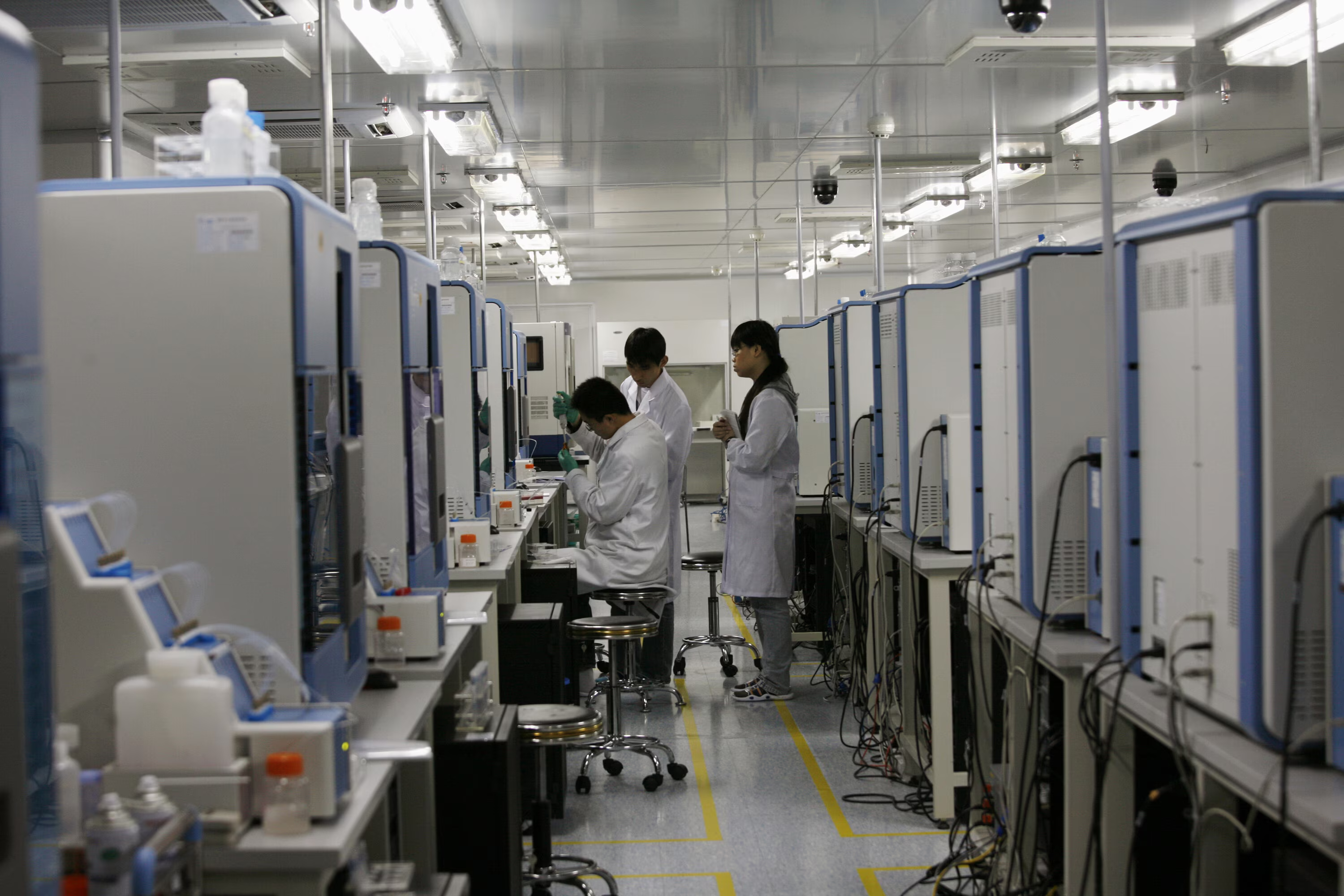
A new paradigm of scalable innovation – centred on deep collaboration and powered by AI – is quietly emerging in China’s biopharmaceutical sector. Image: REUTERS/Bobby Yip
- Rising geopolitical uncertainties and regulatory barriers are forcing a shift from traditional solo drug development towards cross-border partnerships.
- Chinese biopharma is leveraging AI and deep multinational collaborations to accelerate clinical pipelines and lower global R&D costs.
- How promising ideas become scalable impact is a key focus at the World Economic Forum’s Annual Meeting of the New Champions, also known as 'Summer Davos', in China from 23–25 June.
The global trade landscape is undergoing profound changes: heightened geopolitical and economic uncertainty, rising regulatory barriers across countries, and persistent challenges in mutual recognition of clinical data. All of these factors are converging to create unprecedented pressures on the global pharmaceutical supply chain. Supply chain disruptions, escalating compliance costs and fragmented regulatory environments have made traditional models of drug development increasingly inefficient.
Yet crises often breed opportunity. As traditional solo efforts become unsustainable, a new paradigm of scalable innovation – centred on deep collaboration and powered by artificial intelligence (AI) – is quietly emerging in China’s biopharmaceutical sector.
It holds promise as a fresh source of momentum for global pharmaceutical innovation, offering a collaborative blueprint that could benefit patients, companies and healthcare systems worldwide.
From fragmented efforts to collaborative advantage
China has emerged as an indispensable player in global pharmaceutical innovation. From basic research to clinical trials, it is increasingly serving as a vital engine of innovation worldwide.
In recent years, Chinese companies have significantly expanded their presence in global licensing deals. For instance, the average upfront value of licensing agreements between global pharmaceutical and Chinese innovators has grown substantially, reflecting growing international confidence in the quality and speed of Chinese R&D.
However, the path for Chinese companies to “go global” remains challenging: information asymmetry, difficult market access and high compliance risks often prevent promising innovations from reaching international markets.
At the same time, multinational pharmaceutical companies operating in China face their own uncertainties. The “patent cliff” looms for several industry giants, intensified by competition from both local innovative drugs and generics, creating bottlenecks for future growth.
Both sides possess distinct advantages and vulnerabilities. Chinese enterprises offer access to extensive clinical resources, massive and diverse patient populations, cost efficiency in manufacturing and development, and rapid innovation cycles supported by strong engineering and execution capabilities. Multinationals, in turn, offer deep global regulatory expertise, established brand influence, sophisticated commercialization networks, and decades of experience in large-scale clinical development. In this context, zero-sum competitive thinking is inadequate for today’s complex realities.
More companies are recognizing that individual efforts are insufficient. Notably, a number of large, forward-looking Chinese pharmaceutical enterprises have begun engaging in multidimensional, in-depth collaborations with multinational giants, yielding positive results.
Take Sino Biopharmaceutical as an example. The company has explicitly positioned itself as “the best partner for global pharmaceutical companies” and has forged a series of strategic collaborations with international leaders such as GSK, Boehringer Ingelheim (BI) and Sanofi. These partnerships go beyond simple licensing or out-licensing deals; they encompass deep synergies across R&D, manufacturing and commercialization. Each side leverages the other’s strengths: Chinese firms contribute rich clinical resources, large patient populations, cost efficiency and innovation potential, while multinationals bring global expertise, regulatory capabilities, brand influence and mature commercialization networks. This new model of partnership represents a significant turning point for scalable innovation in global pharmaceuticals.
AI empowerment: Shifting from experience-driven to intelligence-driven
In the face of global trade shifts, traditional collaboration models still face limitations in information processing, decision-making efficiency and R&D success rates. Chinese biopharmaceutical companies are actively embracing AI as a transformative new productive force to reshape industry operations.
AI is infusing every stage of the drug innovation pipeline: mining novel targets from vast troves of literature and real-world data; accelerating lead compound optimization through AI-driven drug design; refining clinical trial protocols and patient recruitment strategies via predictive analytics; enabling real-time data verification and risk alerts; and efficiently generating real-world evidence to support regulatory submissions. These improvements are shortening development timelines, reducing costs and boosting success rates. Notably, AI-designed drug candidates have shown markedly higher early-phase success rates compared to traditional methods, highlighting the technology’s potential to de-risk development.
Chinese companies are at the forefront of this shift, contributing significantly to global AI-driven drug discovery advancements. This leadership in applied AI is helping bridge the gap between discovery and commercialization, while enabling a transition towards more continuous, iterative innovation processes rather than one-off projects.
Crucially, AI is propelling companies from localized digitalization towards full-chain intelligence, truly shifting innovation from “experience-driven” to “data + intelligence-driven.” This transformation not only enhances individual enterprise competitiveness but also makes large-scale cross-regional and cross-institutional collaboration feasible. Different teams – whether in Beijing, Boston or Basel – can share data securely, make joint decisions and advance projects efficiently on unified intelligent platforms. By reducing information silos and enabling real-time collaboration, AI turns diverse global talent pools into a cohesive innovation force, supporting the move towards system-level integration where validation and scaling become central.
Towards a new era of boundless symbiosis
Global trade upheaval presents both challenges and a catalyst for reform. China’s biopharmaceutical industry is charting a distinctive path: replacing zero-sum competition with deep collaboration, and empiricism with AI-driven approaches, to achieve genuine scalable innovation. This model not only enables Chinese companies to access global markets more efficiently but also offers multinational firms a practical Chinese solution for navigating the patent cliff, accelerating pipelines, and breaking through growth bottlenecks in an era of heightened uncertainty.
By combining China’s strengths in large-scale execution and clinical resources with global expertise, these partnerships help shift the industry from linear, blockbuster-focused models towards more adaptive, system-oriented innovation. This evolution emphasizes continuous improvement, better integration of data and evidence, and a stronger focus on long-term patient outcomes across the care lifecycle.
Looking ahead, as collaborative models mature and AI technologies deepen, China’s biopharmaceutical sector will play an increasingly pivotal role in the reshaping of global trade and healthcare innovation. With its vast market, robust clinical infrastructure and growing technological prowess, China is well-positioned to contribute meaningfully to solving unmet medical needs worldwide. The ultimate beneficiaries will be patients everywhere, who stand to gain faster access to more affordable and effective therapies.
This is the new era of global pharmaceutical innovation characterized by boundless symbiosis – one where collaboration transcends borders, intelligence amplifies human ingenuity, and shared progress drives collective advancement.
The Forum is spotlighting how innovation moves from breakthrough to scale to impact ahead of 'Summer Davos' in China, 23–25 June 2026. Follow the latest.
Don't miss any update on this topic
Create a free account and access your personalized content collection with our latest publications and analyses.
License and Republishing
World Economic Forum articles may be republished in accordance with the Creative Commons Attribution-NonCommercial-NoDerivatives 4.0 International Public License, and in accordance with our Terms of Use.
The views expressed in this article are those of the author alone and not the World Economic Forum.
Stay up to date:
Artificial Intelligence-Facilitated Healthcare
Related topics:


Forum Stories newsletter
Bringing you weekly curated insights and analysis on the global issues that matter.
More on Technological InnovationSee all

Michael Byczkowski and Andy Moose
September 18, 2026