The new carbon capture method stepping up to tackle heavy industry
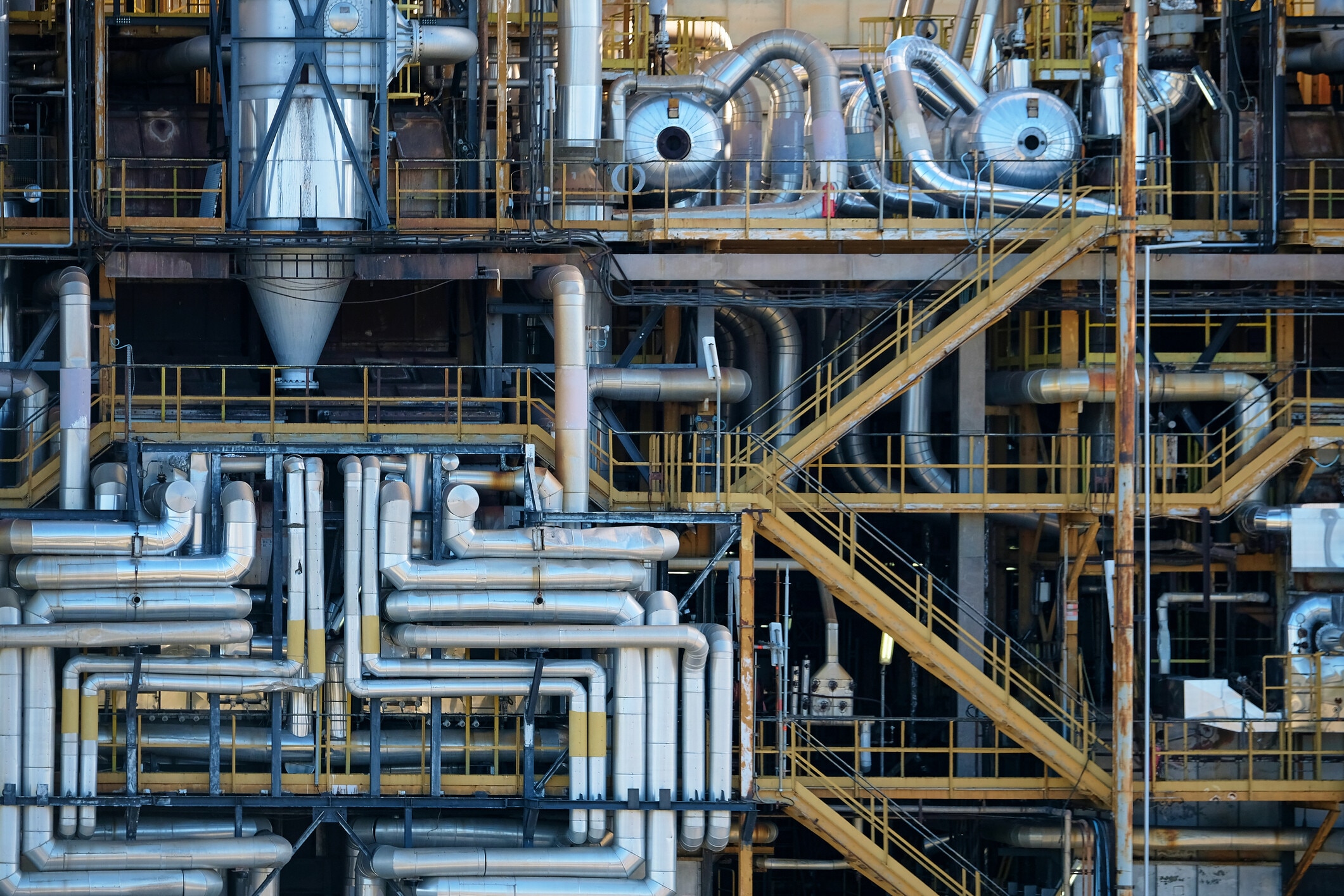
Traditional carbon-capture methods aren't necessarily adapted to high-temperature environments. Image: Getty Images/iStockphoto
- The current most commonly deployed carbon-capture systems rely on amine-based solvents that work best at low temperatures.
- High-temperature approaches involving inorganic materials match heavy industry operating conditions better, rather than forcing companies to adapt systems.
- Improving energy efficiency also boosts cost savings, showing how well-tailored technological solutions drive large-scale adoption.
Heavy industry underpins the entire global economy as well as our daily lives. It produces the steel that shapes our cities, the cement that builds our infrastructure, the chemicals behind products we rely on, and the power that keeps economies running. It is also one of the world's largest sources of emissions, responsible for nearly 70% of industrial carbon dioxide emissions, according to the International Energy Agency (IEA).
Carbon capture is widely recognized as one of the critical tools for decarbonizing heavy industry, particularly in sectors where emissions are difficult to eliminate through electrification alone. Yet too often it's viewed only through the lens of what it costs to deploy, rather than the far greater costs of failing to reduce emissions. More severe flooding and wildfires, rising insurance costs, supply chain disruptions and mounting pressure on food and water resources all carry significant economic consequences. That's why organizations including the IEA and the Intergovernmental Panel on Climate Change have repeatedly concluded that carbon capture deployment must increase dramatically to meet global climate goals.
However, actual deployment remains far behind what those goals require. The question is no longer whether the chemistry works, but whether we've been designing it for the environments where it must run.
Carbon capture today
Today's most commercially deployed carbon capture systems rely on amine-based solvents, which operate best in relatively low-temperature and controlled conditions. But heavy industry operates in far harsher realities than those typically used to develop this chemistry. It’s not pristine labs; its massive smokestacks running hot, pushing out exhaust loaded with contaminants.
Retrofitting conventional carbon capture into these settings requires extensive cooling, cleaning and conditioning. Facilities must layer an entirely new operating model onto existing infrastructure, bolting on added complexity just to make the chemistry viable. Along the way, valuable energy is lost instead of being put to work.
In industries looking to optimize both margins and uptime, these trade-offs determine if a carbon capture project makes economic sense, or never gets past the starting line.
The limits of low-temperature solvents
Amine-based solvents have played an important role in advancing carbon capture and remain well suited to many lower-temperature applications. However, they also illustrate how chemistry changes the game for economics.
Put simply, these systems are energy-hungry. The more energy they consume, the more CO₂ they generate, which can end up compounding the problem they're meant to solve in the first place. Improving energy efficiency improves performance, and it's central to changing the wider economics of carbon capture deployment.
The chemistry itself also presents challenges. Organic solvents such as amine-based ones degrade over time, especially when exposed to heat, oxygen and contaminants common in industrial exhaust, like sulphur compounds, nitrogen oxides, and particulates. Organic molecules can also vaporize and escape into the surrounding environment. This drives replacement costs, increases operational risk and leads to unplanned downtime.
Even with ongoing research improving solvents, the foundational architecture remains constrained by these properties. As a result, many operators looking to decarbonize are left with solutions that don’t fully fit their operating reality.
Meeting industry where it operates
A new generation of carbon capture technologies is asking a simple question: What if the chemistry were designed to match industrial operating conditions instead of forcing industrial facilities to adapt?
Several companies and research institutions are exploring high-temperature approaches using inorganic materials, including molten salts, and solid alkaline earth oxides, such as calcium oxide and magnesium oxide, or mixed metal oxide systems capable of operating in environments where conventional solvents struggle.
While these systems may look similar to traditional ones, the underlying chemistry can be entirely different. Rather than fragile organic molecules, they take an inorganic approach, with materials more akin to rock or lava that can actually withstand harsh industrial environments without breaking down. For example, calcium looping and Mantel's molten borate technology represent this broader shift.
Reducing the traditional energy penalty associated with carbon capture has large implications. When energy efficiency improves, cost savings follow. In sectors where energy is a primary economic driver, this shift inherently changes the business case for deploying carbon capture.
Applications across industry
The advantages are particularly clear in sectors where heat is already central to operations, such as power stations, chemical plants, industrial boilers, steel mills and cement kilns. Oil sands are a strong fit, as operations depend on large volumes of steam for extraction. A high-temperature process can capture CO₂ at the operating temperature, while feeding the recovered heat steam back into the process.
The same applies to pulp and paper mills running large boilers to generate steam for heating wood chips and drying products.
Power generation is another key frontier, especially given the demand we’re seeing from AI. That’s why we’ve been seeing tech giants like Google backing power purchase agreements with natural gas plants fitted with carbon capture and storage. High-temperature carbon capture can integrate into a wide range of generation environments, including data centres, without disrupting operations, and we can expect to see more of this.
The through-line here is that technologies that are re-engineered to match industry’s operating conditions and ways of working are the ones that will actually get deployed. Those requiring facilities to modify and accommodate today’s solvent limitations face a radically different adoption curve.
The broader lesson for industrial innovation
For decades, the carbon capture industry has chased incremental improvements: slightly better solvents, marginal efficiency improvements, modest cost reductions. Those improvements matter, but they don’t actually shift the cost curve enough to make large-scale adoption compelling.
When we design systems that align with how industry operates, the economics begin to radically change. Naturally, adoption follows. Next-generation carbon capture systems that align chemistry with industrial reality can break through the economic barrier that has historically limited deployment.
This trajectory reflects a broader trend in industrial innovation. Too many promising technologies are dreamed up in controlled environments and only later introduced into industry. Technologies that are going to work in the real world have to be designed for it from the very beginning.
Incremental improvements remain essential, and they have driven meaningful progress across countless technologies. But when decades of incremental gains still don’t get us to where we need to be, we need to rethink the foundation entirely.
Don't miss any update on this topic
Create a free account and access your personalized content collection with our latest publications and analyses.
License and Republishing
World Economic Forum articles may be republished in accordance with the Creative Commons Attribution-NonCommercial-NoDerivatives 4.0 International Public License, and in accordance with our Terms of Use.
The views expressed in this article are those of the author alone and not the World Economic Forum.
Stay up to date:
CO2 Capture, Utilization and Storage

Forum Stories newsletter
Bringing you weekly curated insights and analysis on the global issues that matter.
More on Technological InnovationSee all

Niklas Mortensen
August 27, 2026


