The courage dividend: Europe can be a global launch pad for life sciences innovation. Here's how
European life sciences innovation needs to be reformed to benefit patients. Image: Julia Koblitz/Unsplash
- The EU's agreement to pay a 15% tariff on pharmaceutical exports to the US highlights how the global rules on drug development are being rewritten.
- European patients risk being left waiting for medicines their own scientists discovered, meaning the current innovation model needs an overhaul.
- Collapsing the cost curve and reforming regulation will be key to reforming European life sciences innovation making it commercially viable.
The European Union's agreement to pay a 15% tariff on pharmaceutical exports to the United States, breaking a 30-year commitment to zero tariffs on medicines, is the latest signal that the rules of global drug development are being rewritten.
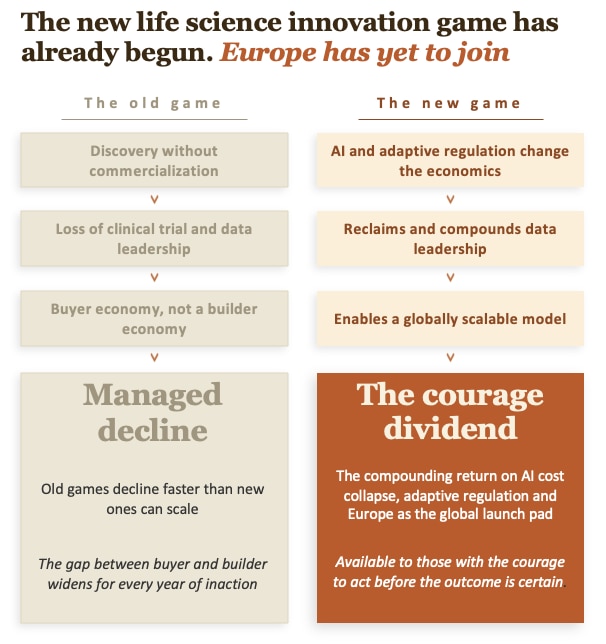
Most attention has focused on damage limitation, but it should turn to strategy. Clayton Christensen, the late Harvard economist, warned that the new game begins before the old game is over and that the behaviours that made the behaviours that made companies successful blind them to the simpler, more efficient models that eventually replace them.
For European life sciences, that moment has arrived.
Historically, the model was rational: fund world-class basic science, de-risk it through agile startups and hand the results to US investors for commercial scaling. European patients did not lose out and costs were recovered through US premium prices and medicines reached European health systems at prices their budgets could bear.
But as development costs surpassed $2.5 billion per approved medicine, that logic became increasingly strained. European value-based pricing was already making smaller EU markets hard to justify. An ‘America first’ policy agenda has compounded that pressure through tariffs, most-favoured nation pricing, science funding cuts and a Federal Drug Administration overhaul, turning the US market into a fortress and pulling companies almost exclusively towards it.
Companies launching in Europe first risk having their prices used to anchor US prices downward – early signs of delays and cancellations are already emerging – and European patients risk being left waiting for medicines their own scientists discovered. These policy shifts make one thing clear: the current innovation model is running out of road, and not just for Europe.
Companies run clinical trials where they intend to commercialize, and with European launch increasingly becoming a liability and China offering lower costs and a growing market, the incentive to run trials in Europe is eroding. Clinical trials in the European Economic Area have seen their global share nearly halve over 10 years to just 12% in 2023, while China surged from 8% to nearly 30%.
A continent no longer running clinical trials opts out of the data generation process that fuels artificial intelligence (AI) and genomic discovery. While European debate focuses on matching US risk capital, funding is only half the battle. The real challenge is reimagining the innovation process to align with sustainable public budgets.
Collapsing the cost curve for R&D
Applied across the full research and development (R&D) chain, AI is an information revolution applied to biology. The industry's 90% failure rate and the $2.5 billion development cost are not laws of nature; they are the consequences of working with inadequate information.
AI can identify which molecules are likely to fail before clinical testing and predict harmful side effects before drugs are synthesized. Evidence is encouraging, with pre-clinical cost reductions of 30-70% already being reported. Using AI, Insilico Medicine advanced a novel fibrosis compound to trials in 18 months, against a five-to-six-year industry average, an early signal of what is possible.
However, the larger prize lies ahead. Most drug development costs sit in clinical phases, where pharma is increasingly directing its AI investment in trial design, dosing strategies and identifying the patients most likely to benefit.
Reforming regulation and health data access
Most-favoured nation pricing rules have made European launches an active commercial liability, leaving European patients at risk of losing access to innovative medicines. The cost-benefit equation has shifted: the harm of withholding innovation now outweighs the risk of approving it earlier with continuous safety monitoring.
Europe already has the tools to act on it. Its orphan medicine framework has spent decades getting treatments to patients with rare diseases faster, by approving them earlier while continuing to monitor their safety and effectiveness, thereby enabling companies to generate revenue and build the evidence base in parallel.
The EU has also initiated a significant regulatory harmonization effort, reforming pharmaceutical legislation, clinical trial infrastructure and health data access. As delayed access becomes a challenge far beyond rare diseases, extending the same logic to the conditions affecting millions, supported by AI systems that monitor safety signals in real time, would replace today's approval hurdle with a faster, adaptive system.
The reward is a self-reinforcing data advantage. Powered by the European Health Data Space, this approach generates evidence that neither the fragmented US system nor China's less diverse patient population can easily match.
As the cycle strengthens, more data produces better models, better models produce better medicines, and better medicines generate richer evidence in return. Europe possesses a structural advantage that will not simply endure, it will compound.
Unlocking the courage dividend for European life sciences
Together these two levers would transform Europe from a beta tester into a self-sustaining hub. AI has the potential to reduce the number of programmes that fail in clinical testing, lowering the total cost of reaching approval. As development costs fall, European value-based price levels would begin to make commercial sense.
Emerging evidence supports this, with AI-originated molecules already demonstrating Phase I success rates significantly above the historical industry average. Designed around such price levels and clinical value rather than the American exception, the model travels in both directions: towards middle-income growth markets where budgets are tighter, and towards the US, which is repricing its own innovation model.
But the model does not build itself without a coherent plan across policy, regulation, reimbursement and innovation funding, spanning institutions, capital markets and industry, with building for European patients and markets as the north star.
As Christensen warned, old models decline faster than new ones scale, and Europe is caught between a US fortress retreating inward and China's high-efficiency engine advancing outward.
The stakes of inaction are significant; patients left behind, an industry hollowed out, and a continent less able to face the next health crisis. What stands between that future and a better one is no longer scientific capacity. It is political will and the imagination of capital markets and industry.
This is the courage dividend: the return on AI-driven cost collapse and adaptive regulation, realized through Europe's position as the global launch pad. The question is whether Europe will claim it.
Don't miss any update on this topic
Create a free account and access your personalized content collection with our latest publications and analyses.
License and Republishing
World Economic Forum articles may be republished in accordance with the Creative Commons Attribution-NonCommercial-NoDerivatives 4.0 International Public License, and in accordance with our Terms of Use.
The views expressed in this article are those of the author alone and not the World Economic Forum.
Stay up to date:
European Union
Related topics:


Forum Stories newsletter
Bringing you weekly curated insights and analysis on the global issues that matter.