The science to eliminate cervical cancer exists. In Asia-Pacific, delivery is the gap
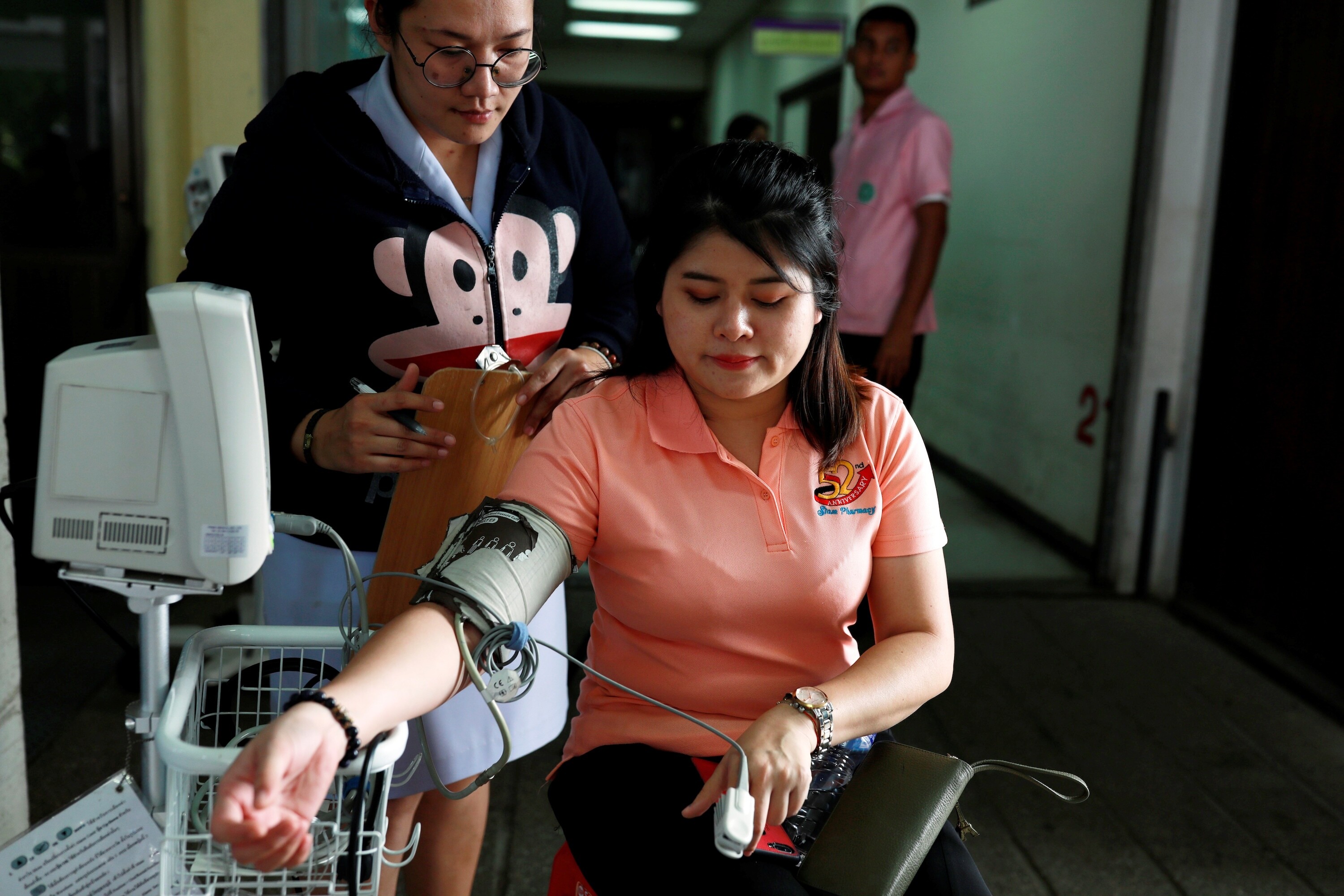
Eliminating cervical cancer in Asia-Pacific is no longer about the science or political will – now, it is a question of getting delivery right. Image: REUTERS/Soe Zeya Tun
- Cervical cancer killed 350,000 women in 2022 with the overwhelming majority of deaths occurring in low- and middle-income countries, despite being largely preventable.
- Across the Asia-Pacific region, where a woman is born remains the most powerful determinant of whether she can access timely screening, diagnosis, and treatment.
- The Cervical Cancer Roadmap by the World Health Organization provides a clear pathway to elimination, but a disciplined focus on delivery is key.
In 2022, clinicians at Dr. Soetomo General Academic Hospital in Surabaya — Indonesia’s second-largest hospital — assessed 215 women being treated for cervical cancer.
Most arrived with Stage III disease. The majority were in their fifties, and 85.6% had never been screened while nearly 90% were unaware that prevention was possible. Half had waited more than a year after their first symptoms before receiving any treatment — delayed by fear, complicated referral pathways, and a lack of access to a screening programme.
Globally, cervical cancer is the fourth-most-common cancer among women, with an estimated 660,000 new cases and 350,000 deaths in 2022.
Yet, the vast majority of cervical cancer is preventable. Australia is on track to become the first country in the world to eliminate it — projected by 2035 — through early adoption of universal HPV vaccination and a transition to primary HPV-based screening. Population-level vaccination and screening are high-yield investments in workforce productivity and long-term fiscal sustainability. These services, when accessible, save lives and keep families intact.
The gap between commitment and care
The international framework for elimination is more complete than for any other cancer. The WHO 90-70-90 strategy, launched in 2020, lays out a strategic, time-bound strategy with clear and measurable targets: 90% of girls vaccinated against HPV by age 15, 70% of women screened twice in their lifetimes with a high-performance test, and 90% of those with cervical disease receiving treatment.
194 countries have pledged to meet these targets. The Asia-Pacific Economic Cooperation (APEC) Roadmap for Cervical Cancer Elimination 2026–2030 has reinforced those commitments at a regional level.
But in many Asia-Pacific economies, screening uptake falls considerably short of the global and regional targets for elimination. Of six South East Asian economies assessed by the APAC Women's Cancer Coalition and Economist Impact, screening coverage among eligible women remains below 50% in five of them.
In the Philippines, Indonesia and India, fewer than 10% of women had been screened for cervical cancer in the last 5 years as of 2021. In Viet Nam the figure is 20%, in Malaysia 40% and in Thailand 60%.
So for millions of women across APAC, geography remains a powerful determinant of whether they are diagnosed early enough to survive. The gap is one of delivery. And across the region, the same three barriers recur with striking consistency.
1. Legal uncertainty
The NGOs, community organizations and sub-national health teams who are the delivery mechanism in much of APAC face ambiguity around data protection, patient registries, public-private data sharing and liability. Without clear guidance, programmes default to restrictive data practices that fragment follow-up and erode effectiveness.
The COVID-19 pandemic showed that rapid, compliant data exchange is possible and best practices exist for data sharing. That precedent has not been translated into lasting legal clarity for many health programmes, including HPV and cervical cancer — the result is that implementers are constrained by lack of contextual guidance that only national governments can provide.
2. Follow-up failure
In many programmes across the region, women who test for HPV don’t receive the follow-up care they need. That means the screening itself, however well executed, does not prevent cancer in a large proportion of the women it identifies as being at risk.
Effective follow-up can begin long before a sophisticated national registry is in place. Malaysia's Programme ROSE — a community-based HPV self-sampling initiative developed by the ROSE Foundation — achieved colposcopy follow-up rates of almost 90% among women diagnosed with HPV.
The team used digital tools that exist in every programme environment: WhatsApp, SMS and community health workers with smartphones. The tools work. What’s missing is standardized guidance on deploying them safely across different regulatory contexts — and a clear strategy to transition these frontline efforts into secure, modernized national registries over time, so that no woman is lost between a positive result, diagnosis and treatment.
3. Testing quality
The proliferation of unvalidated HPV tests and inconsistent laboratory accreditation across the region can undermine the programmes built on their results. Many tests in circulation in APAC have never been validated against internationally recognised performance standards, and laboratory accreditation remains uneven across the region.
Closing this gap is a governance task that will involve national laboratory accreditation frameworks, procurement that admits only assays validated to be recognised international standards, and transparent public tendering that keeps non-validated technologies out of public health workflows.
What elimination requires now
Across Asia-Pacific, economies are approaching this last mile from two different starting points, and the response differs accordingly. Even in economies where elimination is close — Australia, Japan, South Korea — there’s still work to be done. Australia's 2025 progress report identified declining HPV vaccination and screening participation rates, along with persistent inequities in coverage among Indigenous communities and remote populations, for example.
And mature-market economies share a specific regional obligation: to share what they have learned. Australia's EPICC programme — providing tailored country support across the Indo-Pacific — is a model for regional cooperation and learning across varying country contexts. Such models need to scale globally.
For economies earlier in the journey — India, Indonesia, the Philippines and Viet Nam — the starting conditions don’t need to be perfect. Programme ROSE was not built on a comprehensive national registry or a settled legal framework. The model began with community trust, pragmatic digital tools and a commitment to reaching women who had never been screened. Of 4,188 women screened in its pilot phase, 99.7% received a valid HPV result.
The lesson for LMIC programme directors is to build with what exists, invest in validated testing and create follow-up systems that function within the digital infrastructure that communities and health workers actually use.
The two-track path to eliminating cervical cancer
Because frontline realities differ across the region, reaching the WHO 90-70-90 targets and the commitments in the APEC Roadmap calls for differentiated, sequenced pathways set by health-system maturity, with NGOs and community organizations recognised and funded trusted service delivery partners.
Mature and advanced systems — Australia, Japan, South Korea, and Taiwan, China — should push past baseline targets toward firm national elimination objectives. This means completing the shift to organized, population-based primary HPV DNA screening, modernizing national screening registries and automated recall so that no eligible woman is missed. It also means leading structured south-south and triangular cooperation that offers technical support to co-design validated implementation frameworks and laboratory quality-assurance protocols to neighbouring systems, as the EPICC model offers across the region.
Emerging systems should move from fragmented, donor-funded pilots to integrated national programmes backed by sustainable financing. Such a transition calls for costed country investment cases capable of unlocking Multilateral Development Bank capital — concessional lending, blended finance and results-based funding — developed jointly by health and finance ministries.
It also calls for a balanced clinical screening architecture: centralized, high-throughput molecular testing in urban and peri-urban centres, alongside decentralized point-of-care testing and self-sampling in rural and remote areas to reach all those eligible for screening.
Existing programmes must resolve the 30% to 50% loss to follow-up by using accessible community tools such as SMS and WhatsApp now, building toward integrated national registries for the future, and setting clear regulatory timelines for phasing out reliance on low-sensitivity legacy tools in favour of validated HPV-based pathways.
The last generation to lose this battle?
The APAC Women's Cancer Coalition exists because the barriers to cervical cancer elimination within a generation — in every economy in this region, for every woman regardless of where she lives — are known, documented and solvable. The science has been proven for decades. The political frameworks are in place.
Leaders now face a decision: whether the women arriving with Stage III disease at hospitals like Dr. Soetomo will be the last to die from a cancer the world already knows how to prevent.
Don't miss any update on this topic
Create a free account and access your personalized content collection with our latest publications and analyses.
License and Republishing
World Economic Forum articles may be republished in accordance with the Creative Commons Attribution-NonCommercial-NoDerivatives 4.0 International Public License, and in accordance with our Terms of Use.
The views expressed in this article are those of the author alone and not the World Economic Forum.
Stay up to date:
Women's Health
Related topics:


Forum Stories newsletter
Bringing you weekly curated insights and analysis on the global issues that matter.
More on Health and Healthcare SystemsSee all

Shilpika Das
September 10, 2026


