Why the fight against Ebola is a logistics challenge, not just a medical one
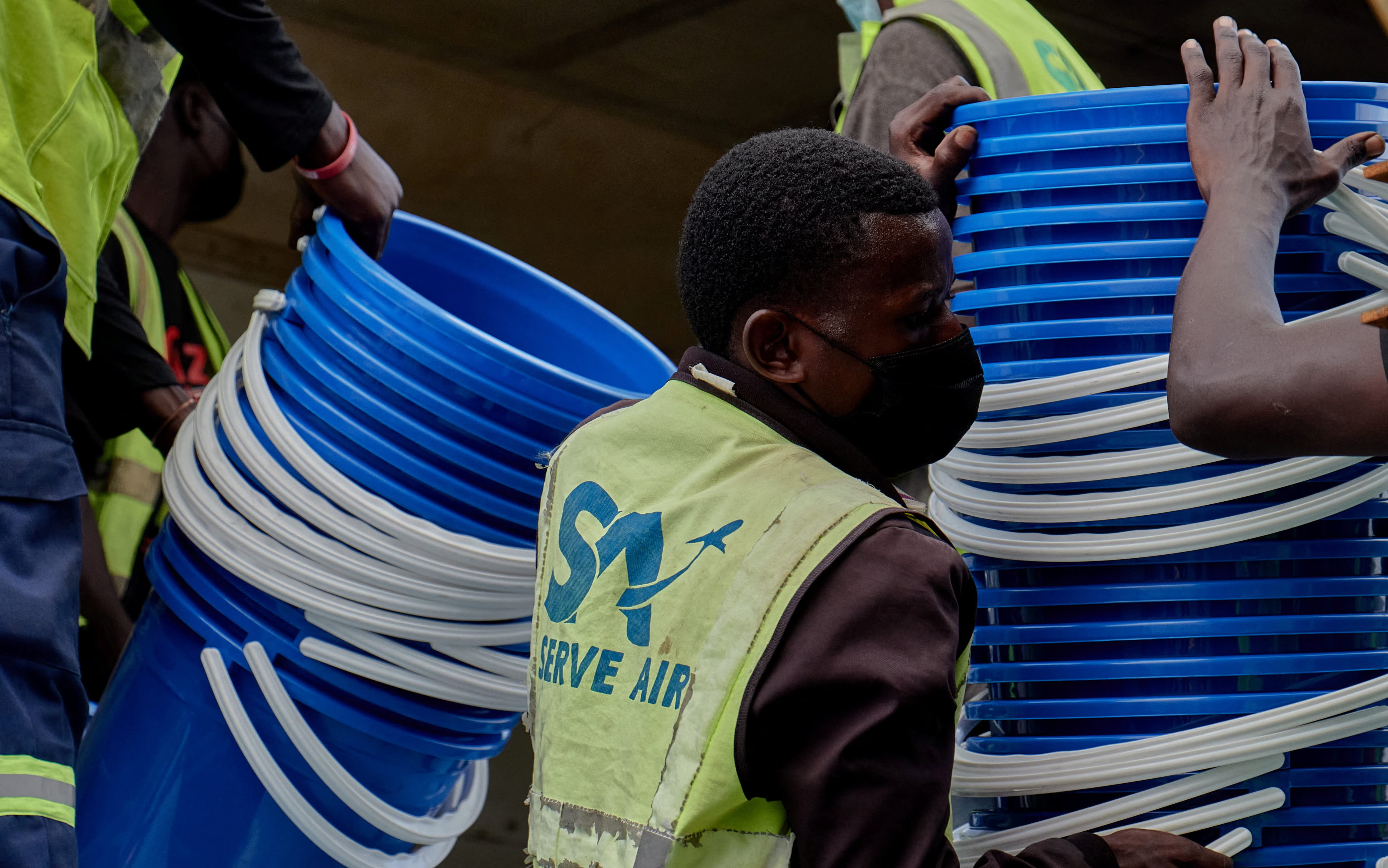
Advances in diagnostics, treatments and public health interventions are only effective if they can actually reach affected communities quickly and reliably. Image: REUTERS/Gradel Muyisa Mumbere
Temidayo Akenroye
Associate Professor of Supply Chains and Analytics, University of Missouri-St. Louis- Medical innovations are only effective if logistical supply chains can reliably reach local communities.
- Fragmented information systems and physical infrastructure deficits routinely cause critical medical resource stockouts.
- Centralized digital tracking platforms could allow diverse health organizations to share data and prevent crises.
When an infectious disease outbreak like Ebola hits the headlines, public attention naturally focuses on vaccines, treatments and frontline responders. We tend to view epidemic control as a purely medical challenge, waiting for the next laboratory breakthrough to solve the crisis.
But the reality is that advances in diagnostics, treatments and public health interventions are only effective if they can actually reach affected communities quickly and reliably. An equally vital, yet often ignored, factor is the invisible ability to coordinate the movement of information, personnel and critical supplies across a complex network of government agencies, healthcare facilities, humanitarian organizations and donors.
The counterintuitive truth of epidemic response is that a medical breakthrough is only as good as the supply chain behind it.
How the logistics crisis is unfolding in the DRC
This hidden operational reality is defining the active response in the Democratic Republic of Congo (DRC). The current outbreak is caused by a rare strain for which no approved vaccine exists, meaning that containment depends entirely on swift logistical execution – early case detection, rapid laboratory sample transport and the continuous resupply of treatment centres.
Yet the physical and organizational environment in the DRC – and in other regions affected by insecurity, displacement, weak infrastructure and limited healthcare capacity – remains incredibly hostile to a smooth supply chain. During health emergencies, poor transport infrastructure, active conflict and fragmented information systems routinely delay life-saving goods.
The sheer scale of this logistical bottleneck is immense. During the 2018 to 2020 outbreak in eastern DRC, the World Health Organization had to move nearly three metric tons of supplies daily using cargo planes, helicopters, trucks, and motorcycles just to reach affected areas. More recently, during the 2025 outbreak in Kasai Province, humanitarian organizations reported that reaching isolated communities required several days of travel over impassable roads.
When coordination breaks down across a massive network of ministries, international donors and local clinics, the consequences are immediate: stockouts of protective gear, duplication of effort, and a distinct drop in public confidence.
All of this points to one thing: that strengthening supply chain coordination should be viewed as a core component of epidemic preparedness, ensuring that information, resources and decisions flow efficiently to the areas of greatest need when every hour matters.
Why standard health logistics frameworks fail under pressure
Why do these problems persist? Academic research offers some clues.
One recurring finding is that most coordination frameworks fail in developing countries because they focus too much on internal operations like scheduling and tracking, while ignoring the broader political, economic and social forces that actually determine success on the ground.
This matters because a medicine supply chain does not operate in isolation. It runs across central, regional and service delivery levels, and the presence of multiple vertical chains creates numerous points of intersection and overlap, drawing in stakeholders whose interests are diverse and often in conflict. Understanding the wider environment in which the chain operates is therefore not a secondary concern but a precondition for coordination that holds under pressure.
In research we carried out in 2019, we found that improving availability depends on a combination of enabling conditions rather than any single intervention. Macro-level enablers such as policy and regulation play a significant role, yet challenges such as political interference, poverty, donor dependence and the absence of appropriate technology continue to obstruct access. Socio-cultural factors add a further barrier, since many communities still rely on traditional herbs for treatment, and these are compounded at the operational level by poor storage management and unreliable electricity. Access cannot therefore be secured by strengthening any one layer alone, but requires attention to the policy environment, the community and the logistics base at the same time.
Building digital solutions for real-time supply chain visibility
What connects these findings is the critical importance of information sharing and the management of interdependencies among supply chain partners. Where communication relies on manual, error-prone processes that lack transparency, the movement of medicines to patients is inevitably delayed and difficult to trace.
Because public health facilities are deeply interdependent, our work advocates for cost-effective digital technologies combined with practical measures like resource pooling and process standardization.
To demonstrate how these coordination gaps can be closed in practice, we developed a prototype for a centralized mobile platform. By bringing together an integrated dashboard, live tracking and a multistakeholder interface, the platform provides real-time visibility to all network partners. This system strengthens control over procurement and forecasting, automatically triggering alerts for overstock or understock situations before a local facility runs into a crisis.
Three structural actions to strengthen outbreak response
Moving forward, closing these coordination gaps requires focusing on three immediate priorities:
- Develop a centralized digital platform for real-time visibility of outbreak-response supplies. A shared system providing information on inventory levels, stock movements, transport capacity, and demand would help prevent stockouts, reduce duplication, and improve resource allocation.
- Strengthen information sharing among government agencies, healthcare facilities, humanitarian organizations, and donors. Common protocols for data sharing, reporting, and coordination can improve situational awareness and allow stakeholders to respond more quickly to emerging needs.
- Establish coordinated forecasting and inventory management before outbreaks occur. Joint planning and pre-positioning of critical supplies can significantly reduce delays when outbreaks emerge.
The stakes for global health security
Defeating an epidemic ultimately depends on a health system’s ability to coordinate information and assets under pressure.
By combining these digital tools with real-world structural alignment, global health partners can finally fix the systemic inefficiencies that cause relief networks to snap. Building this integrated infrastructure is no longer a secondary administrative goal – it is a global health priority. The next novel pathogen will not wait for our logistics to catch up.
Don't miss any update on this topic
Create a free account and access your personalized content collection with our latest publications and analyses.
License and Republishing
World Economic Forum articles may be republished in accordance with the Creative Commons Attribution-NonCommercial-NoDerivatives 4.0 International Public License, and in accordance with our Terms of Use.
The views expressed in this article are those of the author alone and not the World Economic Forum.
Stay up to date:
Logistics


Forum Stories newsletter
Bringing you weekly curated insights and analysis on the global issues that matter.
More on Health and Healthcare SystemsSee all

Hong Yew Lim
October 7, 2026


