How to move biomanufacturing from lab to market
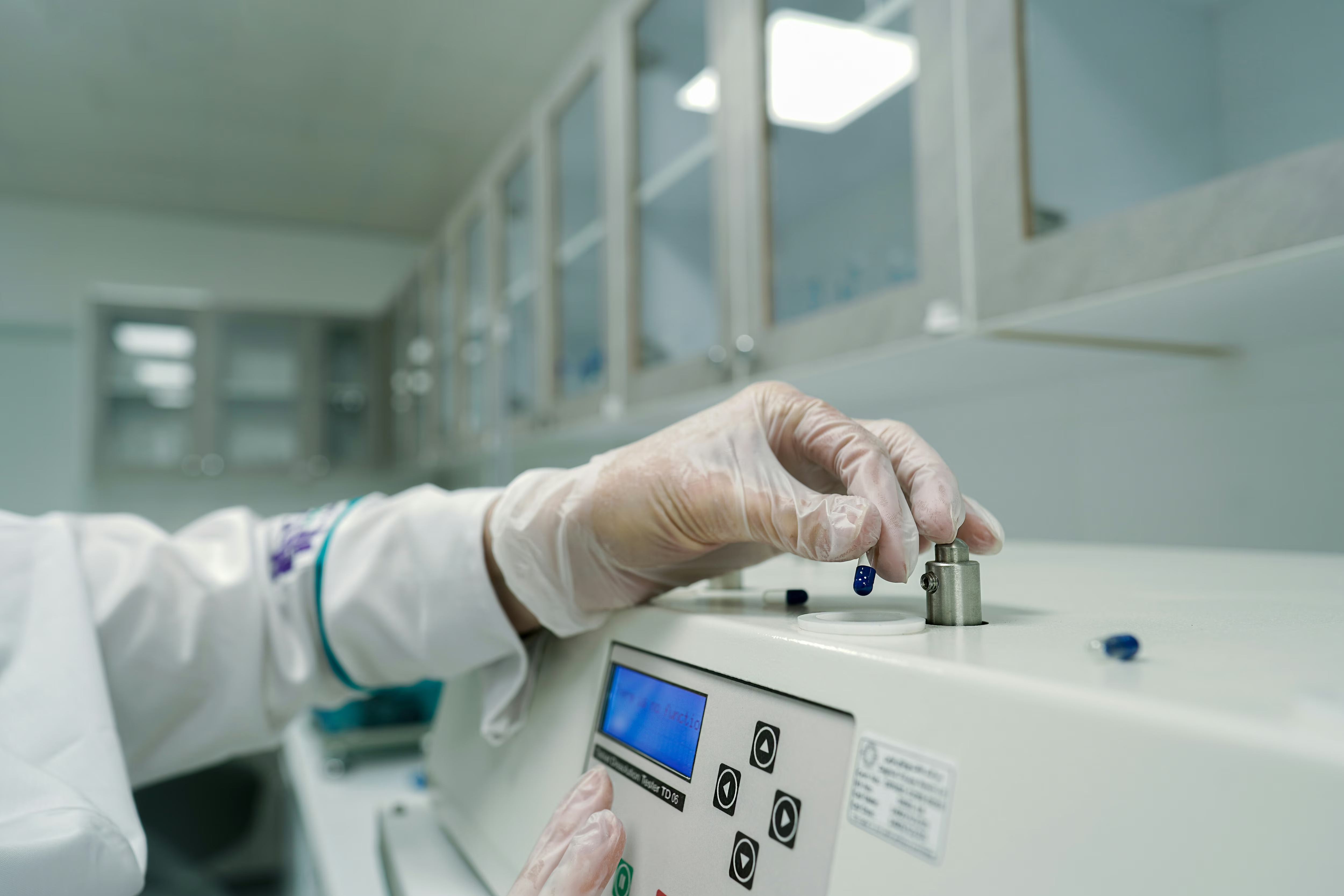
The global bioeconomy, currently valued at between $4 trillion and $5 trillion, stands at a historic turning point. Image: Mina Rad/Unsplash
- The global bioeconomy faces commercial scaling gaps due to systemic coordination failures across value chains.
- Overcoming these barriers requires integrated ecosystems that align innovation, industrial capacity, and targeted capital globally.
- How promising ideas become scalable impact is a key focus at the World Economic Forum’s Annual Meeting of the New Champions, also known as Summer Davos, in China from 23–25 June.
The global bioeconomy is currently valued at between $4 trillion and $5 trillion, and stands at a historic turning point, with research suggesting biological innovations could potentially reshape up to 60% of physical material production.
Yet today, bio-based materials still account for only 1% to 2% of global output. Even polylactic acid (PLA) – the most mature bio-based plastic – represents less than 1% of global plastic production. After a century of progress, it still faces three persistent barriers: high costs, performance limitations and the absence of a closed-loop global ecosystem.
This broader gap between laboratory breakthroughs and commercial-scale deployment is rarely just a technical issue; rather, it stems from systemic coordination failures across the value chain. Isolated technical breakthroughs cannot deliver industrial-scale impact; success hinges on systemic industrial coordination capacity
China: The global testbed for biomanufacturing scaling
To solve these coordination failures, the industry must look to environments capable of massive industrial-scale deployment. Currently, the global innovation landscape is distinct: the United States leads basic research, Europe sets regulatory benchmarks, and China has emerged as a critical testbed for industrial-scale biomanufacturing.
China’s 14th Five-Year Plan for Bioeconomic Development has shifted policy focus from R&D prioritization to ecosystem building and market cultivation. Leveraging a domestic market valued at nearly $20 trillion and the world’s most comprehensive, integrated industrial ecosystem, it offers an unparalleled environment to validate and scale bio-based materials.
Scaling through ecosystem collaboration: a case study approach
It is within this unique ecosystem that our organizations – China Merchants Group (CMG) and Cathay Biotech – have developed and implemented a technology–industry–finance synergy framework. By combining CMG’s industrial scale with Cathay’s focus on synthetic biology, this operational framework aims to restructure how technology, industry, and finance interact, addressing persistent bottlenecks in feedstock supply, production efficiency, and market adoption. In practice, each pillar functions as follows:
- Technology: Deep alignment through equity, strategy and operations embeds industrial requirements at the earliest R&D stage, eliminating misalignment between innovation and market needs.
- Industry: Open access to real-world applications in construction, transportation and logistics; joint development of industry standards; and end-to-end support from R&D to pilot and mass production, providing order-based validation and scaling pathways.
- Finance: Full-spectrum financial services – equity, debt, M&A – back commercialization and mitigate risks.
Proven impact: Real-world validation across diverse sectors
The application of this framework offers early data on how bio-based materials can transition to commercial markets.
For example, the development of bio-based polyamide formwork utilized real estate pilot sites to establish a production–leasing–recycling closed-loop model. Similar validation trials in energy storage enclosures and cold-chain components suggest that bio-based alternatives can meet industrial safety and weight requirements when backed by integrated supply chains.
Global collaboration: Building a sustainable biomanufacturing future
Scaling the bioeconomy requires moving beyond isolated technical breakthroughs towards true systemic collaboration. As our ongoing initiatives suggest, meaningful industrial transformation relies heavily on the structural alignment of innovation, commercial capacity and targeted capital. When these elements align, biomanufacturing has the clear potential to reshape global supply chains and foster resilient, low-carbon ecosystems.
By utilizing large-scale domestic markets like China as a living laboratory, operators can validate the value chain capabilities needed to meet global sustainability goals. To fully realize this potential, our organizations call for strengthened international collaboration, open innovation ecosystems, shared best practices and harmonized global standards – ensuring the industrial and environmental benefits of biomanufacturing can be realized worldwide.
Lei Wang, Xiaqing Xiao and Xiaoqi Zhou contributed to this article.
Don't miss any update on this topic
Create a free account and access your personalized content collection with our latest publications and analyses.
License and Republishing
World Economic Forum articles may be republished in accordance with the Creative Commons Attribution-NonCommercial-NoDerivatives 4.0 International Public License, and in accordance with our Terms of Use.
The views expressed in this article are those of the author alone and not the World Economic Forum.
Stay up to date:
Biotechnology


Forum Stories newsletter
Bringing you weekly curated insights and analysis on the global issues that matter.
More on Manufacturing and Value ChainsSee all

Craig Miller
October 6, 2026


