Six shifts reshaping Asia-Pacific’s industrial competitiveness
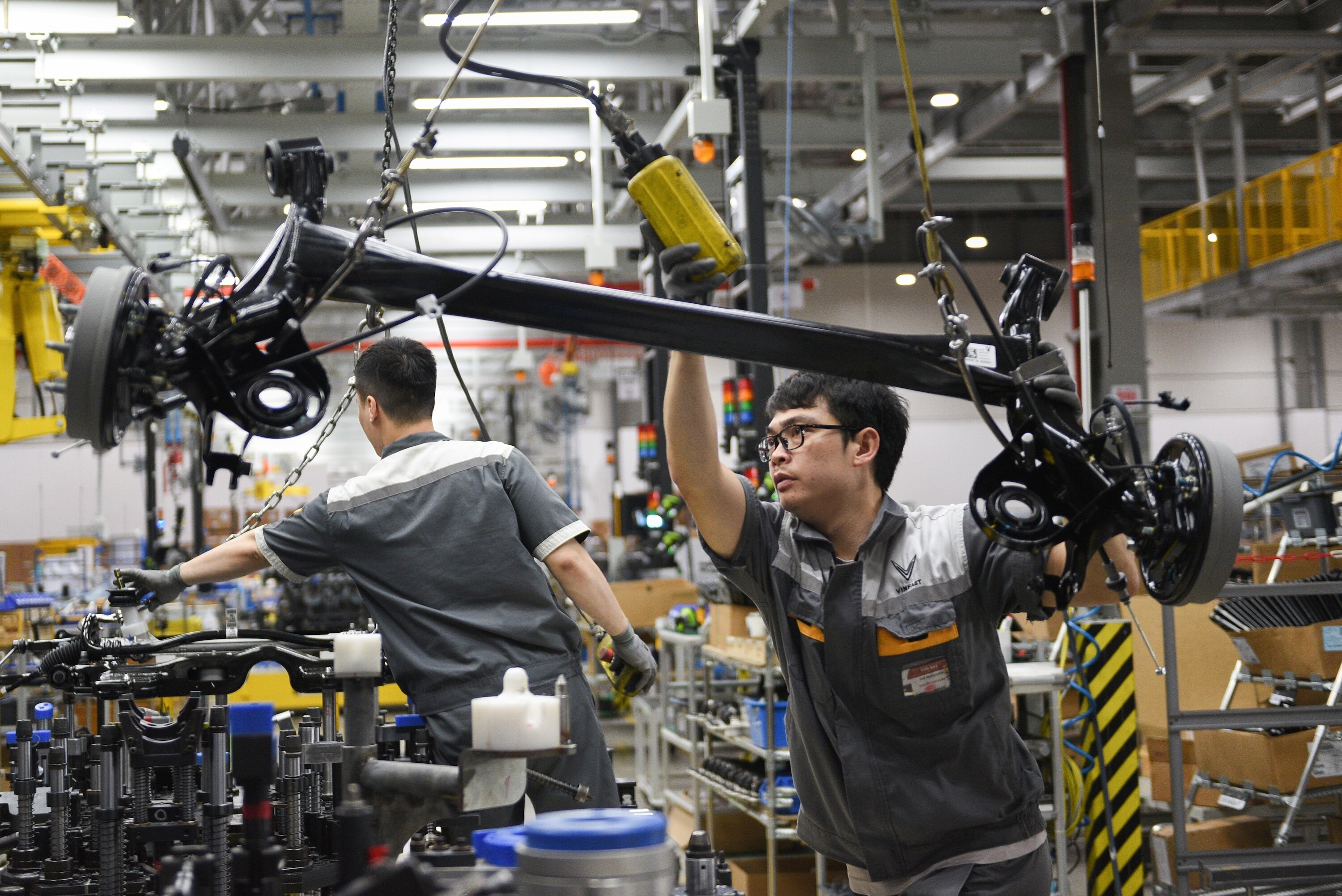
Asia-Pacific is the foundation of global industrial output – and how it operates is changing. Image: REUTERS/Thanh Hue
- Industrial competitiveness increasingly depends on deploying coordinated low carbon industrial systems rather than isolated technologies.
- Demand creation, regional industrial ecosystems and coordinated finance are becoming the foundations of industrial transformation across Asia Pacific.
- Circularity is evolving into a core industrial strategy, strengthening competitiveness, resource security and resilient regional value chains.
Across Asia-Pacific, a new phase of industrial transformation is emerging. For much of the past decade, attention centered on developing breakthrough technologies, reducing costs and proving that industrial decarbonization was technically possible. Now it’s about scaling.
While innovation remains essential, many of the technologies required to reduce emissions across heavy industry now exist.
Scaling these technologies requires more than technological innovation. It depends on aligning demand, finance, infrastructure, standards and policy into coordinated industrial systems capable of accelerating investment, reducing risk and strengthening competitiveness.
Getting this shift right is particularly important in Asia-Pacific. The region accounts for more than half of global manufacturing value added and more than half of global greenhouse gas emissions. It also combines much of the world’s manufacturing capacity, rapidly growing demand, abundant renewable resources and increasingly sophisticated industrial capabilities.
As a result, Asia-Pacific is the real global test on whether we can get this right. If it works here, other economies and geographies will follow.
Here are six ways Asia-Pacific's industrial competitiveness is already evolving:
1. Industrial competitiveness is replacing compliance as the organizing principle
For years, climate policy and industrial policy often evolved along parallel tracks. One focused on reducing emissions. The other focused on productivity, exports and economic growth.
Those distinctions are becoming increasingly blurred.
Carbon performance is becoming embedded within procurement decisions, investment strategies and international trade, making industrial decarbonization increasingly inseparable from industrial competitiveness. Rather than viewing decarbonization as a regulatory obligation, governments and businesses are increasingly positioning it as a driver of export competitiveness, industrial resilience and long-term economic growth. The question is now how economies can strengthen competitiveness while doing so.
Today, across Korea, the distinction between climate policy and industrial policy is disappearing.
2. Regional industrial ecosystems are becoming the preferred implementation model
Industrial transformation is becoming increasingly regional.
Supply chains for steel, critical minerals, chemicals and clean fuels already span multiple countries. As a result, competitive advantage increasingly depends on regional industrial ecosystems that connect producers, manufacturers, logistics providers, financiers and buyers across borders.
Emerging initiatives such as the Australia East Asia green iron corridor and the ASEAN Framework for Circular Economy illustrate this evolution. Rather than coordinating isolated projects, governments are increasingly seeking to align infrastructure, standards, certification and demand across regional value chains, creating larger, more investable industrial systems.
In sectors such as green molecules, alignment on certification, standards and enabling policy can reduce market fragmentation, build investor confidence and accelerate deployment. Likewise, harmonizing recycled content requirements and circular design principles can facilitate trusted cross border trade in secondary materials and strengthen regional circularity.
Regional value chains are becoming the preferred implementation model for industrial transformation, allowing countries to coordinate investment, infrastructure, standards and demand across borders while building more competitive and resilient industrial ecosystems.
The pathway to a lower-carbon world runs through Asia-Pacific. By embracing circularity at scale, the region could drive up to 25% of the greenhouse gas emissions reductions the world needs.
3. Demand creation is becoming the primary deployment challenge
Technology alone does not create markets.
Across many hard to abate sectors, producers remain reluctant to invest without committed buyers, while buyers hesitate until reliable supply becomes available. This coordination gap delays commercial deployment.
Demand creation is therefore becoming one of the defining priorities of industrial policy.
Public procurement, advance market commitments, corporate purchasing coalitions and long term offtake agreements can provide the market certainty needed to transform technically viable projects into investable industries. The focus is creating the markets capable of deploying it at scale.
The market is changing as well with carbon and circularity criteria being embedded in procurement decisions.
4. Circularity is becoming industrial strategy
Circularity is increasingly being understood as a source of industrial competitiveness.
In the face of rising supply chain risks, geopolitical uncertainty and unpredictable swings in primary material prices, circularity has begun to be seen as an indispensable pillar of proactive industrial policy.
This evolution is increasingly being reflected in industrial policy. Korea's new Circular Economy Leading Companies and Industrial Precincts Programme announced in June 2026, with LG Electronics, POSCO and Hyundai Steel among its 16 partner companies, shows circularity being adopted as an industrial strategy and further underscores the evolution of circularity from an environmental play to a core industrial necessity.
Public policy needs to work in tandem with this industry trend, with leaner policies that incentivize the synergies between decarbonization and circularity. This UpLink challenge at the World Economic Forum calls for low carbon and circular technology solutions that drive cleaner production and lower material use for resilient economic systems.
Circularity policy could reduce carbon emissions of our key exports like steel and cement.
5. Finance must shift from funding technologies to funding industrial ecosystems
Financing the transition means financing industrial systems.
Over the past decade, a considerable, although still insufficient, amount of financing has supported the development and demonstration of low-carbon and circular technologies. Public finance has often played a catalytic role by absorbing early-stage risks and crowding in private investment. The next phase of industrial transformation, however, requires finance to move beyond technologies and support the industrial ecosystems that allow proven solutions to scale.
This means philanthropies, development finance institutions, commercial banks and public funds working together across different stages of the innovation and deployment journey. It also requires greater standardization of financial structures and investment vehicles that align projects with investor risk return expectations and mobilize larger pools of private capital.
The destination of finance matters as much as its volume. Ensuring that developing economies and small and medium sized enterprises can access appropriate financing will be critical to avoiding fragmented transition and unlocking industrial transformation across Asia-Pacific. Blended finance, concessional capital and new risk sharing approaches will all play an important role in broadening access to investment.
"We need to move from financing single assets to financing industrial ecosystems," notes Louise Kim, Director, Sustainable Solutions Group, ING Group. "Banks can play a critical role in connecting markets across Asia-Pacific, facilitating cross-border collaboration and learning, and helping build the pipeline needed to scale the transition at the regional level."
6. Industrial transformation depends on coordinated public-private collaboration
Ultimately, industrial transformation is a coordination challenge.
Governments establish policy certainty and market signals. Industry scales production and creates demand. Financial institutions mobilise capital. International organisations facilitate regional cooperation and help align standards.
No single actor can build competitive industrial systems alone.
Success will increasingly depend on institutional arrangements that enable these actors to move together, reducing uncertainty and accelerating deployment across entire value chains.
For a successful industrial transition, we need innovation with speed and collaboration at scale.
Building the next generation of industrial competitiveness
Together, these shifts suggest that Asia-Pacific’s industrial transition is entering a new phase.
The next phase of industrial growth will be defined less by individual technological breakthroughs than by the ability to coordinate demand, finance, infrastructure, standards and regional cooperation into deployable industrial systems.
The race is no longer simply to invent the next breakthrough technology. It is to build the industrial systems capable of deploying proven solutions at scale. Economies in Asia-Pacific and beyond that can do so will improve resource security and help shape the next generation of global value chains.
Don't miss any update on this topic
Create a free account and access your personalized content collection with our latest publications and analyses.
License and Republishing
World Economic Forum articles may be republished in accordance with the Creative Commons Attribution-NonCommercial-NoDerivatives 4.0 International Public License, and in accordance with our Terms of Use.
The views expressed in this article are those of the author alone and not the World Economic Forum.
Stay up to date:
Circular Economy
Related topics:


Forum Stories newsletter
Bringing you weekly curated insights and analysis on the global issues that matter.
More on Manufacturing and Value ChainsSee all

Janka Oertel and Massimo Portincaso
September 9, 2026


